
Trance Music Artists: 10 Legends You Should Know

Trance isn't a nostalgia category, and the numbers say so. 1001Tracklists' 2024 annual report put trance at 8% of the tracks played in DJ sets, one of the leading genres in its survey of what working DJs spin. Demand is real. The supply side is much smaller than people assume.
A handful of artists built the formats the rest of the scene still runs on: the weekly radio show, the label as community, the festival main stage, the vocal anthem, the mix series with a number on it. They're still touring, still releasing, still filling rooms. That makes them worth studying twice, once as a listening list and once as a set of career decisions you can borrow from directly.
Each entry pairs what the artist did with the parts you can copy this month.
Table of Contents
- 1. Armin van Buuren
- 2. Above & Beyond
- 3. Paul van Dyk
- 4. Ferry Corsten
- 5. Tiësto
- 6. Markus Schulz
- 7. Gareth Emery
- 8. Aly & Fila
- 9. ATB
- 10. Chicane
- 10 Trance Music Artists at a Glance
- Turning These Lessons Into Your Own Trance Audience
1. Armin van Buuren
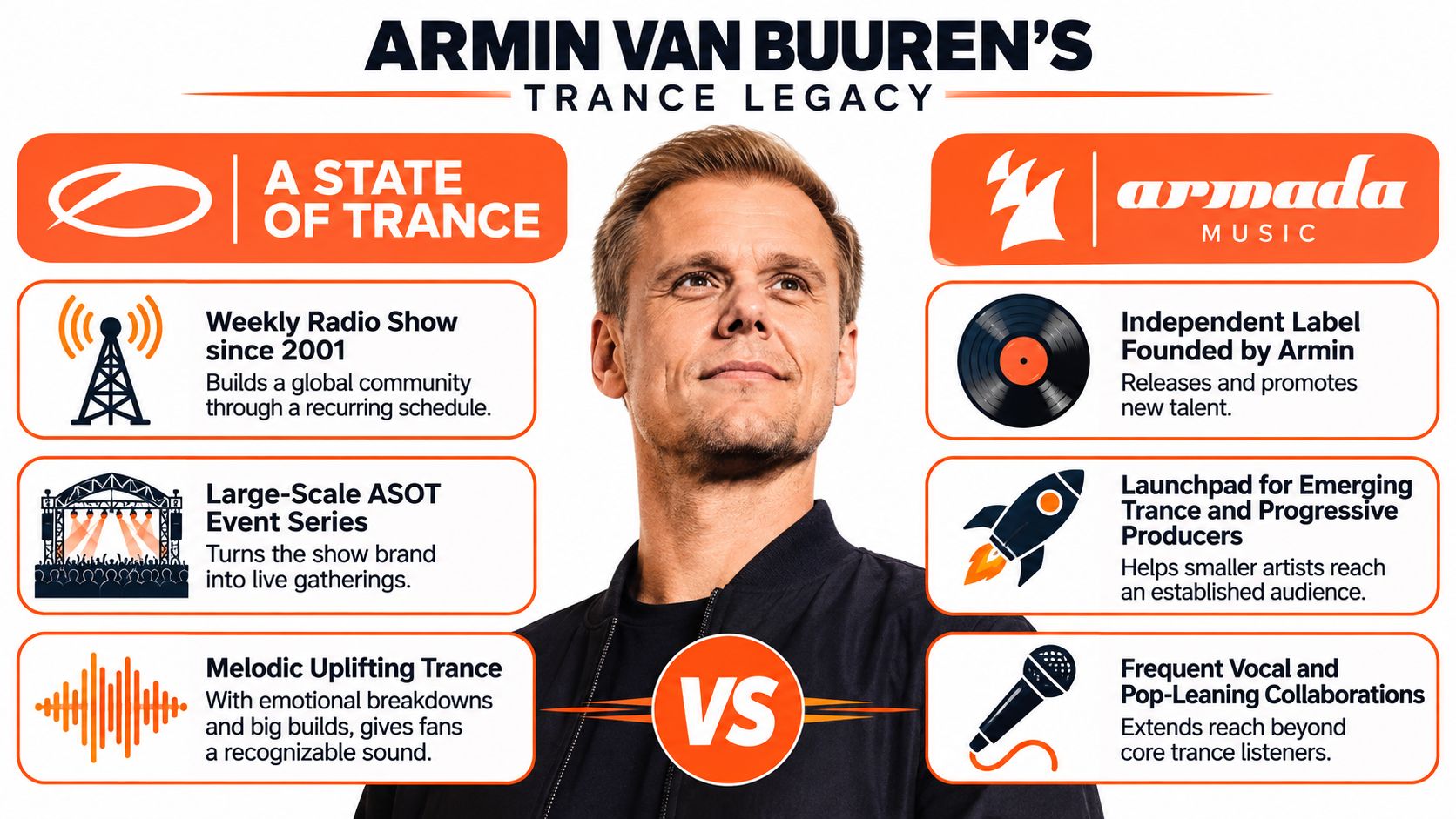
Radio is the cheapest infrastructure in dance music, and almost nobody uses it properly. Armin van Buuren does. A State of Trance has run weekly since 2001, passed 1,200 episodes, and reaches an estimated 40 million listeners across more than 80 countries, according to published summaries of the show's history. That's a distribution channel built one episode at a time.
His release history shows the same patience. "Blue Fear" landed early and broke through beyond the Netherlands only later. A later single charted in his home country and eventually topped a US dance chart. Nothing arrived instantly, and everything kept working afterward. The pattern matters more than the timeline: a record that stays in circulation beats one that spikes and disappears.
What to take from it
A producer with 300 followers and a folder of unreleased edits does not need a radio station to borrow this. A monthly two-hour mix with a fixed name, a fixed day, and a posted tracklist will do more than five standalone uploads, because it gives people a schedule to build a habit around.
- Name the series and number the episodes. A listener who sees Episode 14 understands there are thirteen more to go back to.
- Keep one vocal remix in rotation. "This Is What It Feels Like" with Trevor Guthrie pulled in pop listeners who never searched for trance.
- Let the label amplify the show. Armada Music gave him a release home and a pipeline of new material to feature.
Every artist you feature on the label brings their own audience to your page. That cross-promotion is how electronic music promotion compounds over time.
2. Above & Beyond
Some acts sell records. Above & Beyond sell belonging, and the mechanism is unusually clear. Tony McGuinness, Jono Grant, and Paavo Siljamäki built a trio identity around emotional vocal trance, then wrapped it in two recurring properties: the Anjunabeats label and the Group Therapy radio show. The music is the product. The label and the show are the habit.
A label ecosystem shows up in the numbers of the artists inside it. A 2025 analysis of Anjunabeats-related Spotify data tracked Qrion's streams growing 182% year over year. That lift didn't come from one viral moment. It came from being placed in front of an audience that already trusts the source.

For a solo producer, the transferable move is release architecture rather than label envy.
- Ship a vocal version and a non-vocal version of everything. One production session becomes two entry points for two different listeners.
- Use remixes as second front doors. A remix borrows an audience you haven't met yet.
- Give the show a name and a day. "Group Therapy" works because it sounds like a place, not a file dump.
Practical rule: if a release can't survive as a vocal, an instrumental, and an extended mix, it probably isn't finished.
3. Paul van Dyk
Paul van Dyk is the artist who made the institutions take trance seriously. In 2005 and 2006 he topped DJ Magazine's Top 100 DJs poll in consecutive years, and he became the first DJ to receive a Grammy nomination in the Best Dance/Electronic Album category, for his 2003 album Reflections, as the documented record of his career sets out. By 2008 he had sold more than 3 million albums worldwide.

Build a bridge back to the classics
Run a mix series that pairs your new material with the records that shaped it. Vonyc Sessions works on exactly this logic, and the Vonyc label gives newer producers a place inside that lineage.
- Use descriptive titles and tags. A track called "Uplifting Trance Mix 2026, 138 BPM" gets found; "untitled final v3" does not.
- Publish extended mixes alongside singles. Club DJs need the long intro; streaming listeners don't.
- Credit your references. Naming an influence in a description is free positioning.
When you're ready to widen the net, finding similar artists to target starts with exactly this map of influences.
4. Ferry Corsten
Ferry Corsten shows how to run more than one name without splitting your audience. Gouryella delivered widescreen, melodic trance. System F delivered "Out of the Blue" and a harder, more kinetic edge. Flashover Recordings became the home for both, plus releases from newer producers. Three identities, one recognizable production fingerprint.
That matters because the pipeline of new producers keeps expanding. More tracks compete for the same listeners, and a coherent identity cuts through the noise. Trance culture has always organized around distinct scenes and identities, as a history of trance and Goa club culture traces. Give each project a clear job.
- Standardize how your projects link. Use the same artist bio, links block, and naming convention across aliases, so a listener who finds one finds the others.
- Publish production breakdowns. A walkthrough of your lead synth patch earns more producer respect than another promo post.
- Remix your own tracks. A club mix of an older original resets the release cycle without new writing.
Consistency across aliases reads as range. Inconsistency reads as three strangers sharing a profile.
5. Tiësto
Tiësto held DJ Magazine's World No. 1 DJ position for three consecutive years, from 2002 through 2004, per the agency's career record for him. That run matters because the ranking is an annual international poll rather than a single award tied to one release. Three years at the top is evidence of sustained presence, not a lucky record.
His 2002 remix of Samuel Barber's "Adagio for Strings" is the other half of the lesson: a familiar melody, reworked for a dance floor, reached people who would never have opened a trance playlist. Musical Freedom later gave him a label outlet for the same instinct, and the festival headline sets gave the records somewhere to live.
- Cut a hook-forward edit and an extended club version. Serve the streaming listener and the DJ from one release.
- Plan releases around event cycles. A track that lands three weeks before a festival run gets played all summer.
- Use short previews to sell the full track. A 30-second clip of the breakdown does more than a static artwork post.
The trade-off is real: chasing mass appeal can cost you the heads-down credibility of the underground. Tiësto took that trade and won it. Most artists can't, and shouldn't.
6. Markus Schulz
Markus Schulz has built a two-decade reputation on a schedule. Global DJ Broadcast arrives, the mixes are melodic and progressive-leaning, and the release pace hasn't wobbled. That's less glamorous than an anthem and considerably more durable.
The strongest version of this idea is a numbered season with a payoff at the end. When A State of Trance reached its 1,000th episode, the show ran a listener-voted all-time countdown: 950 tracks from the countdown were revealed beforehand, and the final stretch was presented during the January 21 broadcast from the ASOT studio in Amsterdam, as Armin van Buuren's own announcement of the all-time Top 1000 confirmed. The audience did the curation work. The show supplied the structure.
- Fix the upload day and keep it. Listeners forgive a mediocre mix. They don't forgive a disappearing show.
- Number your episodes and title them plainly. "GDJB 900" is findable. "New Mix" is not.
- Blend melodic and progressive cuts. You pick up adjacent-genre listeners without abandoning the trance core.
Say you run a twelve-episode season. Close it with a listener-voted top 20 of your own catalog. It costs one poll and gives people a reason to argue in your comments for a week.
7. Gareth Emery
What DJs play is measurable now, and that changes how you should plan. At ADE 2024, Billboard's rundown of the most-played artists drew on data collected across 146 events by KUVO Powered by DJ Monitor, using music-recognition technology and direct metadata capture. A record that lands in sets leaves a trail you can see. A record that only lands in a playlist doesn't.
The versioning habit
- Release vocal and extended together. Three versions, three audiences, one deadline.
- Make the title and artwork do the emotional work. Melodic trance is bought on feeling before it's bought on genre.
If the melody doesn't survive being hummed badly in a car, no mix will save it.
8. Aly & Fila
Aly & Fila did something most producers never think to do: they turned geography into brand identity. The Egyptian duo built Future Sound of Egypt as a radio show, a label, and an event series, then let Middle Eastern and Egyptian tonal colors sit inside their uplifting trance rather than apologizing for them. FSOE isn't a release title. It's a container.
That container is the asset. Every FSOE release inherits the trust of the last one, every radio episode reinforces the name, and every event converts listeners into a room. New producers who appear on the label borrow the identity rather than starting from zero.

- Pick one name and use it everywhere. Series, label, event, artwork system, hashtag. Repetition is how a name becomes a place.
- Use a regional signature deliberately. A scale, an instrument, a vocal phrase, applied consistently rather than decoratively.
- Keep the release cadence visible. A show that lands every week tells listeners the label is alive.
If you're a producer in a scene that isn't London, Berlin, or Amsterdam, this is your advantage. Sound like where you're from. Most of your competition is trying to sound like somewhere else.
9. ATB
Andre Tanneberger's "9PM (Till I Come)" is the argument for melody over production budget. The hook is almost embarrassingly simple, and it has survived nearly three decades of format changes because people can recall it instantly. ATB's catalog since then has stayed melodic, emotionally direct, and unafraid of being pretty.
That gives him an unusual advantage in the current revival, where the audience is not one generation. Larger, older listeners and newer ones arriving through festivals and synth culture are showing up to the same stages. A 2026 report on the trance revival noted dedicated-event ticket sales rising 22% year over year, with the average age at major dedicated stages reportedly falling from 34 in 2021 to 24 in 2026 (Trance Nexus on the revival).
- Write the melody first, then produce around it. If it needs the drop to be memorable, it isn't.
- Serve two listening contexts. Radio edits and extended versions aren't redundant; they're two products.
- Publish throwback material next to new releases. A remastered old track gives long-term fans something to share and new fans a way in.
The practical split between those contexts is worth understanding properly, and this comparison of SoundCloud versus Spotify release strategy lays out where each version earns its keep.
10. Chicane
Nick Bracegirdle's "Offshore" and "Saltwater" did something trance still struggles with: they crossed into mainstream charts without thinning out. Atmospheric, melodic, emotionally direct, and built on restraint rather than a peak-time drop. Chicane proved that a trance record could be background music and foreground music at once.
That flexibility is the most valuable asset in the current market, where the boundaries have gone soft. Reporting on the new generation borrowing trance elements describes artists such as KI/KI, Funk Tribu, Marlon Hoffstadt, and DJ HEARTSTRING pulling trance textures into records that resist the label entirely, while others sit on the borders: Maddix between trance and techno, Ben Nicky between trance and hard dance.
So stop targeting "trance fans" as a block. Target shared attributes.
- Tempo and energy. A 138 BPM progressive record shares a floor with melodic techno.
- Festival context. Chill-out, sunrise, and peak-time are three separate audiences.
Genre labels describe the past. Shared attributes predict who will actually press play.
10 Trance Music Artists at a Glance
The fastest way to learn trance is to study repeatable identity, not one-off hits. This table maps ten careers by origin, signature sound, breakout record, and the label, series, or catalog that keeps the work findable.
| Artist | Origin | Signature Sound | Known For | Associated Label or Series |
|---|---|---|---|---|
| Armin van Buuren | Dutch | Uplifting, melodic trance with emotional breakdowns | A State of Trance radio show | Armada Music; A State of Trance |
| Above & Beyond | British | Emotional, vocal-driven trance | Group Therapy radio show | Anjunabeats; Group Therapy |
| Paul van Dyk | German | Anthemic, melodic, progressive-leaning trance | “For an Angel” | Vonyc; Vonyc Sessions |
| Ferry Corsten | Dutch | Energetic, polished trance with driving basslines | Gouryella; System F's “Out of the Blue” | Flashover Recordings |
| Tiësto | Dutch | Accessible, big-room trance with strong hooks | “Adagio for Strings” remix | Musical Freedom |
| Markus Schulz | German | Melodic, progressive-leaning trance | Global DJ Broadcast radio show | Global DJ Broadcast |
| Gareth Emery | British | Melodic, vocal-focused trance | “Concrete Angel” | Garuda |
| Aly & Fila | Egyptian | Uplifting trance with occasional regional influences | Future Sound of Egypt radio show and events | Future Sound of Egypt |
| ATB | German | Melodic, emotional trance with accessible hooks | “9PM (Till I Come)” | “9PM (Till I Come)” catalog |
| Chicane | British | Melodic, atmospheric trance | “Offshore”; “Saltwater” | “Offshore”; “Saltwater” releases |
Use the table as a diagnostic. If your tracks lack a three-second signature, work the Signature Sound column and strip the arrangement until one element carries the identity. If releases vanish between drops, study the label and series column: a home base and a named format give listeners somewhere to return. The strongest rows here connect a sound, a landmark record, and a place to hear more.
Turning These Lessons Into Your Own Trance Audience
Ten careers, one pattern, and it isn't talent alone. Every artist on this list has a named recurring thing, a sound you can identify in three seconds, and output that continued through the releases nobody bought. The formats differ. The structure doesn't.
The market is big enough to justify the discipline. The global electronic music market reached approximately $12.9 billion in 2024, up 6% year over year across recorded music, publishing, live events, and hardware, and the IMS Business Report 2025 also identifies 566 million additional electronic music fans across Spotify, YouTube, TikTok, Instagram, and Facebook during 2024. The audience exists. Being findable is the bottleneck.
The same logic applied to one broadcast proves the point about series. When A State of Trance marked 1,000 episodes in January 2021, Dancing Astronaut's coverage of the ASOT 1000 broadcast described a five-hour show that reportedly reached more than 50 million fans across 121 countries. A weekly habit, sustained long enough, becomes an institution.
What actually transfers
- Pick one format and defend it. A weekly show, a monthly mix, a numbered series. Choose one you can still run in month eighteen.
- Build the identity before the catalog. Name, artwork system, title conventions. Three seconds of recognition beats three extra tracks.
- Ship on a rhythm, not on inspiration. Releases that arrive on schedule train an audience to check back.
- Measure the right numbers. Saves, repeat listeners, playlist adds, profile visits, and 7-day and 28-day return rates tell you more than a follower total ever will.
Give the whole thing a permanent home, too. A profile is rented space; a site you control is not, and own.page's musician website guide covers what that needs to contain.
That's also the problem SCHelper is built for. Instead of guessing at hashtags, you get a daily, curated batch of listeners who already support artists with a similar sound and scene, connected through secure SoundCloud OAuth, with every action confirmed by you and kept inside sensible daily limits.
Pick one tactic from this list. Commit to a weekly series or a fixed release rhythm for the next three months. Then start putting the music in front of the listeners most likely to love it, and measure whether they come back.