
Similar Artists Finder: How It Works and How to Use One

You can name ten artists who sound like you in under a minute. Can you name ten listeners of those artists who play new music, leave a specific comment, or come back after the first listen? A similar artists finder that only returns lookalike names answers the easy question and skips the one that grows an audience.
Table of Contents
- Manual and Tool-Based Ways to Find Similar Artists
- What a Similar Artists Finder Actually Does
- Why Similar-Artist Audiences Matter for Growth
- Filters That Separate Engaged Listeners From Noise
- Pitfalls That Waste Time and How to Avoid Them
- Run a Two-Week Test Before Choosing Your Method
Manual and Tool-Based Ways to Find Similar Artists
A hybrid approach works best for most independent artists: you still judge the scene, and a tool ranks the candidates you don't have time to hunt by hand.
| Method | How it works | Main strength | Main limitation |
|---|---|---|---|
| Manual artist browsing | Start from one artist and review their follower and like lists | Full control over every profile | Slow and limited to what you can check by hand |
| Scene and playlist research | Find artists on shared playlists, labels and event lineups | Surfaces real scene connections | Hard to scale past a few hundred names |
| Audio similarity search | Compare track embeddings to rank artists by sound | Fast candidate lists across large catalogs | A sound match does not guarantee a shared audience |
| Audience-overlap finding | Rank listeners who already engage with your chosen target artists | Points to people likely to care about your sound | Depends on choosing good target artists |
| Hybrid finder with filters | Combine sound, genre, activity and audience signals, then review a daily batch | Balances relevance and scale | Requires regular review time from the artist |
Manual artist browsing is the baseline. Open one peer, scroll followers and likes, and stop on accounts that comment on recent uploads. You learn the scene, and you also burn an afternoon on fifty profiles.
Scene and playlist research widens that view. Shared playlists, label rosters, and event lineups show who sits in the same room. It stalls once the obvious names repeat.
Audio similarity search is fast across a large catalog, and it is also the method most likely to flatter you. Two producers can share a drum palette and never share a listener.
Audience-overlap finding flips the question. You pick target artists, then rank people who already like, repost, or comment on their tracks. The list is only as good as those seeds.
A hybrid finder with filters stacks sound, genre, recent activity, and audience signals, then hands you a daily batch to accept or skip. Manual work teaches taste. Tools save time once you already know which scene you belong in. If you compare discovery products, keeping up with tool changelogs from Creators Toolbox keeps the feature list honest as interfaces change. Broader context on where listeners find music sits in this guide to music discovery platforms.
Practical rule: Pick one method for the next two weeks and write down how many minutes it takes to review 50 candidate listeners. If the minutes climb and the replies don't, switch methods.
What a Similar Artists Finder Actually Does
Think of every artist as a point on a map. Sound and audience place the point. A similar artists finder shows which points sit closest to yours, not which points have the biggest crowds.
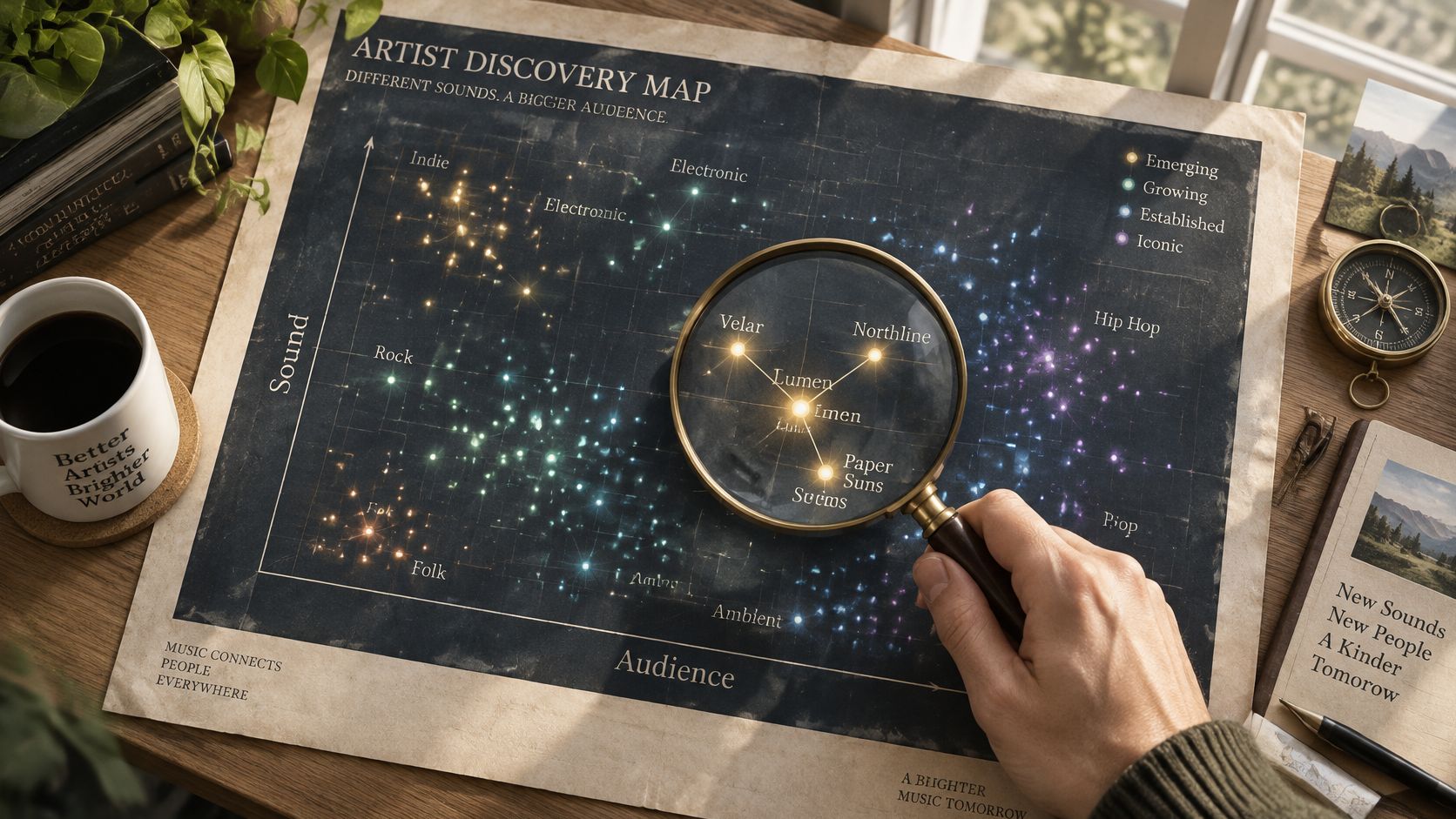
Fingerprint, then measure
The tool turns each track into a numerical fingerprint, a dense audio embedding. That vector holds timbre, rhythm, instrumentation, and production style, details a genre tag never captures. It then measures distance, often with cosine similarity, and pulls the nearest neighbors. Research on music retrieval found that listeners consistently judged clips with higher embedding-based similarity scores as more similar, which is why a ranked sound list is a fair first pass, as described in this music retrieval paper.
Filter and rank
Sound is the start, not the score. Two artists can sit next to each other on the map while their audiences never cross. A hybrid score adds genre, scene, follower overlap, recent activity, and engagement quality, then drops accounts you've already reviewed.
Three words show up for the rest of this guide:
- Target artist: the seed you start from.
- Candidate: a possible match the finder returns.
- Audience signal: a public action such as a like, repost, or comment.
A map shows neighbors. It does not show guaranteed fans.
Why Similar-Artist Audiences Matter for Growth
A similar sound can help a listener notice your track, but it cannot guarantee they will care enough to return. Growth depends on what happens after discovery: whether people replay, respond, or seek out more of your music.
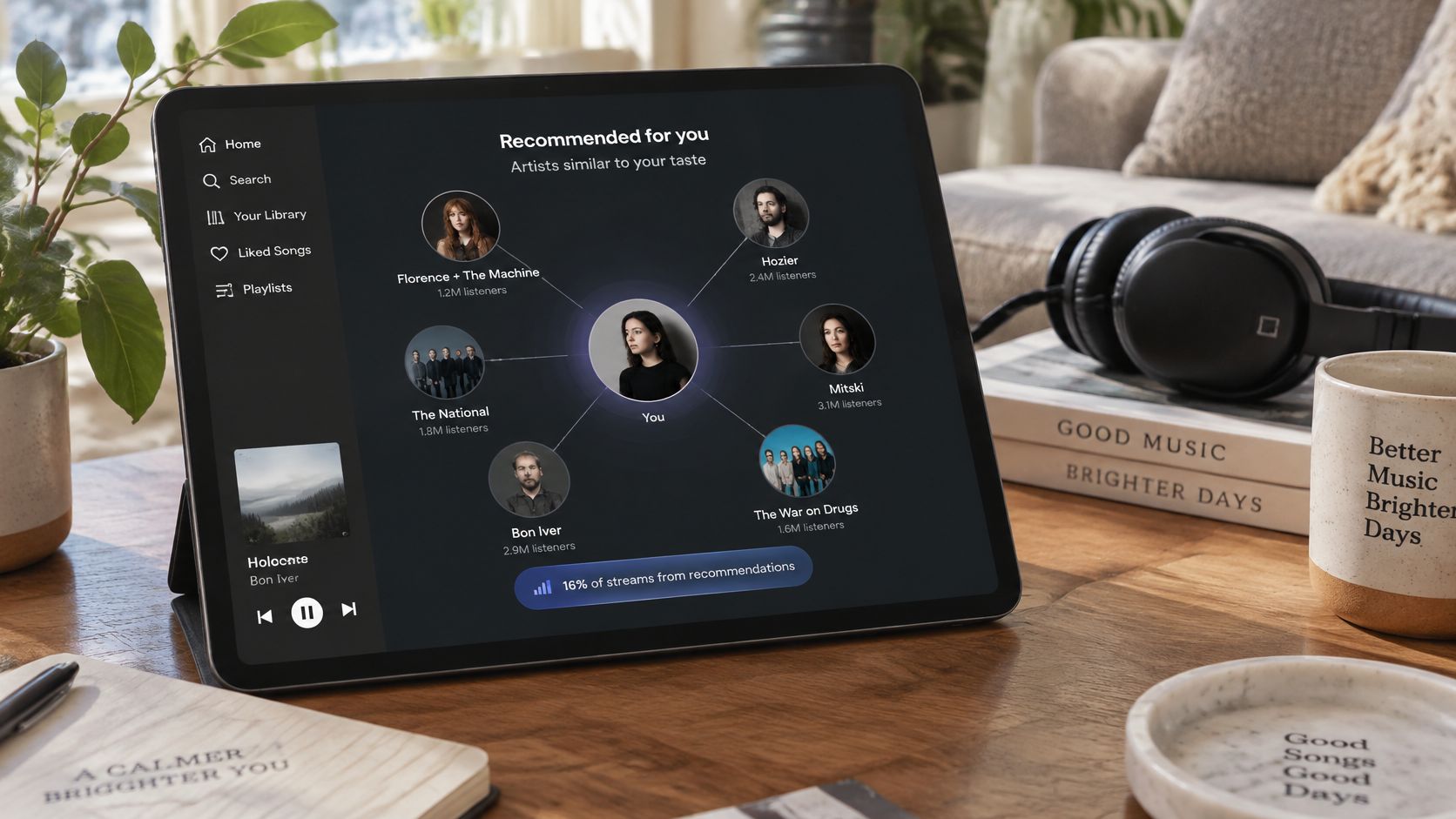
A study of music discovery illustrates why discovery method and listener response should be measured separately.
| Discovery finding | Value |
|---|---|
| Streams started by a platform recommendation system | about 16% |
| Songs discovered off-platform played again organically | 47.3% |
| Songs discovered through algorithmic recommendations played again organically | 12.6% |
| Songs discovered through human-curated playlists played again organically | 15.6% |
| Organic streams from algorithmic discovery compared with playlist-based discovery | about 84% more on average |
The figures describe different outcomes. Algorithmic discovery produced about 84% more organic streams on average than playlist-based discovery, while songs found through human-curated playlists had a slightly higher replay rate: 15.6%, compared with 12.6% for algorithmic recommendations. Songs discovered off-platform had a higher replay rate still. More streams, then, do not automatically mean a stronger connection with each listener.
What you should do with that split
Use a small set of related artists to identify listeners whose tastes fit your sound and scene. Then judge the audience by its response, not by how many names a tool returns. A long list of sonic lookalikes may bring little value if those listeners do not engage.
For example, a producer with a few hundred followers could choose three target artists and review about 20 candidate listeners a day for two weeks. The useful measure is whether those listeners play, reply, or return, rather than the size of the batch.
These figures are not specific to SoundCloud, and they do not guarantee new followers or streams. They show why it helps to separate discovery volume from repeat listening: a first play opens the door, while an engaged listener gives you a reason to keep making music for that audience.
Filters That Separate Engaged Listeners From Noise
Run every candidate through six checks before you spend a message or a repost on them.
| Filter | What to check | Why it matters |
|---|---|---|
| Recent activity | Likes, comments or reposts within the last 30 days | Dormant accounts rarely reply or return |
| Shared audience overlap | Whether the account engages with your chosen target artists | Shared taste predicts relevance better than sound alone |
| Genre and scene fit | Uploaded tracks and playlists match your sound | Sonic lookalikes can have unrelated audiences |
| Profile completeness | Artwork, bio, website link and public tracks | Empty profiles give few signals to judge |
| Exclusions | Accounts you already engaged with or reviewed | Prevents repeat effort and keeps the list fresh |
| Comment quality | Specific replies rather than generic emoji | Specific replies signal genuine listening |
The two filters that change the list
Recent activity is the first cut. A like from last year is a souvenir, not a listener. Prefer accounts that touched a recent upload. On SoundCloud, new music is what people play, so a dormant profile is a poor bet even when the taste looks right.
Shared audience overlap is the second cut. You choose target artists whose listeners already match your sound and scene, not the biggest name in the genre. Then you ask whether this candidate engages with those artists. A perfect sonic twin with a crowd that never touches your lane will waste the week.
What you can actually see
Score one point per filter a candidate passes. Engage only at four of six or higher. Empty bios, emoji-only comments, and accounts you've already reviewed all fail on purpose. For a closer look at which public actions are worth your time, see this breakdown of SoundCloud engagement.
Pick ten target artists. Apply the six filters to the first 50 candidates before you engage with any of them.
Pitfalls That Waste Time and How to Avoid Them
The closest sound match is a tempting shortcut, and it's often the wrong prospect. People don't jump straight to the most genre-pure artist. They start with relatively popular, less representative tracks and only later move toward niche, genre-defining ones, which is why "similar for what purpose?" is the key question in this paper on how listeners explore unfamiliar music.
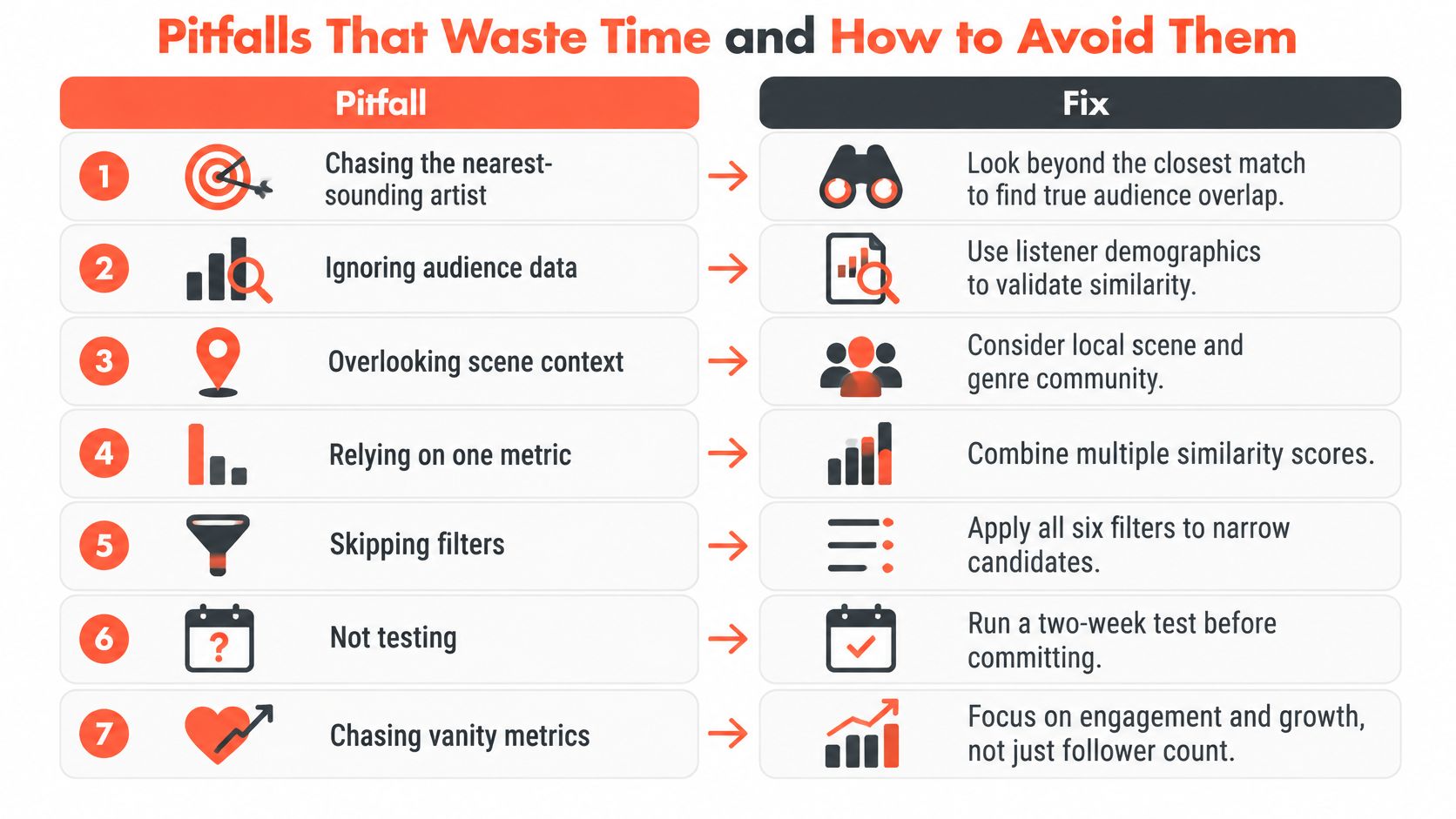
- Chasing the nearest-sounding artist. The tightest audio match can share nobody with you. Check audience signals before you treat the name as a lead.
- Targeting only the biggest names. Huge artists bring crowded comment sections and thin reply rates. Mid-sized peers in your scene give you a fairer shot.
- Counting followers instead of engagement. A large follower total can be hollow. Track profile visits, comments, and reposts, and read up on fake followers before you trust a number.
- Ignoring purpose. Collaborators, playlist curators, and everyday listeners need different seeds. Use gateway artists for people new to the scene, and smaller genre-defining artists for people already deep in it.
- Letting lists go stale. Refresh target artists monthly. Keep the exclusion list current so yesterday's rejects don't refill the batch.
- Trusting one data source. If a candidate looks active on another platform and silent on SoundCloud, believe the SoundCloud profile. That's where you're asking them to listen.
A smaller, better-filtered list beats a long one you never finish.
Run a Two-Week Test Before Choosing Your Method
Don't marry a method on the first afternoon. Run it for 14 days and keep it only if engaged listeners show up.
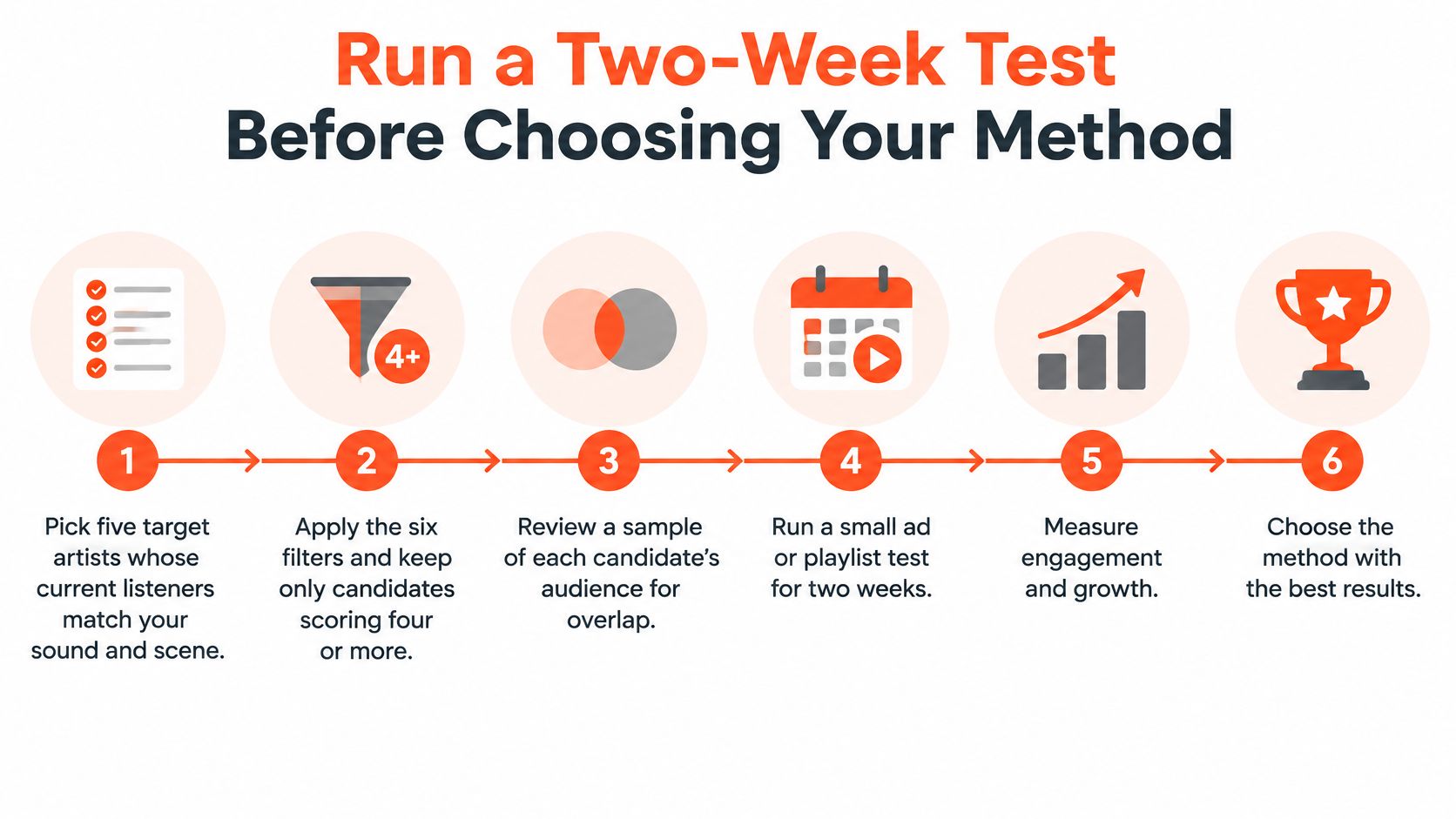
- Pick five target artists whose current listeners match your sound and scene.
- Apply the six filters and keep only candidates scoring four or more.
- Review a small daily batch and engage only where you have a genuine reason, a specific track, a shared scene, a real comment.
- Record a baseline in SoundCloud Insights before day one. Insights report plays, likes, reposts, comments, and downloads by day, week, month, or year, plus your top five tracks, top fans, first fans, and the sites or apps driving plays.
- After 14 days, compare replies, profile visits, and repeat listens with that baseline. Keep the method that produced more engaged listeners, not the one that produced more names.
Where a daily batch fits
SCHelper is a web app that organizes this routine for SoundCloud artists. You choose the target artists. Each day you get a focused batch of recommended listeners built around your genre, scene, and target audience, and you review each candidate yourself. It connects through SoundCloud OAuth and doesn't store your password. SCHelper isn't affiliated with SoundCloud. You're responsible for activity on your account and for the people you choose to engage with.
If the two weeks produced replies and return listens, keep the method and refresh the target list every two weeks. If they didn't, change the seeds before you change the effort.
SCHelper gives SoundCloud artists a daily batch of listeners already tied to the artists, genre, and scene you choose, so a similar artists finder turns into a short review instead of an endless scroll. You decide who is worth your time, and the public signals stay in front of you. Visit SCHelper and set your first target artists before the next two-week test.