SoundCloud vs Spotify for Artists in 2026: A Practical Guide
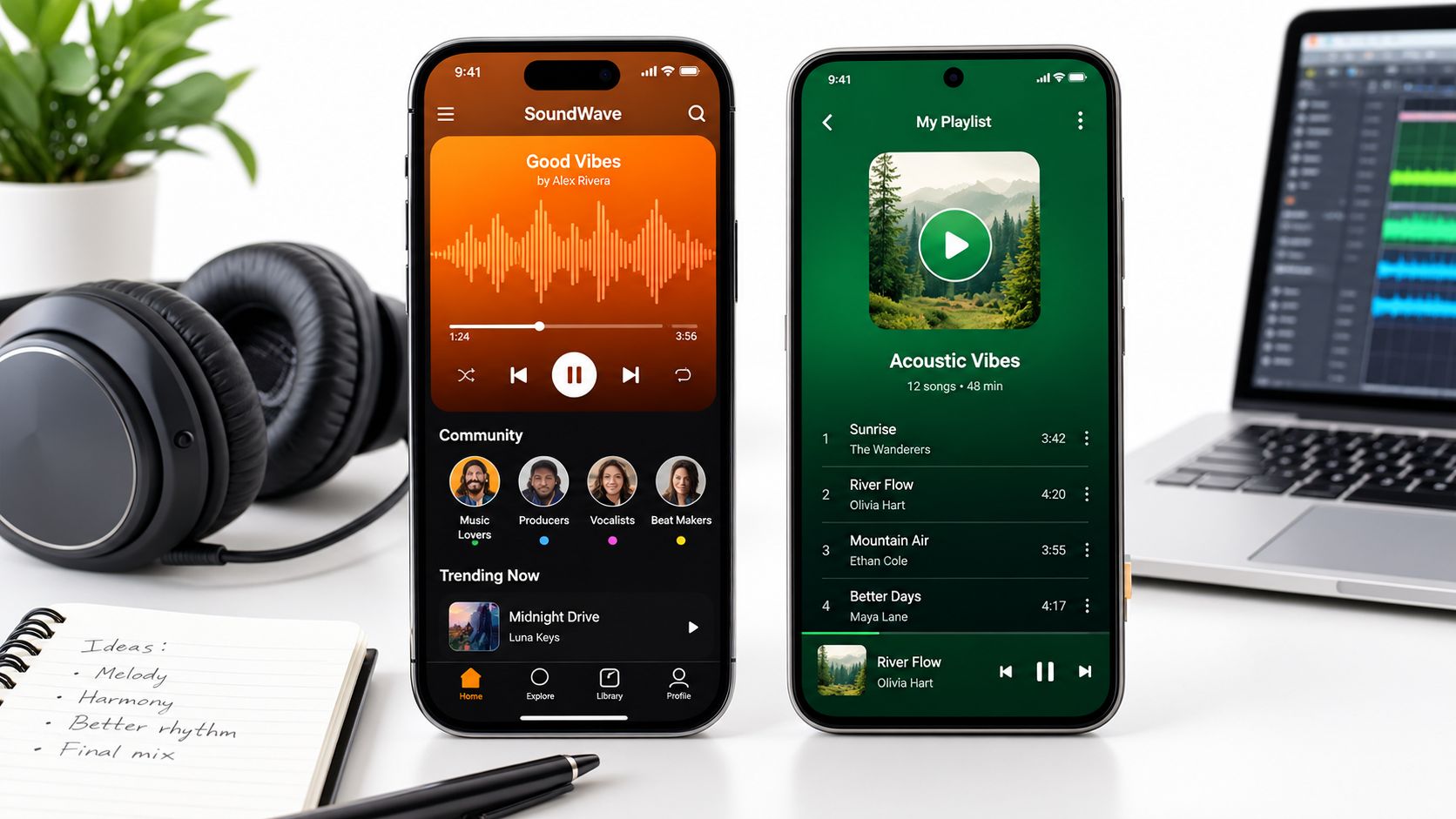
You're probably looking at a release on your calendar and asking the wrong question first. The choice isn't whether SoundCloud or Spotify is “better,” it's which one should carry the next 90 days of attention, because each platform rewards a different kind of momentum. One is built around reach, the other around relationship, and that difference changes how I'd plan a rollout for an independent artist.
If you've got a finished track, a few hundred followers, and no label machine behind you, the answer usually isn't to pick a winner and ignore the other side. It's to use SoundCloud to find the first real listeners, then use Spotify to scale the release once people are already responding. That's the frame I use when I manage campaigns for artists who need results, not platform mythology.
| Criterion | SoundCloud | Spotify |
|---|---|---|
| Core strength | Creator-first sharing, comments, reposts, scene discovery | Licensed catalog, recommendation engine, broad listener scale |
| Best for | Emerging artists, remixes, demos, niche scenes | Mainstream releases, long-tail listening, playlist-driven growth |
| Mastering approach | Flexible uploads, lossless recommended, more room for creator workflows | Controlled distribution master, FLAC preferred, stricter delivery standards |
| Discovery signal | Profiles, follows, comments, reposts, tags | Saves, retention, playlist adds, sustained consumption |
| Business shape | More community-centered, higher creator density | Larger audience scale and subscription-led consumption |
Table of Contents
- Why Independent Artists Compare SoundCloud and Spotify in 2026
- Where SoundCloud and Spotify Came From and What They Became
- Side-by-Side Comparison of SoundCloud and Spotify
- Audio Upload Specs and Discovery Signals Explained
- Who Each Platform Rewards in 2026
- SoundCloud Promotion Strategies That Fit Each Release Stage
- Measuring Success on Each Platform Without Mixing Up the Numbers
Why Independent Artists Compare SoundCloud and Spotify in 2026
A producer sends me a finished single on Monday, asks where to post it first, and by Friday wants to know whether the release is “working.” That's the normal pressure point. The problem is that SoundCloud and Spotify answer two different questions, so if you judge them by the same number, you'll misread the campaign.
SoundCloud launched publicly in 2008 as an open place for creator uploads and direct audio sharing, while Spotify also began commercial launch in 2008 with a legal, convenient alternative to piracy built around on-demand listening and a licensed catalog (BBC). That origin story still matters. SoundCloud grew around uploads, comments, reposts, and scene behavior, while Spotify matured into a mainstream listening system where catalog scale and sustained listening shape practical reach.
The best comparison isn't “which platform has more users.” It's which platform helps you get the right reaction at the right stage. A track can get early comments and reposts on SoundCloud without becoming a huge stream on Spotify right away. A Spotify release can remain low-key until playlists, saves, and listener retention start to compound.
Practical rule: if you need feedback from people who actually like your lane, SoundCloud usually gives you faster signal. If you need passive listening at scale, Spotify usually does more of the heavy lifting.
That's why I never plan releases as a binary choice. I plan them as a sequence, where one platform tests the record and the other expands it. If you want the artist-side version of that logic, this SoundCloud guide for upcoming artists fits the same mindset.
Where SoundCloud and Spotify Came From and What They Became
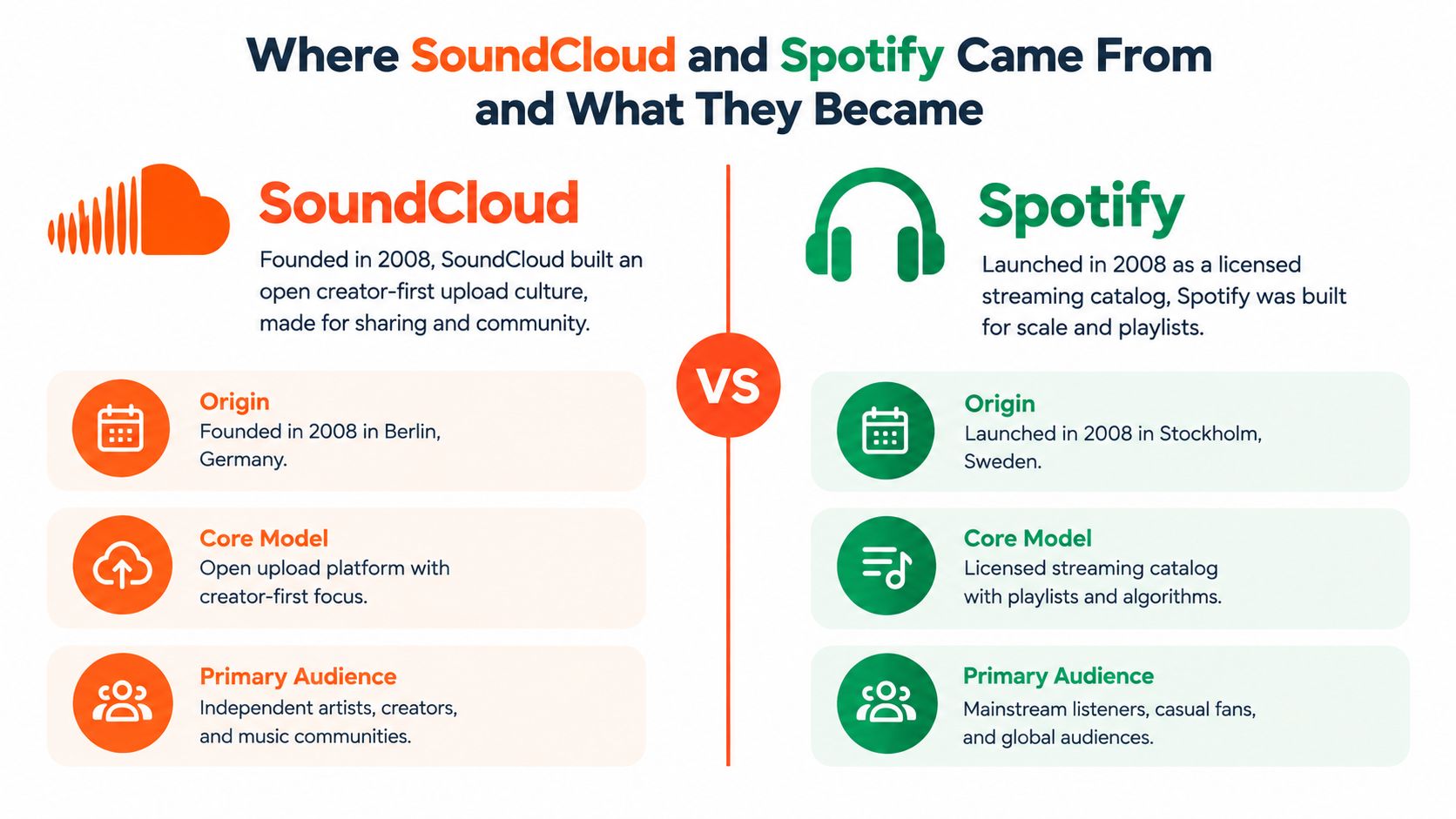
The way each platform was built still shows up in the work artists do on it. SoundCloud started in Berlin with Alexander Ljung and Eric Wahlforss, and BBC reported its creator-led rise alongside early user growth and a reported $700 million valuation in 2013 (BBC). That origin fits a platform built around uploads, comments, reposts, and scene-level sharing.
SoundCloud also grew by encouraging volume from creators, with leadership describing a constant flow of audio being uploaded worldwide (BBC). The practical result was a network where new music, drafts, remixes, and community feedback could sit close together.
Spotify came from a different problem. It was developed in Sweden in 2006 by Daniel Ek and Martin Lorentzon, then launched commercially in 2008 as a licensed streaming service designed to make listening easier than piracy (BBC). That foundation pushed it toward catalog depth, licensed playback, and habits built around repeat listening.
By 2019, Spotify had reached a much larger consumer audience, with Premium doing most of the revenue work (Toptal). SoundCloud and Spotify therefore grew into different kinds of tools, and artists feel that difference every time they plan a release.
Why that still matters now
SoundCloud still behaves like a creator network. Upload speed, comments, reposts, and follower behavior can surface whether a record is resonating inside a scene.
Spotify behaves like a listening system. Saves, retention, and playlist placement shape how far a release travels after launch.
For an independent artist, the trade-off is simple. Use SoundCloud first when you need real reaction, testing, and scene proof. Use Spotify when the track is ready to carry broader listening over time. I usually treat SoundCloud as the measurement layer for early response, then use Spotify to extend the record once the signal is clear.
Side-by-Side Comparison of SoundCloud and Spotify
| Criterion | SoundCloud | Spotify |
|---|---|---|
| Audience shape | Smaller overall audience, denser creator activity | Larger consumer scale, more mainstream listening behavior |
| Monetisation path | More creator-facing, with advertising a larger share of the mix in the cited comparison | More subscription-led, with Premium driving most revenue |
| Discovery style | Community signals like reposts, comments, tags, follows | Retention, saves, playlist inclusion, sustained listening |
| Best release types | Remixes, demos, edits, underground and early-stage records | Official releases built for broad, repeat listening |
| Upload flexibility | Wide format support and flexible creator workflows | More controlled delivery standards for distributed masters |
Spotify had more than 248 million monthly active users in Q3 2019, while SoundCloud's reported monthly audience in the same comparison was about 75 million, with around 20 million creators uploading music (Toptal). That doesn't make SoundCloud “smaller” in a useless sense. It makes it denser, which matters if your release depends on scene participation instead of mass passive listening.
What matters most is the type of outcome each service tends to produce. Spotify is stronger when the release needs broad catalog exposure and a subscription-driven audience. SoundCloud is stronger when the goal is to build an audience around direct interaction, because the platform is still built around creator-to-listener contact instead of pure consumption.
If you're comparing music platforms more broadly, the taap.bio guide to musician platforms is a useful reference point, but the practical test remains the same, match the platform to the release objective.
Audio Upload Specs and Discovery Signals Explained
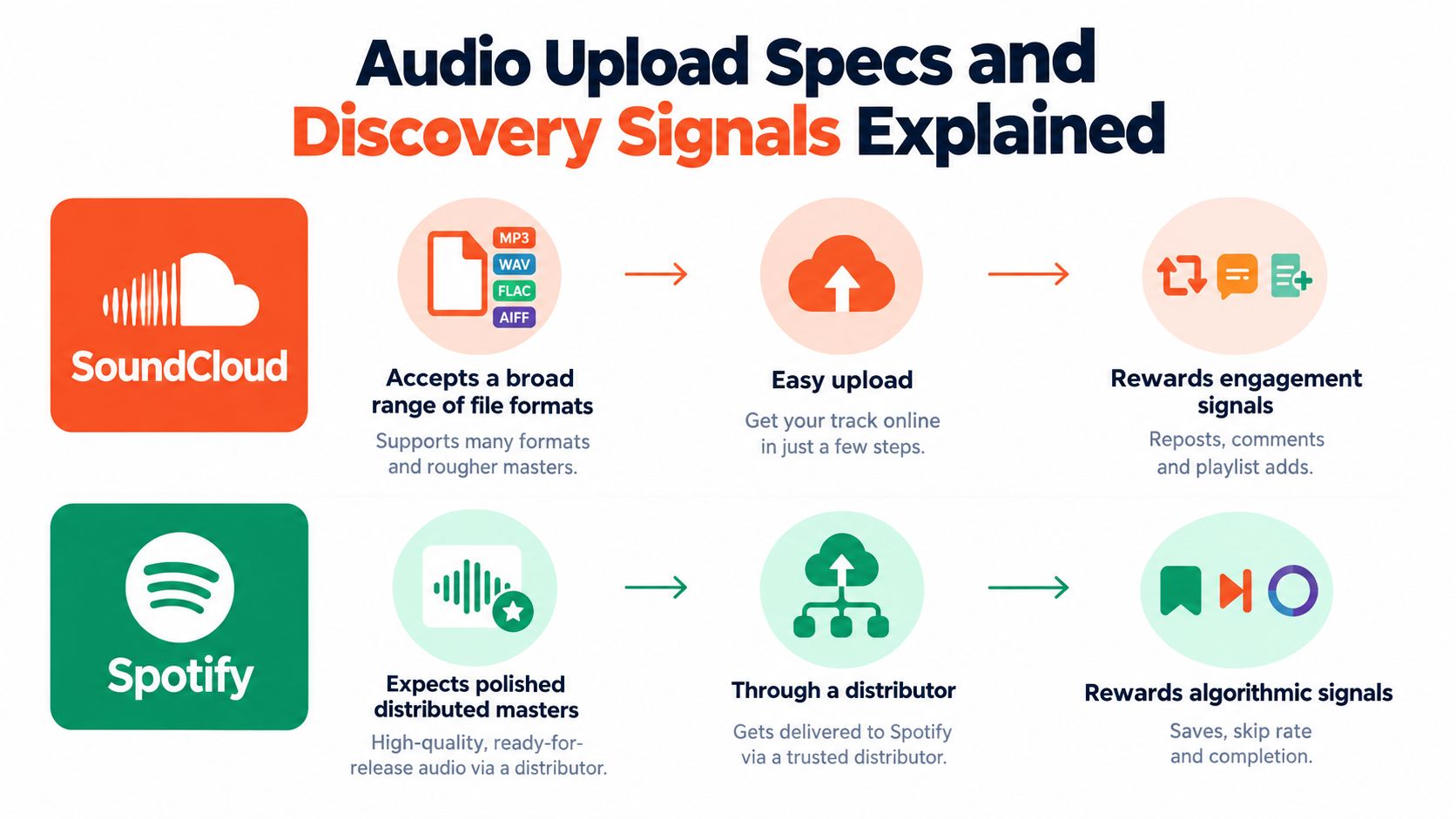
If you are releasing a track to both platforms, the first trade-off is simple, SoundCloud is more forgiving on source files, while Spotify expects a cleaner master workflow. SoundCloud accepts formats like WAV, FLAC, AIFF, ALAC, OGG, MP3, and AAC, and its upload guidance recommends 16-bit/44.1 kHz with about -0.5 to -1 dBFS of headroom because transcoding can push peaks higher. It also notes that a stereo lossless upload may be converted to AAC at 256 kbps for streaming (SoundCloud help).
Spotify is stricter at delivery. FLAC is strongly preferred, WAV is accepted, stereo is required, 44.1 kHz or higher is supported, and the native bit depth should stay intact, 24-bit if that is your source master or 16-bit if no higher-resolution master exists (Spotify support). For campaign work, I send one export that is clean and unclipped for Spotify, then I check the SoundCloud result separately, especially on dense masters sitting close to 0 dBFS.
SoundCloud's discovery layer matters for different reasons. Its AI tagging and similarity system uses the audio itself to help surface emerging artists, remixes, demos, and niche genres through sonic matches, which suits records that need scene-level attention rather than passive background plays. Spotify discovery is driven more by metadata, listener retention, saves, playlist adds, and repeated listening.
For release timing, that split is practical. On release day, Spotify is the stronger home for broad reach. In the first weeks, SoundCloud is often better for comments, reposts, and direct feedback. Six months out, the platform that keeps the audience talking back usually tells you more about who is likely to return. For artists working on remixes or beat-led releases, hip hop beats for creators is a useful reference because those files often expose low-end and headroom problems fast.
The safest workflow is still the same, export for quality first, then read the signals each platform gives after upload.
Who Each Platform Rewards in 2026
Spotify and SoundCloud don't reward the same behavior, and that's why so many artists talk past each other when they compare results. Spotify's scale is real, and Spotify said it had more than 13,800 artists earning at least $100,000 in 2025, while independent artists and labels generated roughly half of Spotify's royalties (Spotify newsroom). That's a massive ecosystem, but it still favors sustained momentum.
SoundCloud's advantage is different. It's not about the biggest audience. It's about community behaviors that can make an early-stage record feel alive, like direct uploads, reposts, comments, tags, and profile-level follows. That makes it especially useful for remixers, DJs, underground scenes, and artists whose listeners care about participation, not just playback.
Reach metrics and relationship metrics
Reach metrics tell you how many people encountered the release. Relationship metrics tell you whether those people came back, followed you, or left proof that they care. On Spotify, that usually means thinking in streams, saves, playlist adds, and retention. On SoundCloud, it means follows, comments, reposts, and repeat engagement.
Reach gets the first click. Relationship gets the next release heard.
That distinction matters because a large stream count can hide weak audience intent. A smaller but more engaged SoundCloud audience can tell you which songs deserve more investment, which scenes respond, and which listeners might convert later on Spotify. A broad Spotify audience can then expand that record once it already has traction.
The mistake is treating the two platforms as substitutes. They're not. One is better at revealing who cares. The other is better at converting that interest into scale.
SoundCloud Promotion Strategies That Fit Each Release Stage
A release-day plan should look different from a six-month plan. On day one, I'd rather see an artist get a small number of real listeners who follow similar artists than chase a broad but passive audience. SoundCloud is usually the better starting point for that because the platform's community signals can surface a track inside a relevant scene before Spotify has enough data to do anything useful.
A practical stage-matched workflow
For the first release window, keep the focus tight. Share the record with listeners already connected to your lane, watch who comments, reposts, or follows, and use those reactions to decide what deserves more promotion. That's not glamorous, but it gives you usable feedback.
After the record starts picking up real engagement, layer Spotify in harder. At that point, playlist placement, saves, and retention matter more because the track has already proven there's an audience around it. If you push Spotify too early, you often get numbers without context. If you push SoundCloud forever, you may never convert the interest into broader consumption.
Daily habit that works: short, controlled batches of outreach beat frantic bursts that burn energy and usually look spammy.
I'd also split the 90-day view into three phases. First, validate the record on SoundCloud with real listener behavior. Second, use that response to sharpen messaging, artwork, and clip selection. Third, push Spotify harder once the release has signs of life and the audience knows what it's responding to.
If you want a more tactical version of that plan, this SoundCloud promotion guide for new artists maps cleanly onto the same logic. The core idea is simple, don't confuse early proof with final scale.
Measuring Success on Each Platform Without Mixing Up the Numbers
One of the biggest mistakes artists make is counting a SoundCloud stream and a Spotify stream as if they mean the same thing. They don't. SoundCloud often gives you a clearer view of listener intent, while Spotify tells you more about consumption behavior at scale. If you blur those two, you'll make bad release decisions.
Track the right signal for the right platform
On SoundCloud, I'd watch profile visits, follows, comments, reposts, and repeat engagement. Those are the signals that show whether people are connecting with the artist, not just the track. On Spotify, I'd watch streams, saves, playlist adds, and retention indicators. Those are better signs that the release is holding attention inside a much larger listening environment.
The relationship between the two matters too. SoundCloud can surface the right niche listeners early, and those listeners can become the people who later carry a Spotify release by saving it, sharing it, and returning to it. That's why I treat SoundCloud as the relationship channel and Spotify as the consumption channel.
If a release gets plays but no follows, no comments, and no repeat behavior, the campaign has reach but not traction.
That mindset also helps avoid platform envy. A smaller SoundCloud audience isn't automatically weaker, and a bigger Spotify audience isn't automatically more valuable. You want the metrics that change your next move. If you need a deeper breakdown of the listening side of the equation, this SoundCloud plays guide is a useful companion.
If you want a controlled way to turn SoundCloud into a real listener pipeline, SCHelper is built for that job. It helps independent artists find and engage real listeners who already follow similar artists, so the growth work stays tied to actual scene fit instead of empty volume. Visit SCHelper if you want a measured SoundCloud workflow that supports the exact kind of release strategy covered here.
Created with Outrank