
SoundCloud Engagement: What Counts in 2026
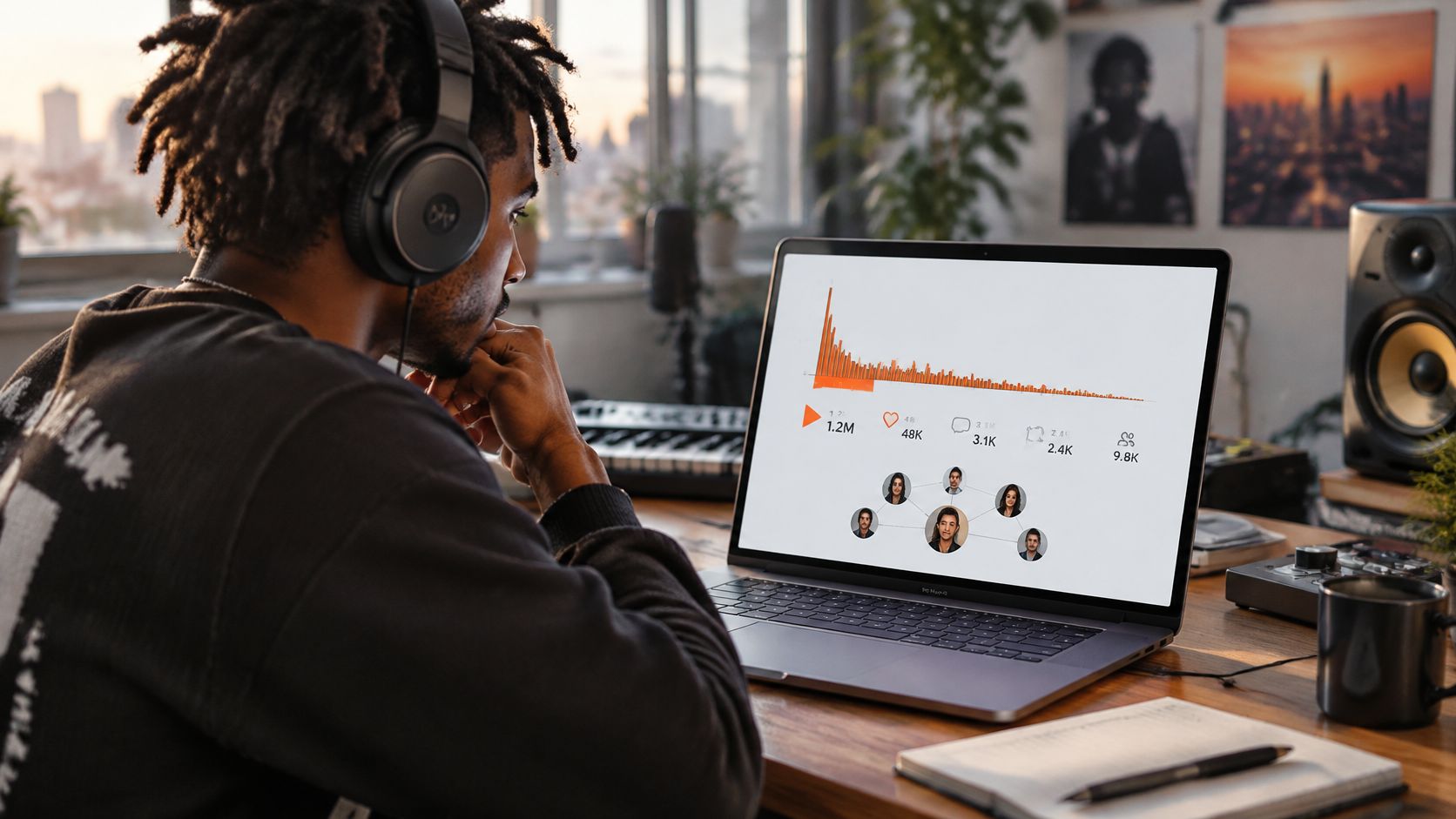
“Get more plays” is incomplete advice. A rising counter can mean more people encountered your track, but it doesn't tell you whether anyone wanted to hear it again. Chasing that counter alone can leave you promoting harder without understanding who cares.
SoundCloud engagement is the difference between being heard and being worth returning to. Treat Insights like a studio notebook: record what changed, give the results time to appear, and compare listener decisions rather than celebrating every spike. The useful question isn't just how many plays you gained. It's whether discovery became affinity, conversation, or another listen.
Table of Contents
- What SoundCloud Engagement Actually Counts
- How Delayed Insights Change What You Judge
- Quality Ratios That Separate Fans From Passersby
- Why New Music Gets the Listening Time
- A Daily Listener Routine Inside Platform Limits
- Release Week Examples From First Play to Return
- Start the Log Before You Add a Tool
What SoundCloud Engagement Actually Counts
A rising play count isn't the same as an audience. Start by separating the decisions listeners make, from encountering a track to returning voluntarily.
SoundCloud engagement signals and what they prove
| Signal | What the listener did | What it proves | What it does not prove |
|---|---|---|---|
| Play | Listened via site, embed, app, or API | Reach and exposure | Loyalty or intent to return |
| Like | Saved the track to their Library | Affinity strong enough to keep it | |
| Comment | Wrote a response on the track | Direct attention and conversation | A large audience by itself |
| Repost | Shared it to their profile and followers' Feed | Discovery beyond current followers | |
| Download | Kept the file where downloads are enabled | A stronger keep than a casual play | Ongoing listening after the download |
| Repeat listen | Played the same track more than once | Behavioral quality and early fandom | A complete census of logged-out listeners |
SoundCloud's Insights documentation identifies plays, likes, comments, reposts, and downloads as measurable actions, with reporting across day, week, month, and year views. Its play reporting includes listening through SoundCloud.com, embedded players, mobile applications, and the API.
Read the table as increasingly useful evidence, not a universal ranking of fans. A DJ downloading your track for a set and a listener replaying it at home can both matter, but they represent different relationships with your music.
Read the decision behind the action
A play establishes exposure. A like adds an intentional save, making it more informative about affinity, though it still isn't a promise to return.
A comment gives you language you can interpret. Someone describing the bass texture or asking about a vocal sample provides a different kind of evidence from a generic compliment. Read the response rather than counting it blindly.
A download suggests that someone wants to keep the file. A repeat listen shows that someone chose the music again. Neither tells the entire story, but both help you look beyond momentary exposure.
Use the available reporting views to distinguish a release-day burst from continuing interest. Stop treating every play as equal evidence of audience growth.
How Delayed Insights Change What You Judge
Some plays can take up to 24 hours to appear, while logged-in listeners' plays update in real time and self-generated plays are excluded from your artist total, according to Advanced SoundCloud Insights. The same documentation describes recommendation and repeat-listener information refreshing approximately daily, so an afternoon snapshot can be incomplete.
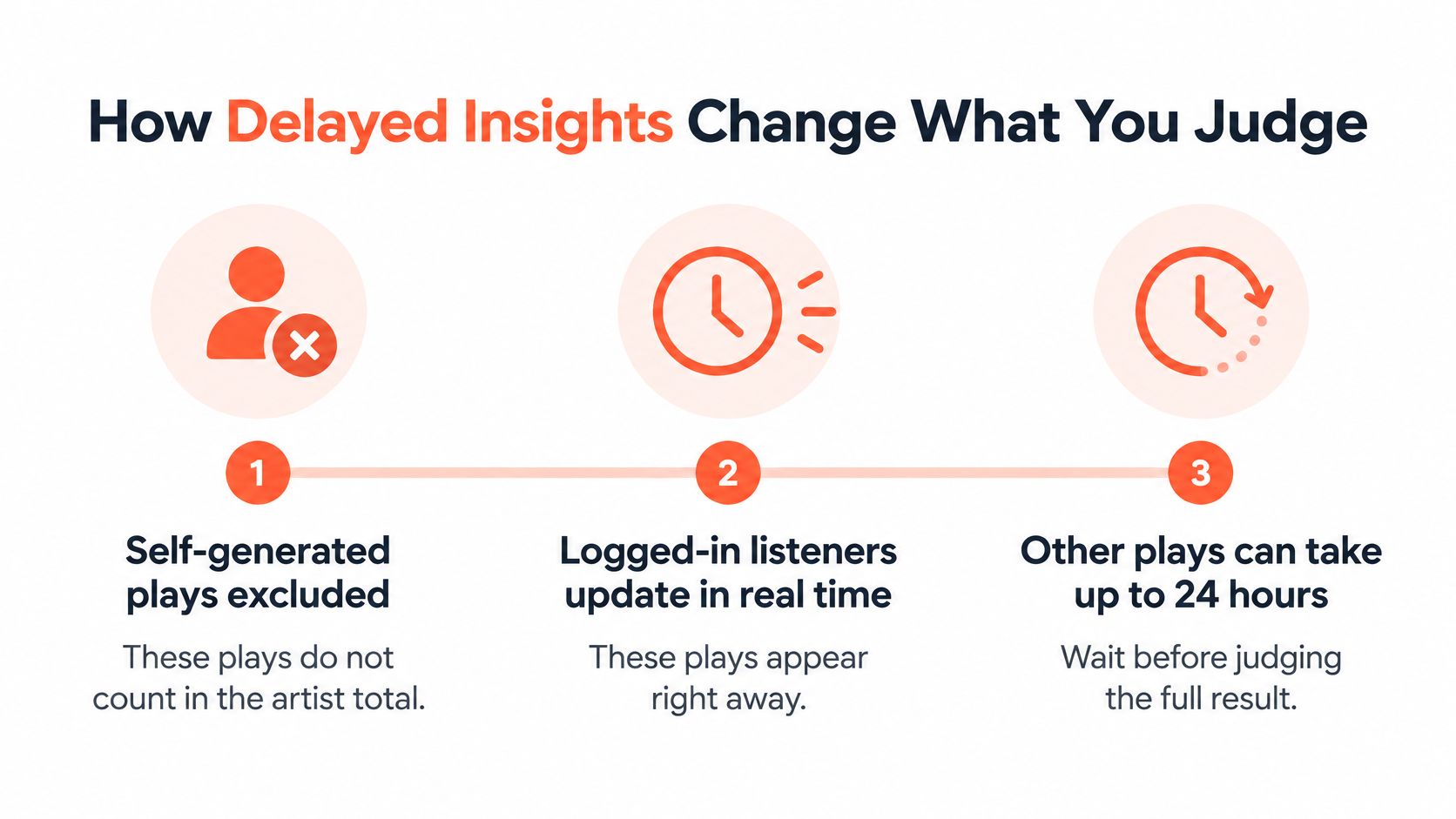
Treat a 24 to 48 hour review window as a practical working routine, not a promise that every metric has identical timing. Leave the first impression in your notebook, then return when the reporting has had time to settle.
Establish a baseline before changing direction
Record several ordinary days before changing whom you try to reach. Note whether you published, shared a preview, received a repost, or changed track availability. Without that context, you may credit your outreach for attention that arrived from somewhere else.
Keep the same fields in each entry:
- Audience: Unique listeners and repeat listeners, where available.
- Consumption: Total plays and downloads.
- Intentional actions: Likes, meaningful comments, and reposts.
- Origin: Traffic sources and any known external promotion.
Check source information before assigning credit. Listening can arrive through embeds, mobile apps, API-based experiences, RSS, and downloads in relevant reports, so a rise in plays doesn't establish which activity caused it.
If you're still finding your way around the artist workspace, use this guide to SoundCloud for Artists to organize the account side of your measurement routine.
Make the comparison fair
Say you're comparing broad discovery with a more focused audience connected to comparable artists. Keep the groups similarly sized, and hold release timing, posting frequency, and track availability as steady as possible.
Don't change the artwork, publish another track, and start a new promotion channel during the same test if you want a clean interpretation. You won't remove every outside influence, but you can avoid creating unnecessary confusion yourself.
Practical rule: Record activity when you do it. Judge the response after reporting has caught up.
Compare repeat interest and meaningful actions per listener, not just the earliest play total. If you can't identify individual cohorts reliably, describe the result as a period comparison rather than claiming exact attribution.
A simple log is enough: date, activity, track, audience or source, initial snapshot, delayed snapshot, interpretation. Fill the later snapshot in after the review window, and write what the evidence supports, including “unclear” when several activities overlap.
Quality Ratios That Separate Fans From Passersby
Suppose a track receives 1,000 plays, 40 likes, 6 comments, 8 reposts, and 12 downloads. In this hypothetical example, dividing each action count by plays and multiplying by 100 gives 4.0 likes, 0.6 comments, 0.8 reposts, and 1.2 downloads per 100 plays.
Now suppose another track gets 3,000 plays and the same 40 likes. Its like rate is about 1.3 per 100 plays. It reached further, but a smaller proportion of its plays was accompanied by a save.
Neither track automatically wins. The first shows stronger affinity relative to exposure; the second may have introduced your music to more people. Your next decision should depend on whether those new listeners return.
Engagement quality ratios to track per track
| Ratio | Calculation | Read it as | Watch-out |
|---|---|---|---|
| Likes per 100 plays | Likes divided by plays, times 100 | Save or affinity rate | A play spike can hide a falling rate |
| Comments per 100 plays | Comments divided by plays, times 100 | Conversation rate | A few specific comments beat a silent spike |
| Reposts per 100 plays | Reposts divided by plays, times 100 | Propagation into other Feeds | One relevant repost can outweigh many empty plays |
| Downloads per 100 plays | Downloads divided by plays, times 100 | Keep rate where downloads are on | Not available on every track |
| 7-day return share | Listeners returning within 7 days divided by the first cohort, times 100 | Early repeat interest | Same-day data is incomplete |
| 30-day return share | Listeners back within 30 days divided by the first cohort, times 100 | Durable fans versus one-time reach | Needs a baseline before the release |
These are working calculations, not official platform performance thresholds. For the return measures, define the first cohort as the identifiable listeners who arrived during your chosen discovery period.
Keep the denominator honest
A per-play rate isn't a percentage of unique people. Someone can contribute several plays, so don't describe likes per play as the share of listeners who liked the track.
FoPost's explanation of why engagement rate denominators matter is useful when deciding whether your question concerns exposure, people, or an existing audience. Choose the denominator before comparing results, and keep it consistent.
SoundCloud's Insights guide describes Top Fans through repeated listening and explains that identifiable listener information covers signed-in listeners. Logged-out listening can contribute to aggregate activity without becoming an identifiable person in your cohort, so your return estimate isn't a complete audience census.
If you can't track the same listeners over time, don't invent a retention figure. Record the repeat-listener information you can see and label its limitations.
Compare like with like
Compare tracks at similar release ages and separate traffic sources where the reporting allows. You can also mark whether a track is under 18 months old as an editorial grouping, but don't mistake that category for a quality score.
Use your own baseline rather than borrowing an unexplained “good engagement rate.” A specialist mix, a downloadable edit, and a vocal single invite different listener decisions.
This distinction also changes how to get more listeners on SoundCloud: seek people who are likely to care, then measure what they do. Pick likes per 100 plays or a 7-day return estimate, and apply that same measure to every release.
Why New Music Gets the Listening Time
US SoundCloud listeners spent 43% of their listening time on music released within the previous 18 months, compared with 24% across the broader industry, a 19-percentage-point gap, in the proprietary listening data discussed alongside SoundCloud's 2026 Music Intelligence Report. The report also says electronic uploads rose from approximately one in four tracks in 2020 to more than one in three in 2025.
That's a reason to think of SoundCloud as a discovery room, not a catalog shelf. Recent music can be part of listeners' normal exploration rather than something they only encounter after an artist becomes established elsewhere.
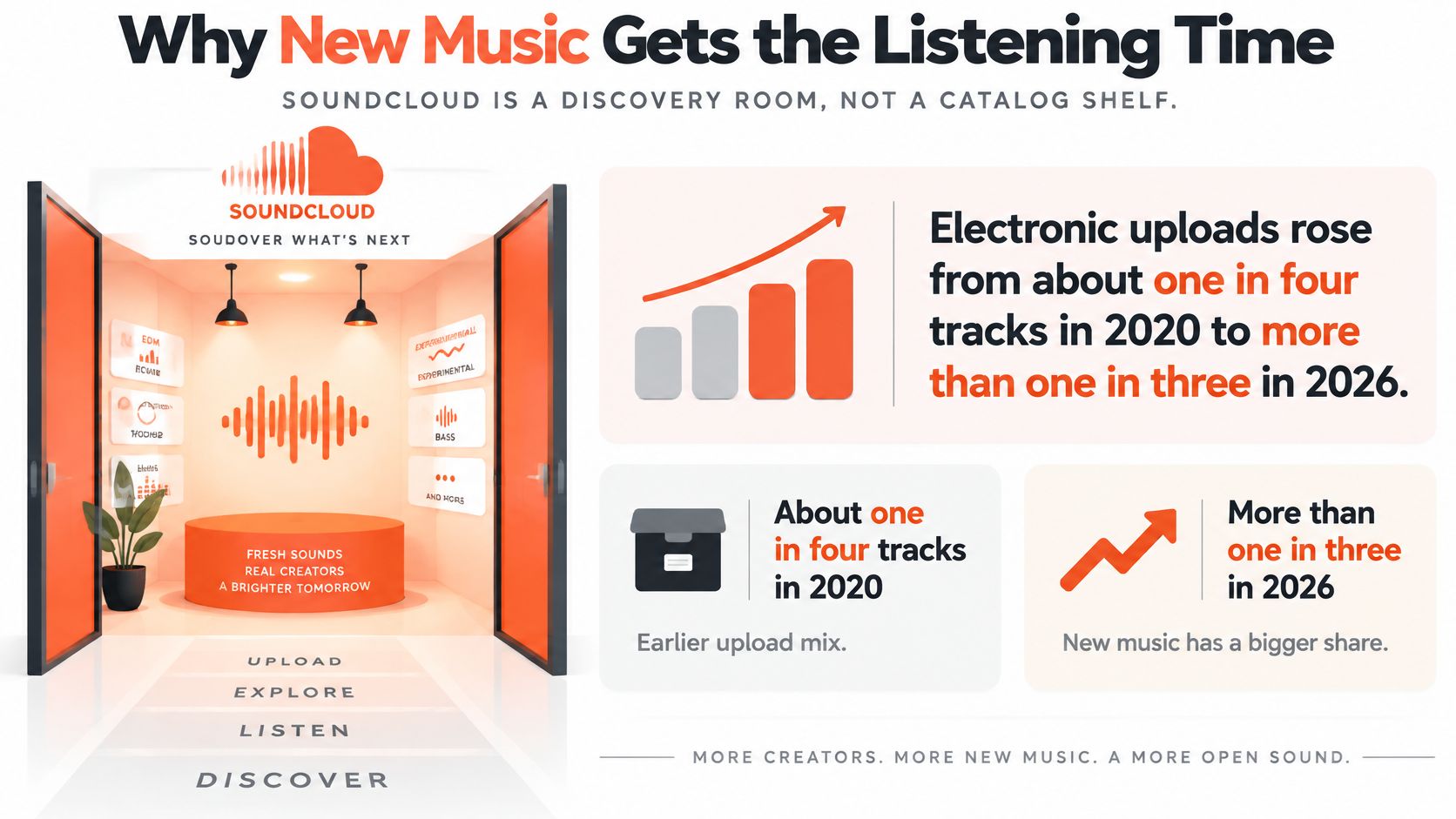
The upload comparison concerns electronic music's share of uploads, not proof that every new release receives attention. More supply creates more music for listeners to discover, but it also means your track needs a clear place within a scene.
Turn discovery interest into a release habit
Build promotion around what makes the current upload relevant. A club edit might belong beside DJs playing similar rhythms; an intimate vocal demo might fit listeners drawn to stripped-back songwriting.
Choose adjacent artists by listening, not just by matching a broad genre label. Compare mood, arrangement, vocal approach, and the setting in which someone would play the music. A shared tag doesn't guarantee a shared audience.
Keep the invitation simple:
- Identify the sound: Describe the track accurately rather than attaching unrelated popular genres.
- Give listeners context: Explain the musical idea, mix concept, or reason for sharing this version.
- Offer a clear next step: Make a related track or mix easy to find on your profile.
A play is someone walking into the room. A like, comment, repost, or second play is them staying for the next song.
Let the preview resemble the music
Your promotional visual should help the right listener recognize the track's character. A quiet live-room performance and a hard club tool shouldn't need identical presentation.
For an intimate performance concept, ImagesArt AI's discussion of Tiny Desk-inspired visuals for social creators can serve as a creative reference. Use the visual to communicate atmosphere, and keep the actual music central rather than suggesting a performance happened when it didn't.
Don't abandon older tracks that still connect. Use a recent upload as a relevant entry point, then offer older work that makes musical sense beside it.
This approach is especially useful for emerging producers, DJs, vocalists, and small labels releasing consistently. It gives each release a distinct invitation without reducing the job to publishing more often.
A Daily Listener Routine Inside Platform Limits
A useful daily routine should leave you with better musical judgment, not a larger pile of indiscriminate actions. Keep it small enough that you can listen, decide, and remember why you responded.
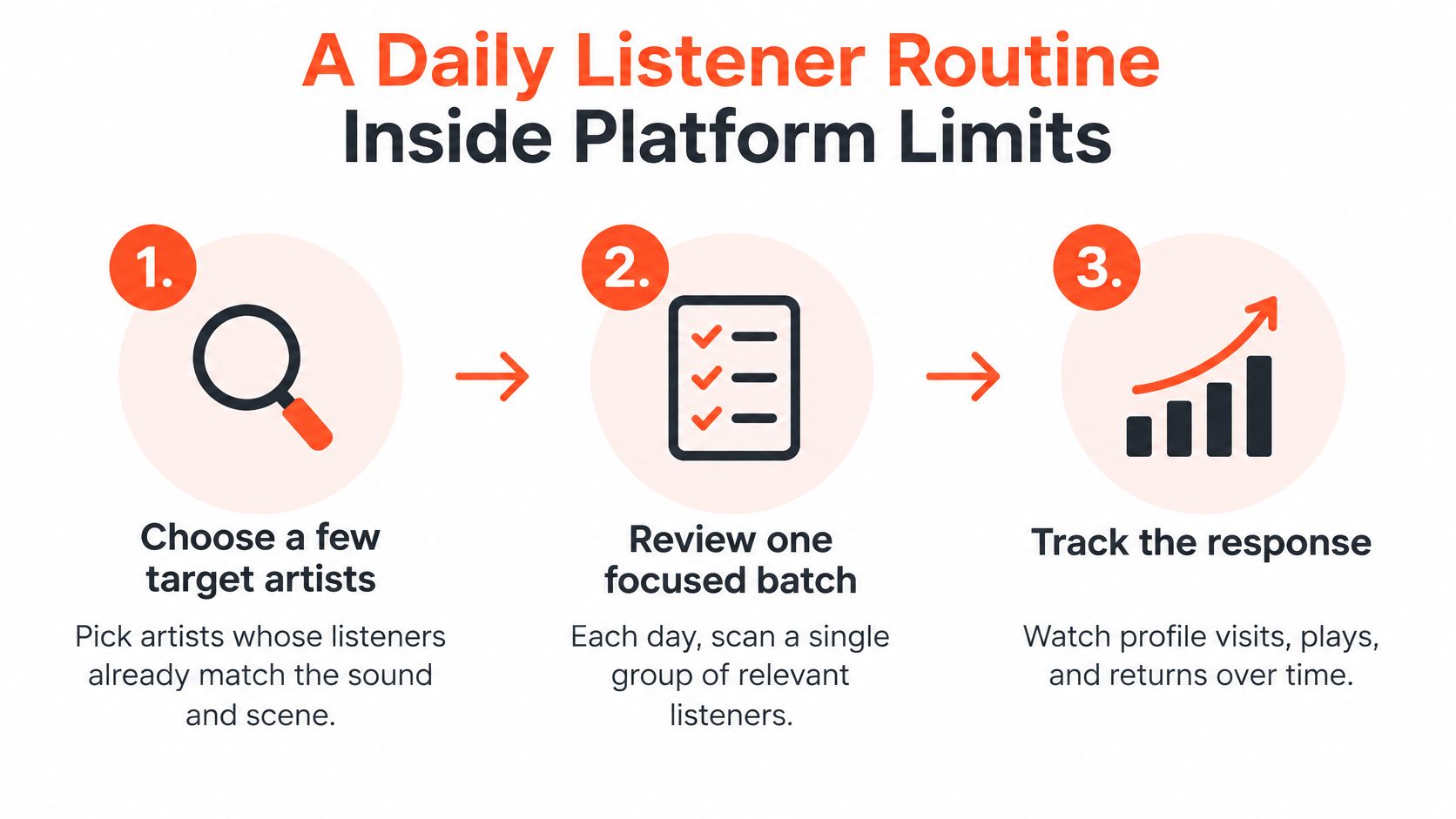
Work through a focused listening session
Choose adjacent artists. Select artists whose listeners already match your sound and scene. Write down the connection, such as percussion style, vocal delivery, or the kind of mix where both tracks would belong.
Review a focused batch of potential listeners rather than searching at random. Open profiles selectively and look for musical relevance. A daily reminder can help you maintain the habit, but it isn't a reason to act when nothing fits.
Listen before responding. Leave a comment only when you have something specific to say. Mention a transition, texture, lyric, or arrangement choice instead of inserting a request to hear your own track.
Repost music you'd stand behind publicly. Ask whether you'd still share it if the artist never noticed. Your profile should reflect your taste, not an attempt to collect favors.
Answer genuine responses on your own tracks. Reply to real comments and appropriate messages when you can give them attention. A useful answer might explain a production choice or acknowledge what the listener heard.
Review the delayed results in your log. Record profile activity where available, likes, comments, reposts, downloads, and repeat listening. Note whether the people you reached seemed musically relevant, not just whether the totals rose.
The session can end without an outbound action. Deciding that a recommendation doesn't fit is useful audience research, not a failed day.
Treat restrictions as boundaries
SoundCloud's likes guidance states that likes have a limit within a 24-hour period and that repeated flags can lead to progressively longer blocks on liking or unliking. It doesn't publish a universal numeric daily threshold, so no service should present a single count as an officially safe allowance.
The platform's misuse controls also cover engagement features such as reposting and messaging. Staying below an assumed count isn't a substitute for genuine behavior.
A platform limit is a boundary, not a daily target.
If liking or unliking is blocked, stop those actions for the full block period. Don't look for a workaround. You can still review recommendations and maintain your notebook, and respond to genuine comments only where your account permissions allow.
For artists using our workflow, you choose the target artists and review the recommendations yourself. You're responsible for your account activity and for the audiences you decide to approach.
We don't permit spam, fake engagement, abuse, or unauthorized access to another person's account. A reminder should support thoughtful listening, never pressure you into filling an activity quota.
Use quiet sessions to refine your selection criteria. If the profiles repeatedly feel unrelated, change the musical starting point before increasing your activity.
Release Week Examples From First Play to Return
Say a producer releases a club edit aimed at listeners of neighboring artists. Instead of treating the upload as a race toward a record counter, they use each release stage to answer a different question.
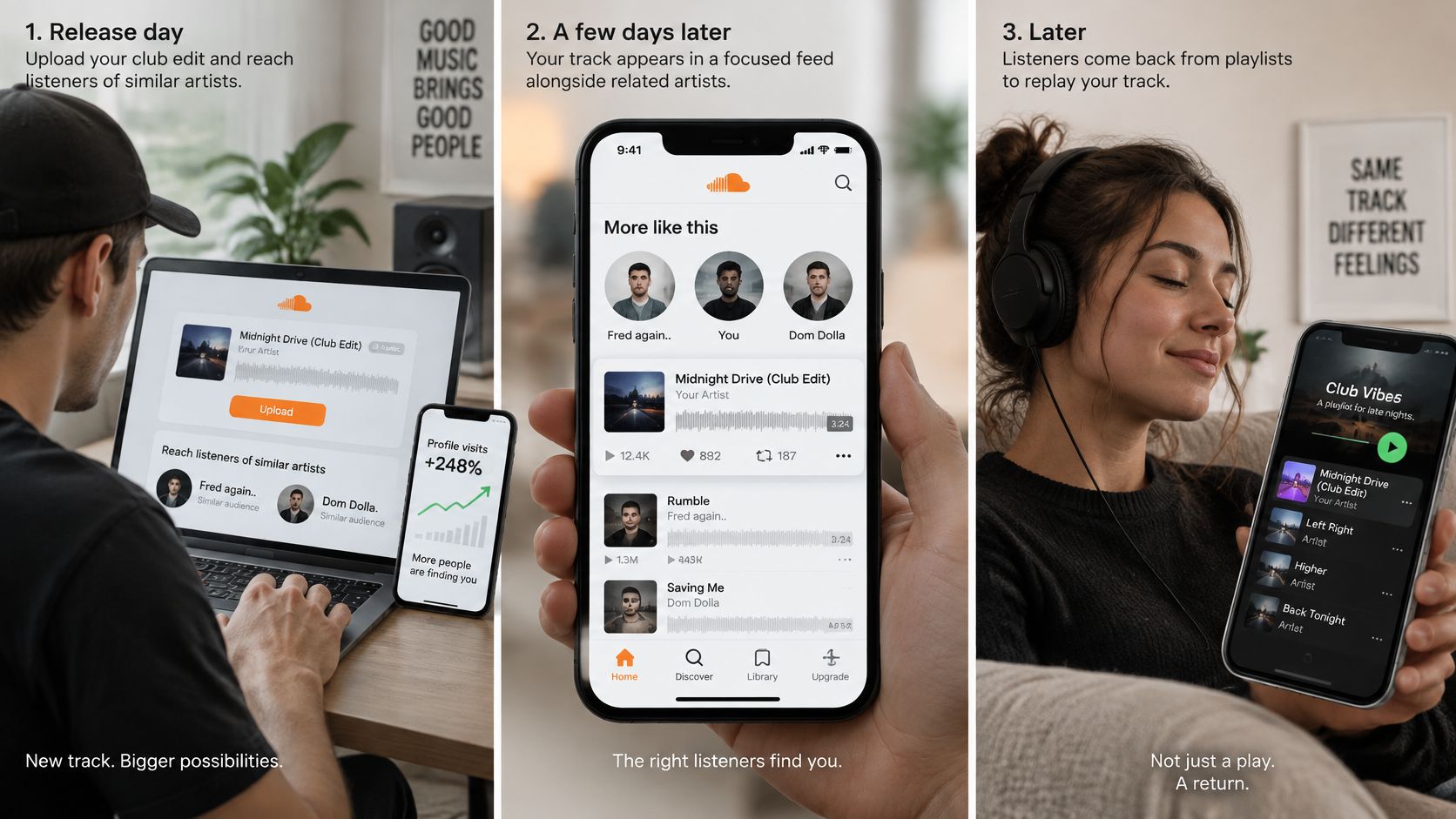
Release day means finding the right room
The producer checks that the profile presents the edit clearly and offers a related mix. They share it in relevant contexts and pay attention to profile interest and comments about the actual music.
At this stage, retention is a question to investigate, not a result they can already claim. A thoughtful response about the groove gives them something useful to answer while they wait for listening behavior to develop.
During the first week in this hypothetical release, a broad repost brings a rush of plays. The producer notices that saves aren't keeping pace, while a smaller scene-specific source brings listeners who return.
That doesn't prove the broader audience is worthless. It gives the producer a reason to inspect the source and wait for the return picture before spending more effort there.
They answer genuine comments and note identifiable repeat listeners. They don't chase unrelated audiences just because those audiences can produce a larger spike.
The later review shapes the next release
A music release strategy becomes more useful when each release leaves evidence for the next creative decision.
The audience may be far beyond the producer's local scene. Music Business Worldwide reported in November 2025 that SoundCloud hosted more than 400 million tracks from over 40 million artists across 193 countries, with about 85% of listening time devoted to user-generated content and more than half focused on new music.
A distant listener's comment may be the clearest visible sign that the track mattered. Give that response more attention than an unsupported rule about the perfect local posting hour.
Discovery is useful when it gives the right person a reason to come back.
Repeat the sequence: relevant audience, easy profile exploration, selective conversation, then retention. Which scene matches your current release: the opening invitation, the audience-fit check, or the decision about what to make next?
Start the Log Before You Add a Tool
Write today's baseline before changing anything. Choose a signal you can measure consistently, add the track's release stage and traffic context, and commit to recording what happens before interpreting it.
If you already know your adjacent artists and have time to find relevant listeners by hand, stay manual. A helper makes sense when finding suitable people is the bottleneck, not when you're hoping to manufacture attention.
Buy help for a defined task
SCHelper is our web app for that narrower job: a daily shortlist of listeners connected to music close to yours, with reminders to review recommendations. We connect through SoundCloud OAuth and don't store your password; SoundCloud's developer documentation describes consent-based authorization for access to user resources.
We're not affiliated with SoundCloud, and you still choose every action. Each connected profile needs its own active subscription: our 3-month subscription costs $26.99 and is recommended for steady follower growth, while our 6-month subscription costs $53.99 and is intended for longer-term audience building.
Those terms describe the intended use, not a promise of a particular result. Check the current plan terms and judge whether the time saved is useful for your workload.
Keep production and audience discovery separate
You may have a different bottleneck entirely, such as preparing a visual preview. LunaBloom AI's AI video creation for marketing teams is a separate resource to evaluate for that production task, not evidence that a music campaign will gain fans.
Use a clear decision test:
- Stay manual when you can find suitable listeners without neglecting your music or existing audience.
- Consider a shortlist when repeated searching consumes the time you'd otherwise spend listening and responding.
- Pause expansion when new reach produces little meaningful interest and you haven't understood why.
Keep the log regardless of what you choose. The tool should help you find relevant people; your evidence should tell you whether those connections matter.
SCHelper offers daily curated listener recommendations based on artists whose audiences fit your sound and scene. Visit SCHelper if finding those people is your bottleneck, then use your engagement log to judge the response through real actions and returning listeners.