
Music Release Strategy: The Complete 2026 Guide
“Release more often” is incomplete advice. If every upload gets an announcement and then silence, you're repeating the same weak campaign faster. A useful music release strategy gives each song a path from first discovery to another listen, a profile visit, and a reason to return for the next release.
For independent SoundCloud artists, that means planning the work between drops as carefully as the upload itself. Launch day matters. It just shouldn't consume the entire plan.
Table of Contents
- Why Launch Day Is the Wrong Goal in 2026
- The Six-Week Pre-Release Runway
- Release Day Execution Sequence
- A SoundCloud Daily Engagement Workflow That Compounds
- Channel-Specific Tips for SoundCloud, TikTok, Instagram, and Email
- The Four-Week Post-Release Plan
- Turning One Release Into a Repeatable Cycle
Why Launch Day Is the Wrong Goal in 2026
The launch-day myth assumes your audience will discover the song when you announce it. That's a poor planning assumption, especially when you're still finding your listeners. Build around discovery happening at different times, not around everyone arriving together.
Streaming generated 69% of approximately $29.6 billion in global recorded-music revenue in 2024, according to IFPI's Global Music Report. The strategic implication isn't that artists should upload constantly. It's that a release belongs to an always-available catalog, where promotion can continue after the announcement disappears.
Separate the release date from the campaign objective
A release date answers when the music becomes available. A campaign objective should answer what you want interested listeners to do afterward.
For a developing SoundCloud artist, useful objectives include:
- Audience relevance: Reach listeners who already engage with music in your scene.
- Profile conversion: Give curious visitors a clear introduction to your sound.
- Continued listening: Help people move from the new single into related tracks.
- Permission to reconnect: Invite follows or email subscriptions without demanding them.
That changes how you allocate effort. Instead of spending your entire content budget on a reveal, keep material for production breakdowns, listener conversations, and later discovery.
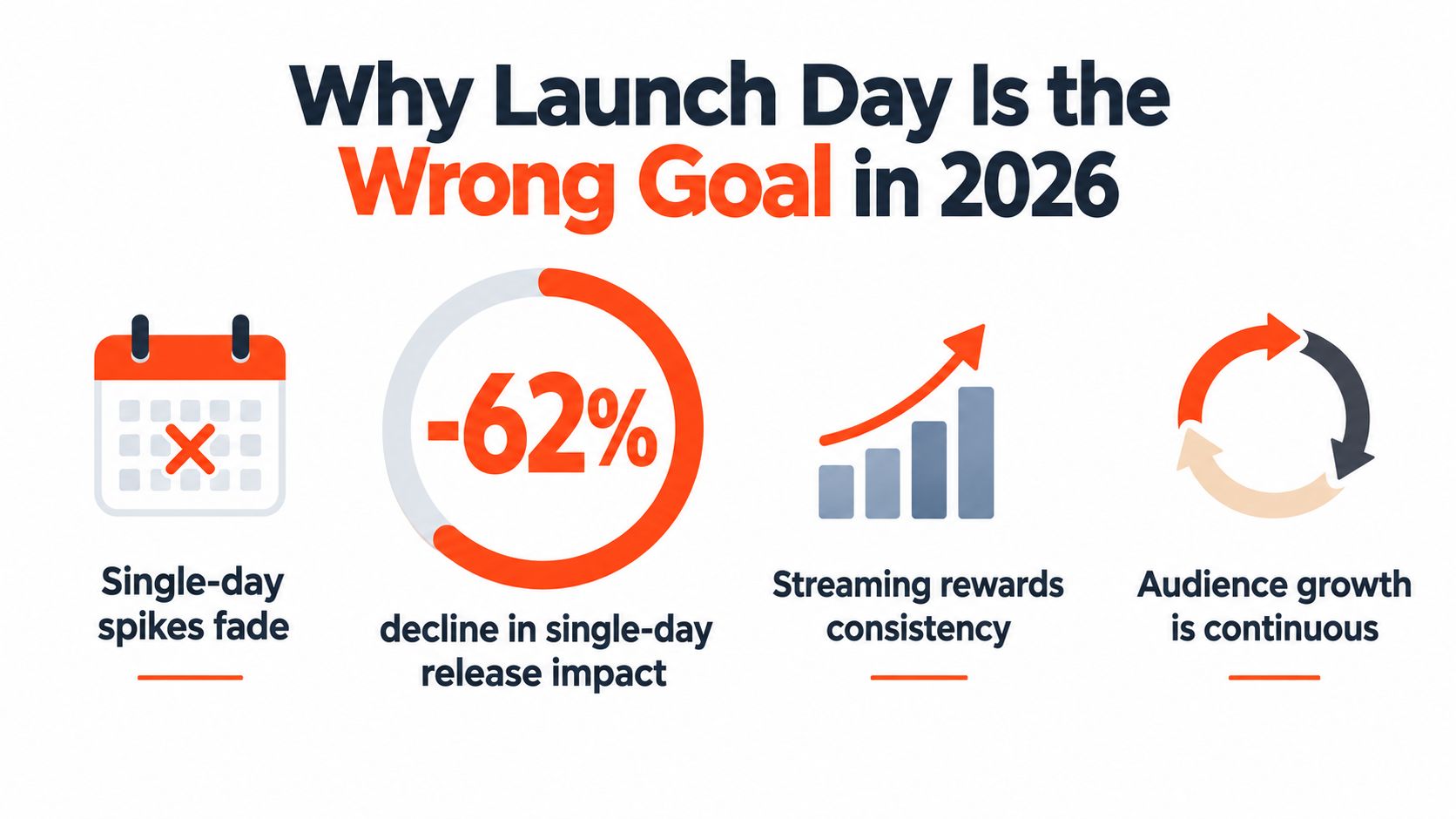
Treat launch-day performance as an observation, not a verdict. A quiet opening doesn't prove the track has no audience, and an enthusiastic opening doesn't prove those listeners will return.
Practical rule: Don't schedule more releases than you can support with relevant outreach, useful content, and actual replies.
Staggered singles can give each track its own promotional focus before a larger project. The trade-off is workload: every announcement creates another set of assets and conversations to manage.
For organizing those assets across channels, see Scheduler.social's campaign guide. Use that planning exercise to assign responsibilities and publication dates, rather than filling a calendar with repeated announcements.
The Six-Week Pre-Release Runway
Start with the finished release, not the teaser. Announcing while you're still negotiating credits or replacing the master turns a creative deadline into a public promise you might not keep.
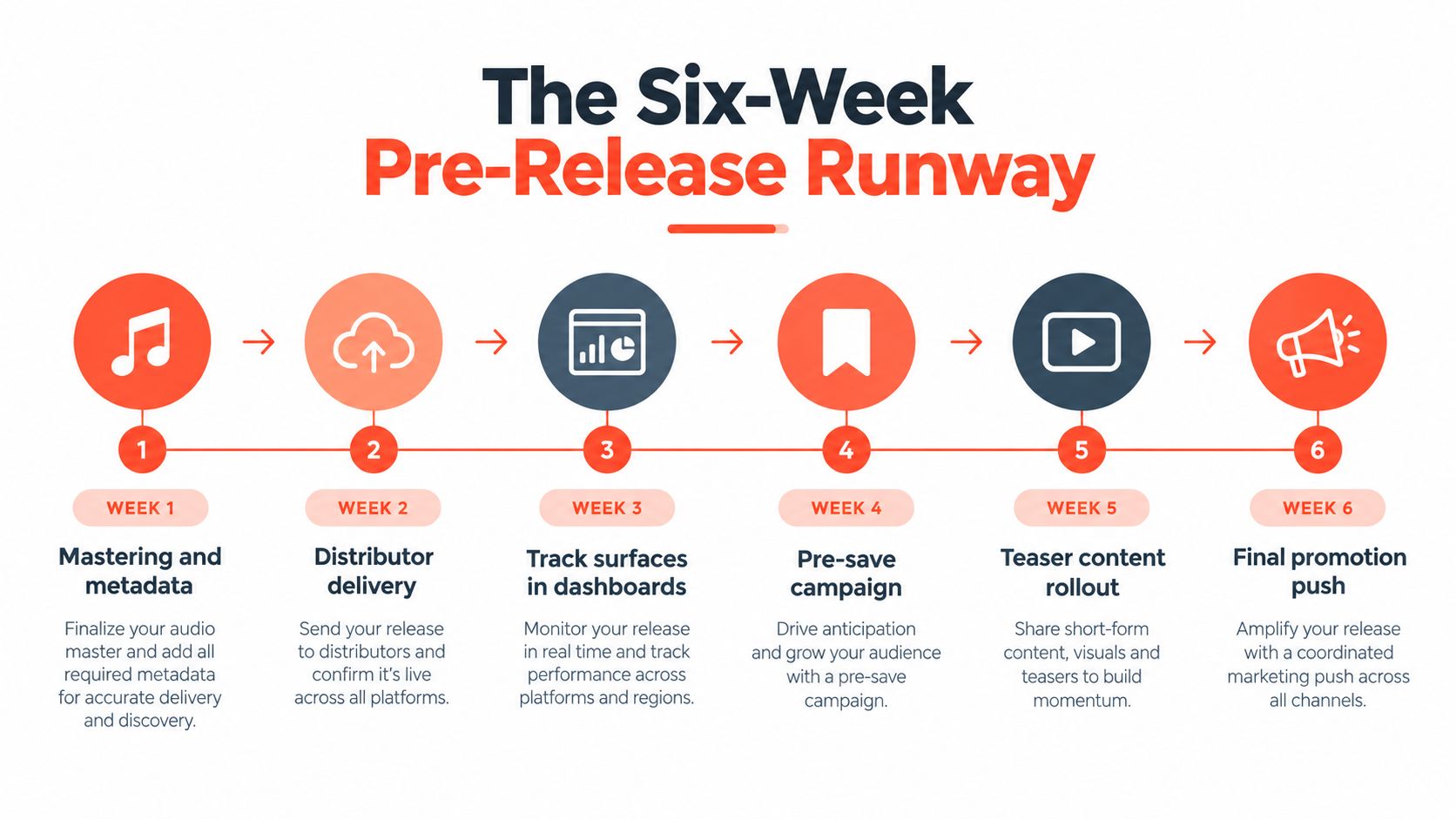
A six-week runway is a practical planning choice within the preparation workflow outlined in Spotify for Artists' release guide. That workflow calls for locking the release and delivery early, pitching before launch, and preparing promotional assets rather than improvising them afterward.
Lock the technical foundation first
During the opening phase, approve the master, artwork, title, artist credits, rights, and collaborator agreements. Select the focus track before approaching curators or press, so everyone receives a consistent story.
Deliver through your distributor early enough to confirm that the release appears in the relevant artist dashboard. Don't assume that uploading to a distributor means every downstream step is complete.
- Audio: Check the actual delivery file, not an earlier listening copy.
- Metadata: Confirm spelling, featured artists, credits, and release information.
- Presentation: Make sure artwork and promotional copy describe the same release.
- Rights: Resolve permissions before anyone starts promoting the track.
Pitch early and prepare the follow-through
Aim to submit the Spotify editorial pitch at least two weeks before release; seven days is the operational minimum, and released tracks can't be submitted through that process, as specified in the release guide linked above. Describe genre, mood, instrumentation, and genuine promotional context. Editorial consideration isn't a placement guarantee.
While the pitch is pending, prepare pre-save or notification assets for people who already want updates. If you don't yet have that audience, don't spend the entire runway asking strangers to pre-save music they haven't heard.
Batch content by purpose: a compelling musical excerpt, an explanation of the track, and material that shows how it was made. Save some of it for after release.
For a broader view of how those activities fit together, use this music streaming promotion guide to organize discovery and follow-up alongside distribution.
Release Day Execution Sequence
Release day should feel coordinated, not frantic. Your job is to make the track easy to hear, make your profile worth exploring, and stay available when people respond.
Choose one primary listening destination for the campaign. If SoundCloud is where you're developing your audience, point the main announcement there instead of asking visitors to choose among several competing actions.
Morning means checking before broadcasting
Open the public release as a listener would. Confirm the audio plays, the artwork is correct, the title is readable, and the destination works on mobile.
Then publish the main announcement, send the release email, and update the relevant profile links. Use a direct message: what the track is, why someone might care, and where to hear it.
- SoundCloud: Present the release with accurate tags, credits, and a useful description.
- Instagram Stories: Pair a musical excerpt with an obvious listening route.
- TikTok: Lead with the musical moment rather than a long explanation.
- Email: Keep the listening action prominent and the surrounding copy focused.
Midday means responding, not reposting everything
Check for broken links, confused replies, and genuine listener reactions. Answer specific comments with specific responses. A thoughtful observation about the drums deserves more than a pasted promotional message.
Use DMs selectively. Contact people who requested the release, collaborators, or listeners with whom you already have a relevant conversation. Don't turn every follower into a cold-outreach target.
In the evening, share a different angle: a performance excerpt, the production choice behind the hook, or a listener's post with permission. Repeating the identical announcement adds volume without adding a reason to listen.
Treat early activity as feedback you can act on, not proof that you've triggered an algorithm.
There's no need to invent a universal opening-hours threshold. Watch what you can verify: whether links work, whether visitors understand the release, and whether interested people take another action.
Invite follows where appropriate, and offer a related artist playlist for listeners who want more context. Don't stack requests to listen, comment, repost, subscribe, and message into every caption. Choose the action that fits that particular moment.
A SoundCloud Daily Engagement Workflow That Compounds
Consider a hypothetical producer releasing scene-specific club music. The producer doesn't need everyone who likes electronic music. They need to identify listeners whose existing interests make this particular sound a plausible fit.
The discovery challenge is substantial: independent artists and DIY sources accounted for roughly 96.2% of new track deliveries in 2025, according to Unchained Music's coverage of independent-artist discovery. That's a reason to narrow your targeting, not expand your outreach indiscriminately.
Build a shortlist you can explain
The producer begins with comparable artists who share meaningful musical characteristics: tempo feel, vocal treatment, production style, or participation in the same scene. Fame alone isn't a useful targeting criterion.
They review potential listeners before acting. An account following a relevant artist is a starting point, not proof of interest in every adjacent release.

The daily routine stays deliberately controlled:
- Review relevance: Check whether recommended accounts plausibly belong to the intended audience.
- Confirm actions: Approve any batch rather than allowing unattended activity.
- Respect limits: Follow current platform guidance and tool controls, without treating a daily allowance as a quota.
- Maintain exclusions: Remove previously approached accounts and anyone who shouldn't receive further attention.
- Record responses: Note genuine conversations, relevant follows, and signs of continued interest.
Keep discovery separate from manufactured engagement
In this hypothetical workflow, the producer carries the same review process across successive releases. They refine comparable artists when recommendations feel wrong and preserve useful relationships instead of restarting outreach from scratch.
Batch follow and unfollow functions require judgment. Don't follow someone merely to provoke a follow-back, then repeatedly cycle through the same account. Use unfollowing for deliberate account management, not as the main growth tactic.
Confirmation-based tools can help organize decisions, but confirmation doesn't make every action appropriate. Stop when you see platform warnings or when you can't assess the accounts properly.
A spreadsheet and manual review can support this process; a dedicated discovery tool can reduce the searching involved. Either way, the principles in this organic follower growth guide are most useful when you judge progress by relevant listener relationships, not the number of actions completed.
Channel-Specific Tips for SoundCloud, TikTok, Instagram, and Email
Give each channel a job. Publishing the same announcement everywhere is easy to administer, but it doesn't answer why someone would engage with it in that setting.
For planning purposes, treat SoundCloud as your listening destination, TikTok as a place to test musical entry points, Instagram as a relationship space, and email as a permission-based route back to interested listeners. These are working roles, not claims that every artist's audience behaves identically.
Channel Roles Across a Release Cycle
| Channel | Best Fit | Cycle Phase |
|---|---|---|
| SoundCloud | Full tracks, related catalog, scene context | Discovery and continued listening |
| TikTok | Hook-led clips, performance ideas, creative demonstrations | Awareness and renewed discovery |
| Studio context, conversation, listener recognition | Anticipation and relationship maintenance | |
| Direct release updates and meaningful follow-ups | Re-engagement and future releases |
SoundCloud needs context. Arrange your profile so a visitor can understand what you make without detective work. Use track descriptions and related playlists to connect the current release with the rest of your musical identity.
For TikTok, test different entrances into the same song. A vocal phrase, an unusual sound, and a performance moment are different creative propositions. Don't assume the section you prefer as a producer is automatically the clearest introduction for a new listener.
Match the workload to your capacity
Instagram can carry the human context around the music: a recording decision, a rehearsal, or an answer to a real question. DMs work better as conversations than as a substitute for a mailing list.
Email gives you a direct, permission-based contact route, but it isn't infrastructure you own outright. Keep exportable records, respect unsubscribe requests, and send something more useful than repeated reminders that the song exists.
- Keep a primary destination: Avoid changing the listening objective with every post.
- Choose a supporting channel: Prioritize the place where you can sustain useful interaction.
- Reuse selectively: Adapt the idea to the channel rather than copying every asset unchanged.
For visual production planning, the AI content creation workflow offers another process to consider. Keep any generated supporting material consistent with the release's actual identity.
Use this online music promotion guide when deciding how much work to assign each channel. A manageable plan is preferable to several neglected profiles.
The Four-Week Post-Release Plan
Reserve calendar space after launch before you announce the release date. The following four-week schedule is a working plan, not a claim about a universal promotional window.
Observe before changing direction
During the opening week, record the response against your own pre-release baseline. Review saves where available, follows, comments, playlist additions, and evidence of repeat listening.
Keep platform measurements separate. Don't label SoundCloud likes as Spotify saves, and don't infer individual listener retention from aggregate plays when your dashboard doesn't expose it.
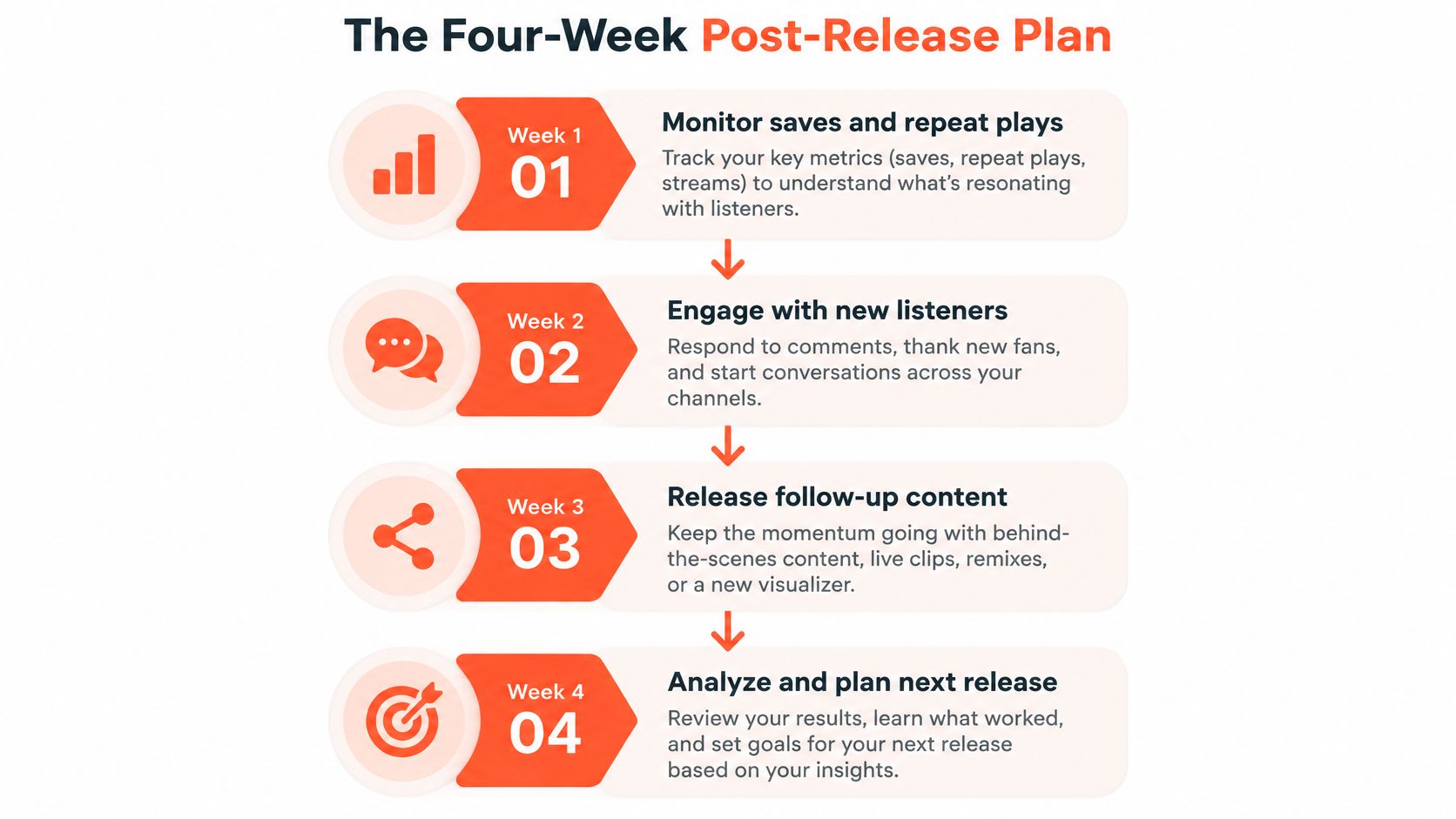
In the following week, approach independent curators whose selections fit the track. Explain that fit specifically rather than sending a biography and hoping they find the connection.
Invite creative participation with a usable idea, such as a performance interpretation or production response. Ask permission before reposting listener content, and don't manufacture the appearance of fan activity.
Test a fresh angle before extending the campaign
During the third week, publish follow-up material that adds information. A breakdown of an unusual bass sound gives a different reason to engage than another artwork animation.
Review whether earlier listeners are visibly returning through available analytics or direct interaction. If you can't establish that, describe what you do know instead of inventing a retention measure.
- Relevant response, limited exposure: Test another closely matched audience or curator.
- Attention without further listening: Review the destination, profile presentation, and promise made by the clip.
- Little response across suitable audiences: Preserve the learning and consider redirecting effort.
Decision checkpoint: Continue promotion because you can name the next useful test, not because stopping feels uncomfortable.
By the final week, decide whether the track merits active promotion or moves into catalog mode. Catalog mode means keeping the release accessible and connected to your profile without making it the center of every post.
An underperforming release doesn't require an emergency remix. Sometimes the useful next move is improving the next track, the targeting, or the way you introduce the music.
Turning One Release Into a Repeatable Cycle
A sustainable music release strategy should leave you with more than a finished campaign. It should leave you with clearer audience choices, reusable assets, and a record of what deserves another test.
More output alone isn't a solution. Approximately 106,000 tracks were delivered daily in 2025, while 88% of tracks generated 1,000 streams or fewer, according to Luminate's year-end music report. Treat consistency as a repeatable working process, not a contest to maximize uploads.
Keep a small, honest scorecard
Choose measurements that answer whether listeners are developing a relationship with your music.
- Repeat listening: Use returning-listener data where available; otherwise state the limitation.
- Follower conversion: Compare follower changes with relevant listener or visitor data, without assuming every follow came from the release.
- Catalog activity: Check whether attention reaches older tracks rather than stopping at the promoted single.
- Relationship evidence: Record replies, unsolicited shares, and people asking about future music.
Follower count alone can't tell you whether people care about the catalog. Equally, aggregate plays can't explain why someone returned. Read quantitative results alongside actual listener behavior.
Schedule around the work you can sustain
Keep unfinished music, finished masters, and promotional assets in separate planning stages. A backlog gives you options, but don't turn it into an obligation to announce everything.
Review campaign activity weekly. Reassess your release calendar monthly, considering production capacity, outstanding conversations, and whether the current song still has a worthwhile promotional test left.
After successive campaigns, compare like with like: audience fit, asset type, outreach quality, and available analytics. Change something specific rather than rebuilding the entire process because a release disappointed you.
The useful endpoint isn't a flawless launch. It's a system you can repeat without neglecting either the music or the listeners you've already reached.
SCHelper offers curated listener recommendations based on similar artists and controlled, confirmation-based SoundCloud engagement workflows. Visit SCHelper if you want to organize relevant listener discovery into your release routine, then evaluate the activity through genuine engagement and continued listening rather than follower count alone.