
Social Media Marketing for Musicians Without Guesswork

Social media marketing for musicians is the day-to-day work of putting songs in front of people who are already primed to hear them. Deloitte reports that Gen Z and millennial fans often find artists through social platforms and user-generated video. For an independent musician, that change can decide whether a release fades fast or reaches listeners who actually care.
Table of Contents
- Why Social Media Marketing Matters for Independent Musicians
- What This Means Without a Label Budget
- Awareness Versus a Real Fan Base
- Start With Sound, Scene, and Habits
- Study Artists Whose Fans Already Fit
- Audience Signals Worth Tracking
- The Three Stages of a Release Cycle
- Spread Content Across Channels
- Batch Content So You Stay Consistent
- A Simple Weekly Rhythm
- Replying With Specifics
- Finding the Listeners Who Deserve a Reply
- Inviting Conversation Without Begging
- Three Realistic Scenarios
- Steady Habits Beat Breakthroughs
- Look Beyond Raw Plays and Impressions
- Key Metrics for Musician Social Media Marketing
- Compare Results Across Content Types
- Adjust When the Numbers Disappoint
- Ask Three Questions After Each Cycle
- Which Platform Should Independent Musicians Focus on First?
- How Often Should You Post Between Releases?
- How Do You Measure Real Audience Growth?
- What Should You Do When Engagement Stays Quiet?
- Your Next Steps This Week
Why Social Media Marketing Matters for Independent Musicians
A track drops on Friday. You spend the weekend checking plays, and the silence starts to feel personal.
That silence is common. Even a strong song rarely travels far without help.
Fans now meet music inside feeds, short videos, captions, and comment sections. Many never start with a search bar or a release page.
- One clip can preview your sound before someone clicks a streaming link.
- One comment thread can prove that real listeners caught something specific in the song.
- One profile can guide people toward the next release instead of leaving them at a single post.
What This Means Without a Label Budget
You do not need a full team or a major-label spend to begin. You need a recognizable sound and the habit of showing up where listeners already spend time with music like yours.
Social media marketing for musicians is real audience work. It gives you a direct path to people who may stick around for the next release.
Reach matters only when it lands with the right listeners. A crowd that keeps scrolling is attention, not a fan base.
This guide moves from audience targeting and release planning into engagement and measurement. The process stays practical at every step. None of it depends on chasing a viral shortcut.
Plenty of musicians hear "social media marketing" and imagine a grind of daily posts, trending audio, and chasing whatever goes viral this week. That picture misses how fans actually find and stick with an artist.
Think of your profile as a listening room with the door propped open. A visitor should be able to tell within seconds what kind of music is playing, who made it, and where to hear the next track.
Social media marketing for musicians is the set of habits that keeps that door open and brings the right people inside.
Those habits are fairly simple:
- Profile design that makes your sound obvious
- Regular updates between big announcements
- Direct conversation with people who stop to listen
- A steady presence outside of release week
Awareness Versus a Real Fan Base
Awareness is a single encounter. Someone sees your name once, maybe hears a few seconds of a song, and keeps scrolling.
Fandom comes later. That same person comes back to your music on their own, without being prompted.
A crowded doorway is not a fan base. The fans are the people who come back.
Getting from one to the other takes time, and it happens in stages. A first post sparks interest. Consistent activity keeps that interest alive. Real relationships are what turn occasional listeners into long-term supporters.
The same pattern shows up across genres:
- A DJ posts a short mix clip, then replies to the commenter who asks what track came next.
- A producer shares a beat in its raw form, then in its finished form, and points people to the full release.
- A vocalist posts a rough voice note between singles so returning listeners know another song is on the way.
None of these artists has a flawless feed. What they have is a space that's easy to understand and a habit of making people who stick around feel welcome.
Social media marketing for musicians works when a return visit feels familiar. The sound is clear, the door stays open, and the people who come back have a good reason to keep listening.

Most quiet releases don't fail because the song is weak. They fail because the song reached the wrong room. Social media marketing for musicians starts working when you figure out who already cares about a sound like yours.
Broad age ranges won't get you there. A useful audience is really a cluster of taste, scene, and listening habits.
Think about it like choosing a club night. The people who stay for your set already know the tempo, the references, and the artists you'd sit next to on a playlist.
Start With Sound, Scene, and Habits
Try describing your listeners through four filters:
- Sound. The textures, tempo, and moods they keep replaying.
- Genre. The shelf they already browse, not the label you wish you had.
- Scene. The local or online circle where that music gets talked about.
- Habits. When they listen, which clips they finish, and which artists they keep coming back to.
SoundCloud has roughly 140 million users and about 40 million creators. That's a lot of reach, but it also means a vague profile disappears fast.
Focus is what helps you stand out in a crowd like that. You're looking for people who already respond to music close to yours.
Study Artists Whose Fans Already Fit
Choose a handful of artists whose listeners would find your style familiar. Then pay attention to what those fans actually do.
A relevant listener leaves clear traces:
- They comment on tracks with a specific detail, not just a generic emoji.
- They return to the same artists and scenes over time.
- They move from a post to a full listen or a profile visit.
If you need a tighter starting list, you might find our guide on finding similar artists useful.
Big numbers can look impressive and still tell you very little. A like from someone outside your scene means less than a comment from someone who already lives in it.
Audience Signals Worth Tracking
Not every signal carries the same weight. The table below breaks down a few common ones, what each one suggests about listener fit, and how you can respond to it.
| Audience Signal | What It Tells You | How to Use It |
|---|---|---|
| Repeat comments on similar artists | The listener already spends time with your kind of music | Prioritize them when you share new work |
| Profile visits after a clip | Curiosity moved past a scroll | Make the next track easy to find |
| Scene-specific language in replies | They belong to the same musical circle | Speak in references they already know |
| One-time likes with no return | Attention that may be accidental | Don't treat the number as growth |
Read the table as a set, not a checklist. A single signal rarely tells the whole story, but several pointing the same way usually do.
A hundred listeners who love your sound are worth more than thousands who scrolled past by accident.
Relevance beats raw reach. Social media marketing for musicians gets sharper when every post is written for people who would stay in the room after the first chorus.
Run every idea through that filter before you plan a single post.
Random posting burns energy without building anything. A release plan points that same effort toward momentum, because every post has a clear job to do at a specific moment.
Think of a release like a live show. You don't walk onstage, play the single, and walk off. You warm the room up, build to the peak, and then keep the crowd talking long after the last note.
The Three Stages of a Release Cycle
Each stage calls for different content:
- Teaser phase. Short clips, artwork hints, and behind-the-scenes process shots build curiosity before drop day.
- Release week. Focused posts create a burst of attention once the track is finally out and easy to find.
- Between releases. Previews, playlist-style recommendations, and studio moments keep existing listeners close while the next track takes shape.
Teasers build curiosity, release-day posts create a focused burst of attention, and between-release content keeps the room warm.
Spread Content Across Channels
One platform rarely carries a whole discovery journey. MIDiA Research has found that no single service controls the full path from first exposure to actual listening, so discovery tends to happen across several platforms at once.
That's why betting everything on one viral post is risky. A short clip on one platform, a process photo on another, and a conversation on a third work together like a net instead of a single hook.
If you want a closer look at how to structure this, the "Social Media Content Strategy: Video-First Framework" is a good starting point for ways to improve your social media content system. You can also check out our guide on building a music release strategy for the full timeline.
Batch Content So You Stay Consistent
Consistency sinks most content plans, and it's rarely a lack of ideas. The fix is batching: create several posts in one sitting instead of scrambling every day.
Here's a typical case. Film one studio session, then cut it into a teaser clip, a release-day announcement, and a behind-the-scenes story. One afternoon of filming turns into two weeks of posts.
A Simple Weekly Rhythm
A realistic plan balances time spent creating with time spent publishing:
- Monday. Review what's scheduled for the week and adjust anything tied to the current release stage.
- Wednesday. One focused creation block, roughly two hours, to film or write the next batch.
- Friday. Publish the week's main post and reply to comments while people are still paying attention.
That rhythm leaves most of your week open for making music, which is the part that actually matters.
Social media marketing for musicians works best when the plan bends around the music, not the other way around. Map your content to the life of each release, spread it across channels, and batch the work so momentum never hinges on one good day.

Exposure gets a song heard once. Engagement is what turns that one listen into an actual relationship.
Picture a live gig. The crowd sticks around when the performer makes eye contact, notices who's dancing in the back, and changes the next song on the fly. Online, the same instincts still matter. The difference is that your room is a comment thread.
Replying With Specifics
A generic "thanks for listening!" tells a fan nothing. A specific reply tells them you were paying attention.
- Mention the moment they flagged, like the drop in the second verse.
- Ask what they heard in the track, not just whether they liked it.
- Share one detail about the story behind the sound.
Each reply takes a minute, but it signals that a real person is on the other end. Keep a simple list of who replied and what they said. That way, your next message picks up right where the last conversation ended.
Finding the Listeners Who Deserve a Reply
You can't answer everyone personally, and you don't have to. Focus on the small group who come back, comment with real detail, or click through to your profile.
People stay with artists they feel they know.
Those few listeners form your early community. Give them your attention first, and they'll often bring others with them.
Inviting Conversation Without Begging
Asking a question works far better than a generic call to action. "Which line hit you hardest?" invites an answer. "Please share this!" usually gets silence.
Make your profile easy to explore, too. Pin your strongest track, write a short bio that names your sound, and link to your next release so a curious visitor knows where to go.
Three Realistic Scenarios
Hip-hop vocalist with a first EP. She starts with almost no audience, so she defines her listeners by sound and scene, plans a teaser, and replies to every thoughtful comment for two weeks. Then she checks which clips drew repeat visits.
Electronic producer promoting mixes. He posts each mix with a question about the tracklist and answers people who try to identify songs. He tracks which mix sparks the longest conversations, then plans the next one around that.
Small label manager with several profiles. She gives each roster artist their own audience definition and content plan, so no profile ends up sounding like a copy of another.
The same loop repeats in every case: define, plan, engage, review. Each one starts small and grows as the conversation does. Carlos, a SoundCloud user, explained how daily recommendations helped him stay consistent:
"The daily curated recommendations save me so much time, and I've connected with real fans who appreciate my music." , Carlos
If you want more ideas for turning casual listeners into a community, this guide on improve social media engagement offers practical angles worth comparing with your own routine.
Steady Habits Beat Breakthroughs
Engagement rarely jumps overnight. It builds through small choices you repeat week after week. Keep your replies genuine, be open about who you are, and let the community grow at its own pace. Stay warm and honest, even when the numbers look slow.
Without measurement, every release is basically a guess. You might celebrate a jump in plays while the people behind those numbers quietly disappear. Clear metrics are what turn social media marketing for musicians into something you can actually get better at.
Look Beyond Raw Plays and Impressions
Plays and impressions are the easy numbers to pull up. They prove a post showed up on someone's screen, but not much more.
The stronger signals tell a fuller story:
- Profile visits mean someone was curious enough to keep scrolling past the clip and look you up.
- Repeat engagement means listeners are coming back without being asked.
- Relevant audience members tell you your sound reached the right people.
- Movement toward listening shows interest turning into an actual play.
Research suggests plenty of people who discover music on social media never press play on it. A viral clip can feel like a win while your release sits untouched, which is exactly why the deeper signals deserve more of your attention.
Key Metrics for Musician Social Media Marketing
Here is the short list of core numbers, what each one reveals, and why it's worth watching.
| Metric | What It Measures | Why It Matters |
|---|---|---|
| Profile visits | Curiosity after a post | Shows whether content makes people want to know more about you |
| Repeat engagement | Returning comments and listens | Reveals who is becoming a real fan |
| Relevant listeners | Fit with your sound and scene | Guides where to focus your next post |
| Listening movement | Clicks from posts to tracks | Connects attention to actual streams |
Check these weekly during a release cycle. Weekly reviews reveal patterns, while daily numbers mostly show noise.
Compare Results Across Content Types
Think of your content like a set list. Some songs get the crowd moving, and others make them lean in. You only learn which is which by paying attention to the room.
Compare how each format performs:
- Short clips against longer process videos
- Teasers against release-day announcements
- Mix previews against studio moments
Then look at which audience segments respond most. Listeners who keep commenting on your vocals need a different plan than people who only react to your beats.
Adjust When the Numbers Disappoint
Weak numbers are information, not failure. Change one variable at a time so you actually know what caused the shift.
Common fixes include:
- Refining target artists when the wrong listeners keep showing up.
- Switching content formats when clips draw attention but not profile visits.
- Improving profile clarity so visitors hear your sound and know where to go next.
A profile should answer three questions in seconds: what does this sound like, who made it, and where can I hear more?
Ask Three Questions After Each Cycle
End every cycle with a short review. Ask who engaged, what they did next, and what you'll change. Write the answers down, since patterns only become clear across several releases.
The infographic below shows this process as a repeating loop, moving from tracking metrics to asking the questions that shape your next move.
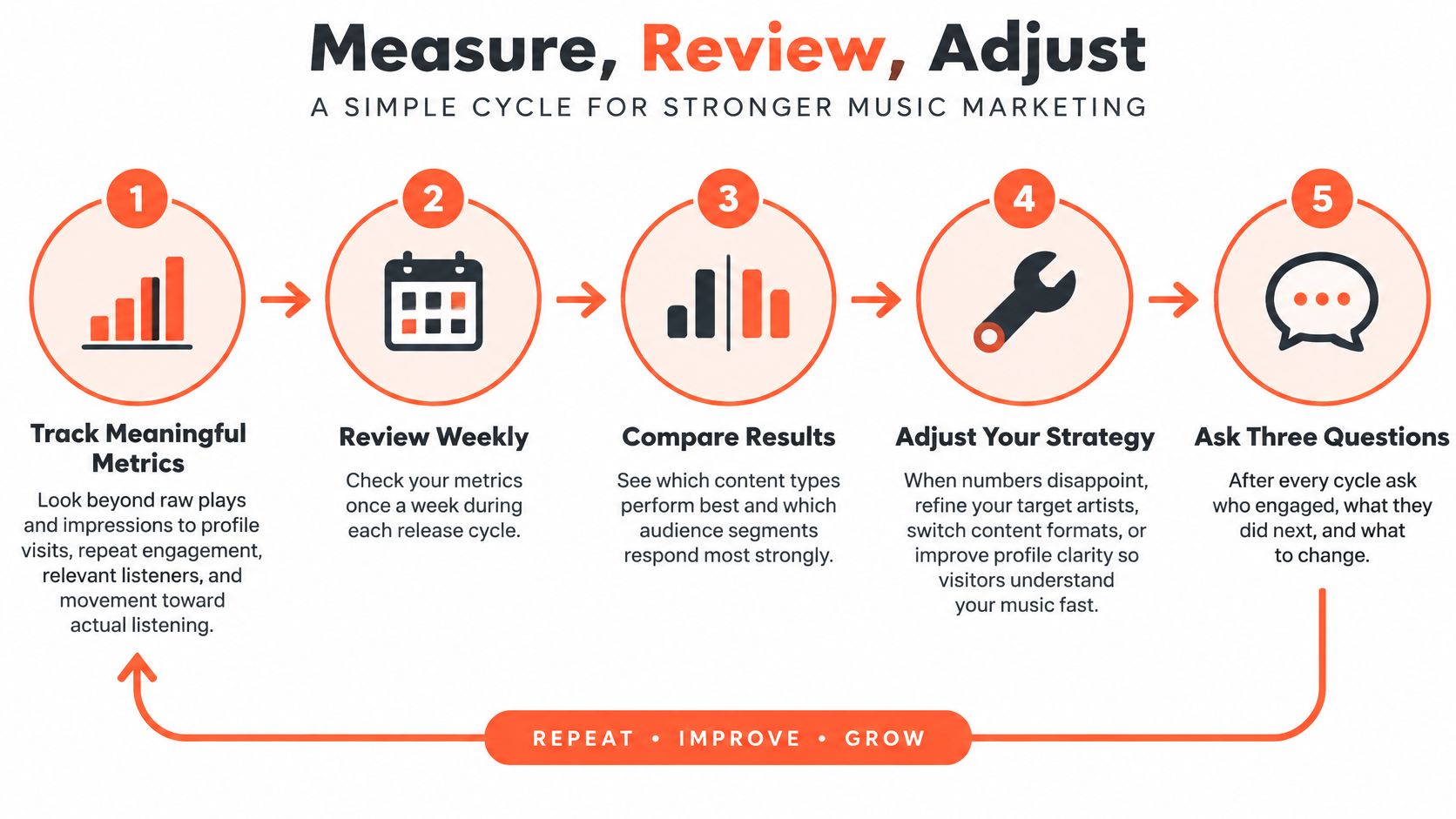
Think of it as a cycle rather than a checklist. Each release feeds the next, so your strategy builds over time instead of starting from zero after every drop.
Read also: our guide on engagement events, which shows how to turn those lessons into stronger connections with listeners.
Which Platform Should Independent Musicians Focus on First?
Start where your listeners already spend their time. Browse the accounts of artists who sound like you and notice where their fans leave comments, share posts, and reply to each other. That's your map. Pick one primary channel to build around, and let a second one wait until the first feels manageable.
How Often Should You Post Between Releases?
Choose a pace you can keep up for months, not just a few busy weeks. In practice, two focused posts a week will do more for you than a daily flurry that runs out of steam by the third day.
- Record and edit in one dedicated block each week.
- Publish one main post, then answer comments that same day.
- Keep one spare clip in reserve for slow weeks.
How Do You Measure Real Audience Growth?
Try to ignore the headline play count for a while. It looks impressive, but it can hide a lot. Watch instead for signs that people are actually paying attention:
- Comments that name a specific moment in a track
- Listeners who come back without being prompted
Ten listeners who keep coming back are worth more than a thousand people who stop by once.
What Should You Do When Engagement Stays Quiet?
A quiet stretch tells you something useful. It doesn't mean you've failed.
Check whether your clips reach the right people, whether your profile explains your sound within a few seconds, and whether you've quietly changed your format. Then look at what people did after they saw the post, not just how many saw it. Change one thing at a time instead of blaming the algorithm.
Your Next Steps This Week
Choose your primary channel, sketch a three-week posting plan, and pick three signals to track. Then set a reminder to review your numbers next Friday.
SCHelper is built for SoundCloud artists who want to reach people already into music like theirs. Each day it puts a shortlist of recommended listeners in front of you to review. Explore SCHelper and build your audience one relevant listener at a time.