
Music Discovery Platforms: 10 Options Compared for Artists
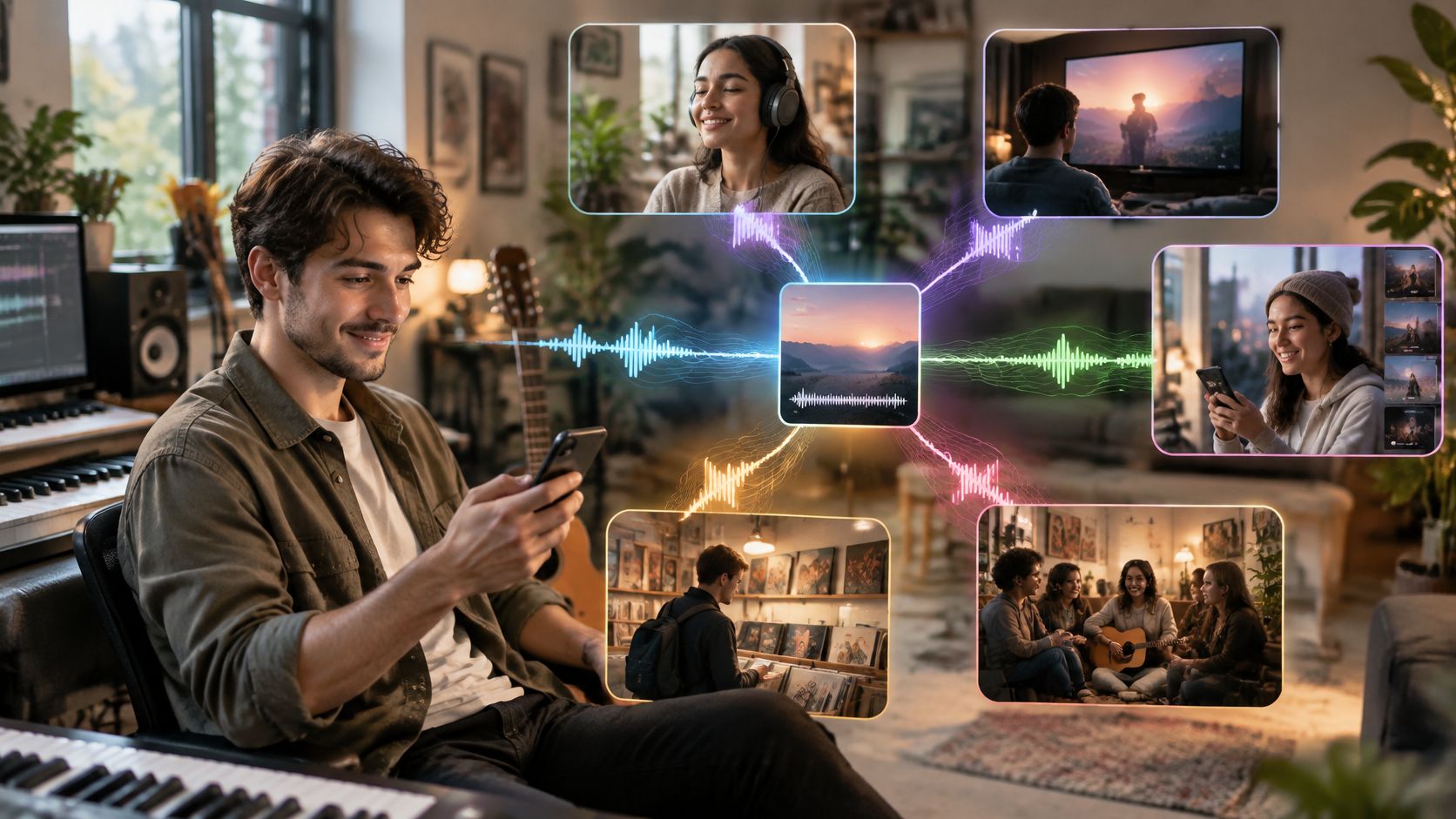
Friday morning, the track goes live. You post the link in four places, send it to a group chat, and by Sunday you're staring at three dashboards telling three different stories. One shows forty plays from people you've never met. Another shows eight plays from the same handful of accounts. A third shows nothing at all until somebody with a blog happens to write it up.
Nothing broke. Music discovery platforms don't do the same job. Some are recommendation engines that decide what a listener hears next. Others are browsing tools where the listener goes looking and the artist mostly needs to be findable. A few are social scenes where the recommendation is a person. Treating them as one channel with ten doors is how artists waste release week.
Every entry below is judged by the listener intent it serves and by what it realistically gives an artist trying to grow, including the parts that don't work. Each one is tied to a concrete job you can assign it, so you can build a platform mix instead of chasing every service on the internet.
Table of Contents
- 1. SoundCloud
- 2. Bandcamp
- 3. Spotify
- 4. YouTube Music
- 5. Apple Music
- 6. Audius
- 7. Deezer
- 8. Last.fm
- 9. Mixcloud
- 10. Hype Machine
- How the 10 Music Discovery Platforms Differ at a Glance
- Building a Discovery Mix That Matches Your Release Plan
1. SoundCloud
SoundCloud is where records live before they're finished. Demos, edits, DJ tools, and unmixed loosies sit beside released singles, and the catalog leans toward independent and unsigned work. That changes what discovery means, because listeners arrive inside a scene rather than being handed a tastemaker's pick.
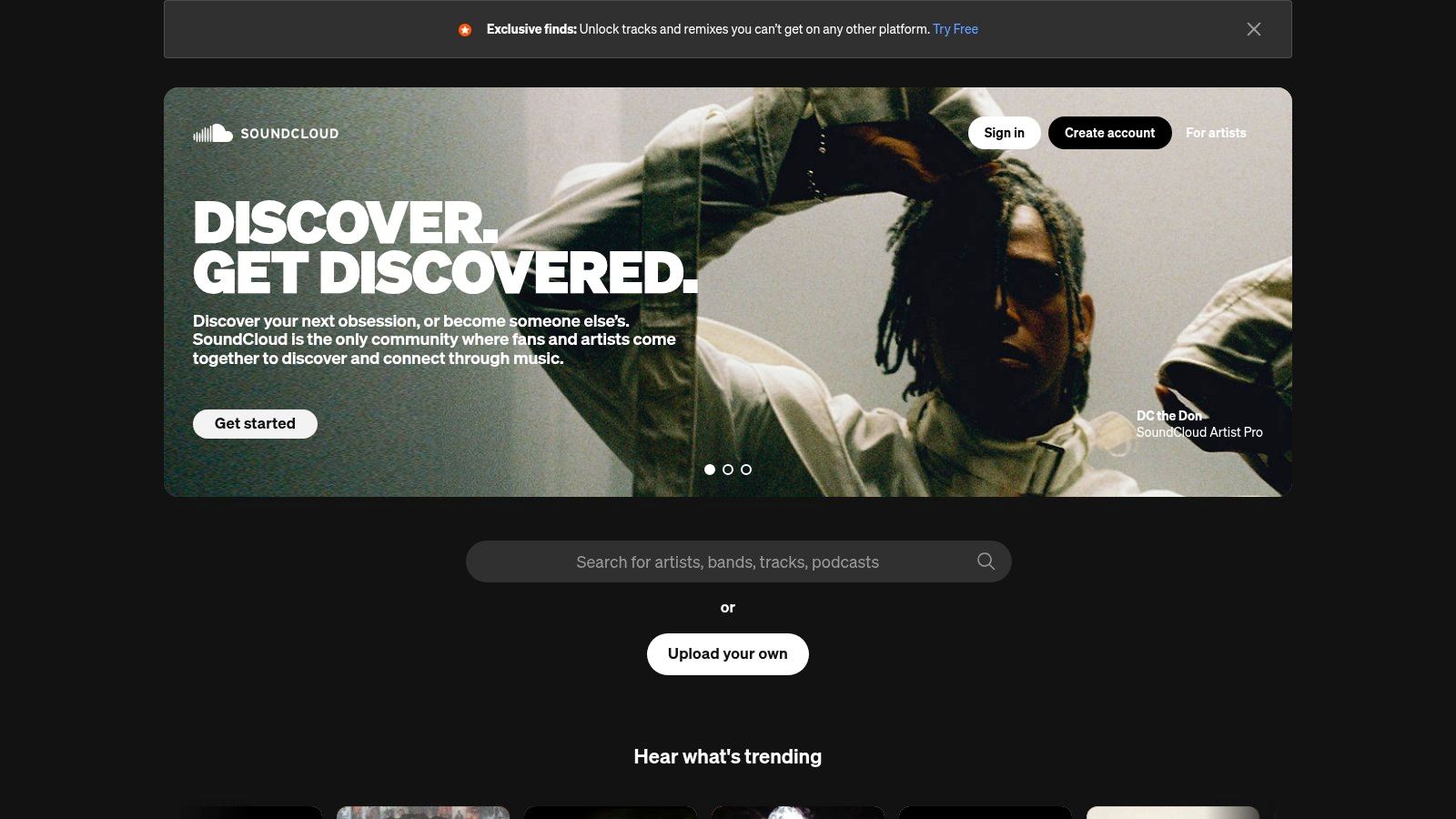
What the network rewards
- Connection depth: listeners tied to artists in your lane rather than scattered reach.
- Public comments: visible to the next listener and read as scene evidence.
The failure mode is volume. Uploads arrive faster than anyone can filter them, the listening experience varies track to track, and relevance is inconsistent. Artist promotional tools mostly sit behind a paid plan.
One hard boundary matters if you use any third-party tool. SoundCloud's API terms prohibit using the API to distribute spam or unsolicited promotional messages, prohibit sending messages, comments, or other direct communications to platform users, and bar apps that encourage others to do the same. Anything that contacts strangers on your behalf is off the table.
Practical rule: treat SoundCloud as a scene tool, not a radio station. Track where each follower came from, not how many arrived.
If you want the mechanics in more detail, this walkthrough on how to grow a SoundCloud profile covers the review loop.
2. Bandcamp
Bandcamp asks the listener to do something increasingly unusual: browse. Discovery pages sort by genre and location, artist and label pages stack releases, merchandise, and updates in one place, and editorial selections sit alongside tag-driven ones. Nobody arrives by accident, and that's the point.
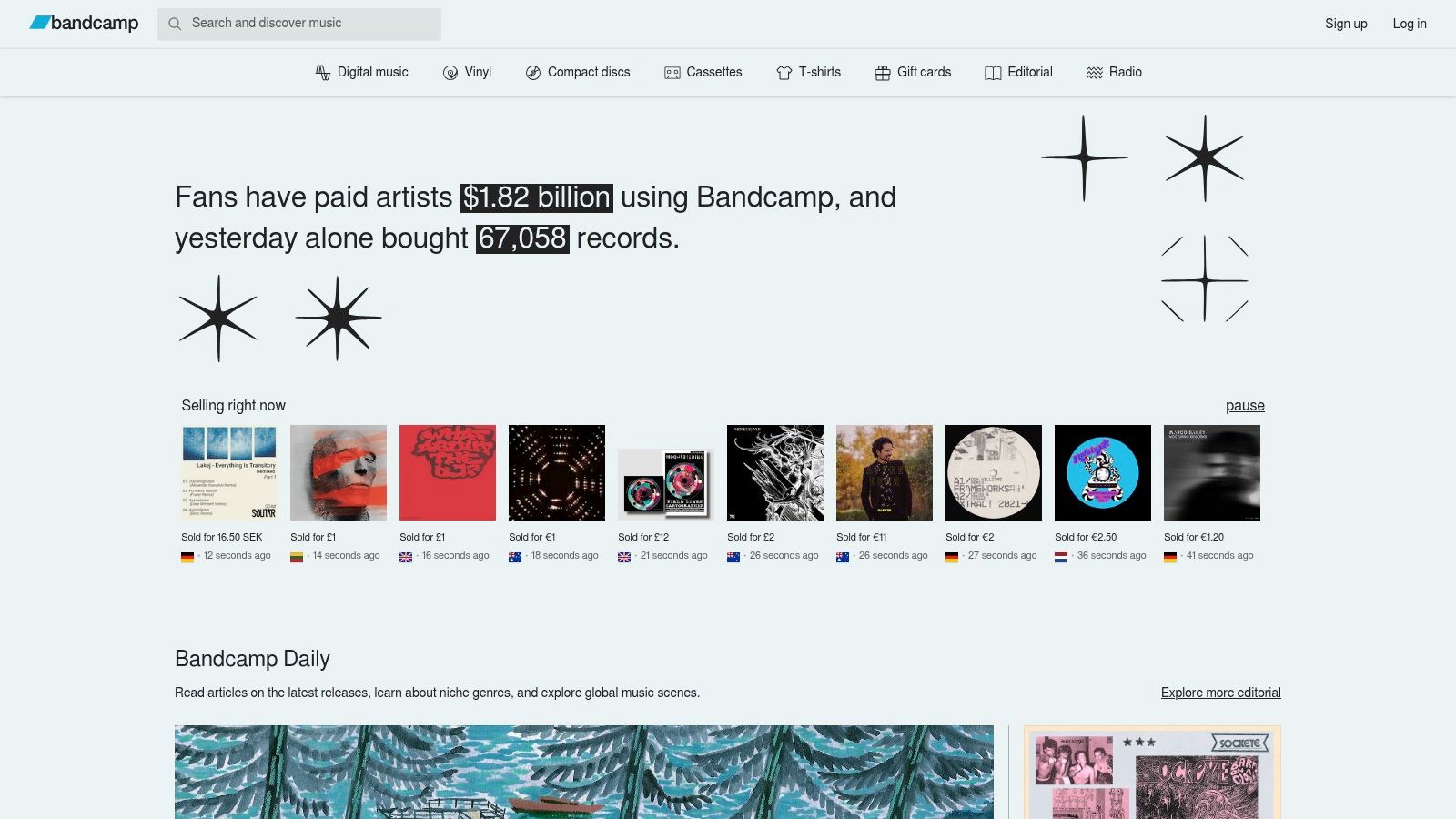
For a niche release, deliberate browsing beats passive exposure. A listener who searches a genre tag and lands on your page is already reading, which is the closest digital equivalent of someone standing in a record shop holding your sleeve.
Where it beats a feed
- Tags do the heavy lifting: genre, location, and mood tags are how listeners find you when they don't know your name yet.
- Purchases beat plays as a signal: someone who buys a record has made a decision, not a reflex.
- Label pages build context: a release sitting next to labelmates reads as a scene, not an isolated single.
The limits are real. Bandcamp isn't built as an unlimited on-demand streaming service, so listeners who want a continuous queue go elsewhere, and some music sits behind a purchase or a preview. Discoverability depends on how completely the artist fills in tags and profile detail. Weak tagging makes a good record invisible, and the browse model punishes laziness harder than an algorithm does.
Point your existing fans at a specific release page rather than a generic profile, and keep the tags honest. Bandcamp rewards the listener who is already looking.
3. Spotify
Spotify is the default, and that's both the advantage and the trap. Discover Weekly, Release Radar, Fresh Finds, daylist, and the personalized mixes put unfamiliar tracks in front of listeners who never searched for them. A record can travel without a single listener choosing it deliberately.
The playlist model isn't new. Spotify launched in Europe in 2008, and by 2019 it had reached 232 million monthly users and 108 million paying subscribers, more than a third of the streaming market at the time, as IFPI's account of the shift from ownership to access records. Editorial playlisting has been part of the product since its first year.
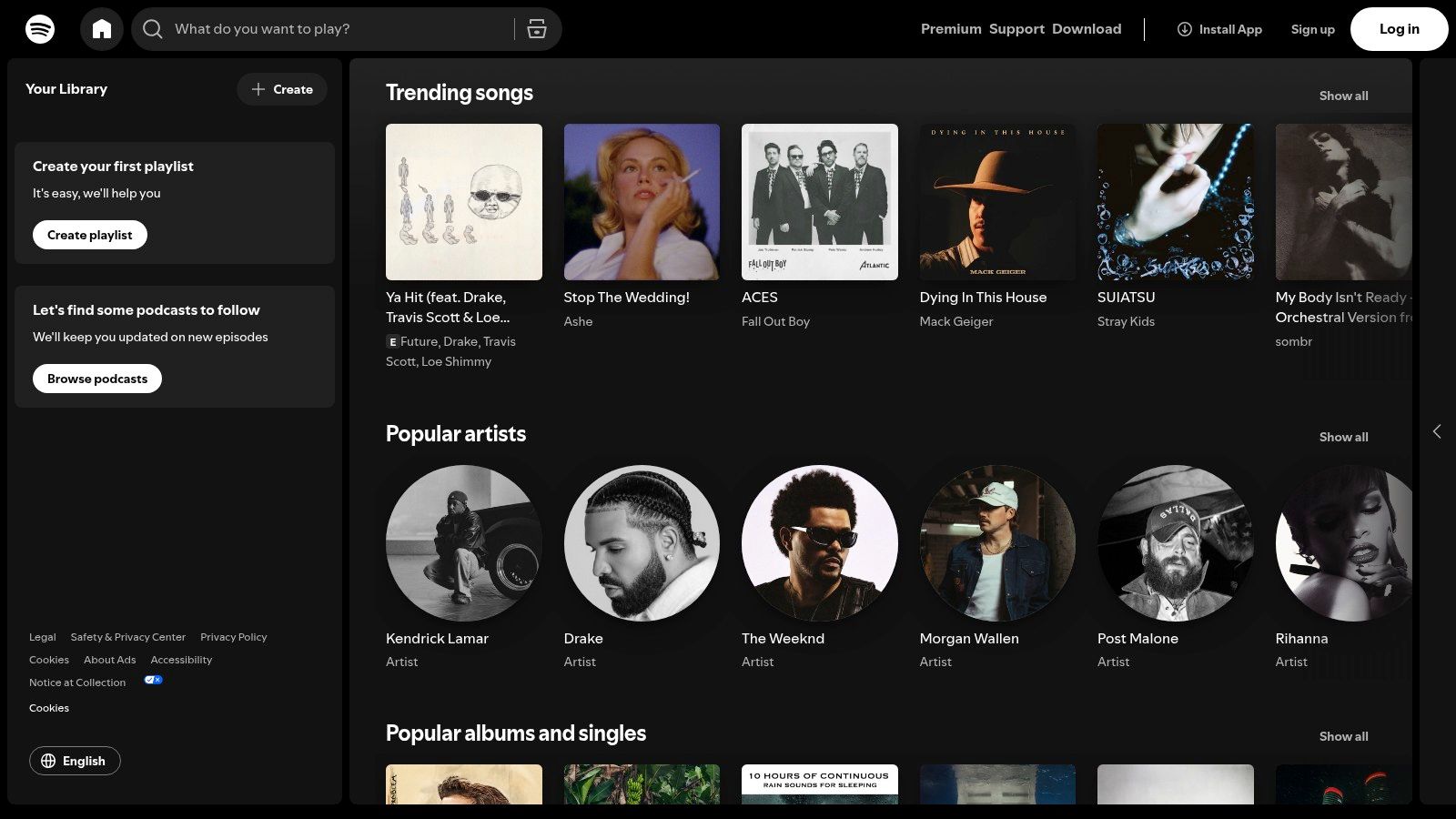
What you actually control
- Metadata and timing: clean credits and consistent genre tags decide which pools your release gets tested in.
- Save and skip behavior: early listeners who finish the track teach the system more than raw volume does.
The trade-offs are blunt. Recommendations cluster around taste the listener already has, so a track that sounds like nothing in their history rarely surfaces. Free listening carries ads and fewer playback controls. And there is no lever that guarantees editorial or algorithmic placement, which is why artists who treat Spotify as a lottery ticket burn out.
Where Spotify earns its place is breadth. It reaches listeners who aren't in your scene at all. For a comparison of scene-driven and catalog-driven discovery, SoundCloud and Spotify side by side is the useful read.
4. YouTube Music
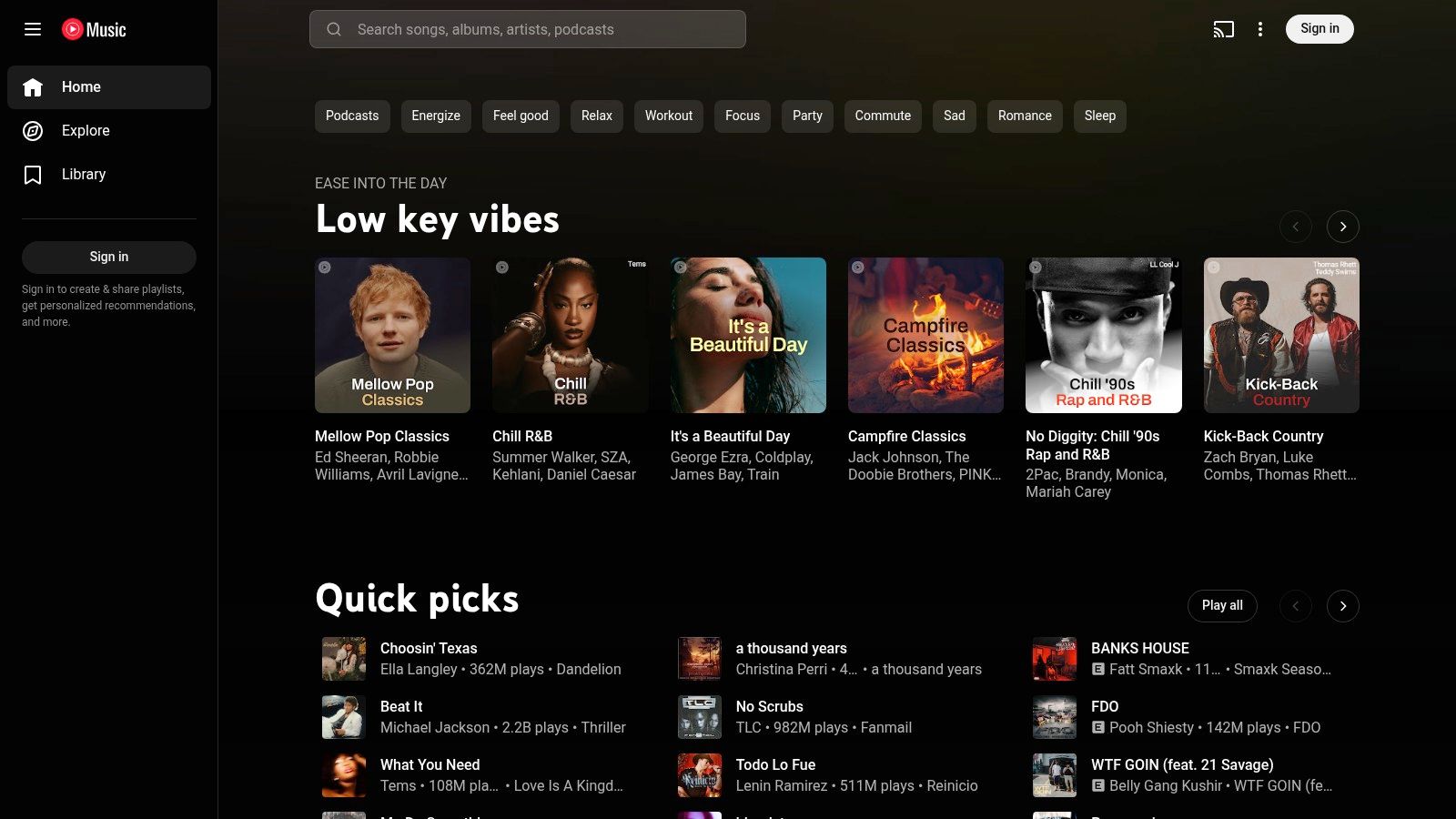
YouTube Music is the one service here where a live take, a cover, or a fan upload can outrank your mastered single. That isn't a bug to fix. It's a second catalog, and it's often the one a curious listener meets first.
The market context explains why it matters for discovery. Music streaming drew more than 800 million subscribers globally by the end of 2024 and represented 69% of recorded-music revenue, according to a study of digital-native listeners, which also identifies YouTube as a major discovery channel. People find music where they already watch things.
Where the video catalog earns its keep
- Versions that don't exist elsewhere: live sessions, remixes, DJ sets, and alternate mixes.
- Search as a discovery tool: listeners look up a song plus "slowed", "live", or a producer's name.
- Cross-service signals: recommendations can draw on listening activity across YouTube.
The weaknesses show up in the details. The line between official releases and user uploads is often unclear, which stings when a reupload captures traffic meant for your master. Free mobile listening has playback limits compared with Premium. And the feed mixes music with everything else on YouTube, so a listener can slide from your track into unrelated video within one session.
Keep the official audio, the visualizer, and any live version linked to each other so a listener who finds one lands on the others. YouTube Music deserves a deliberate upload plan rather than a distributor's automatic delivery.
5. Apple Music
Apple Music is the most editorial of the big streaming services, and that shapes how discovery works there. Discovery Station builds on a listener's taste profile, the New section and genre browsing are curated by people, and artist- or scene-focused radio programming sits somewhere between a playlist and a DJ set.
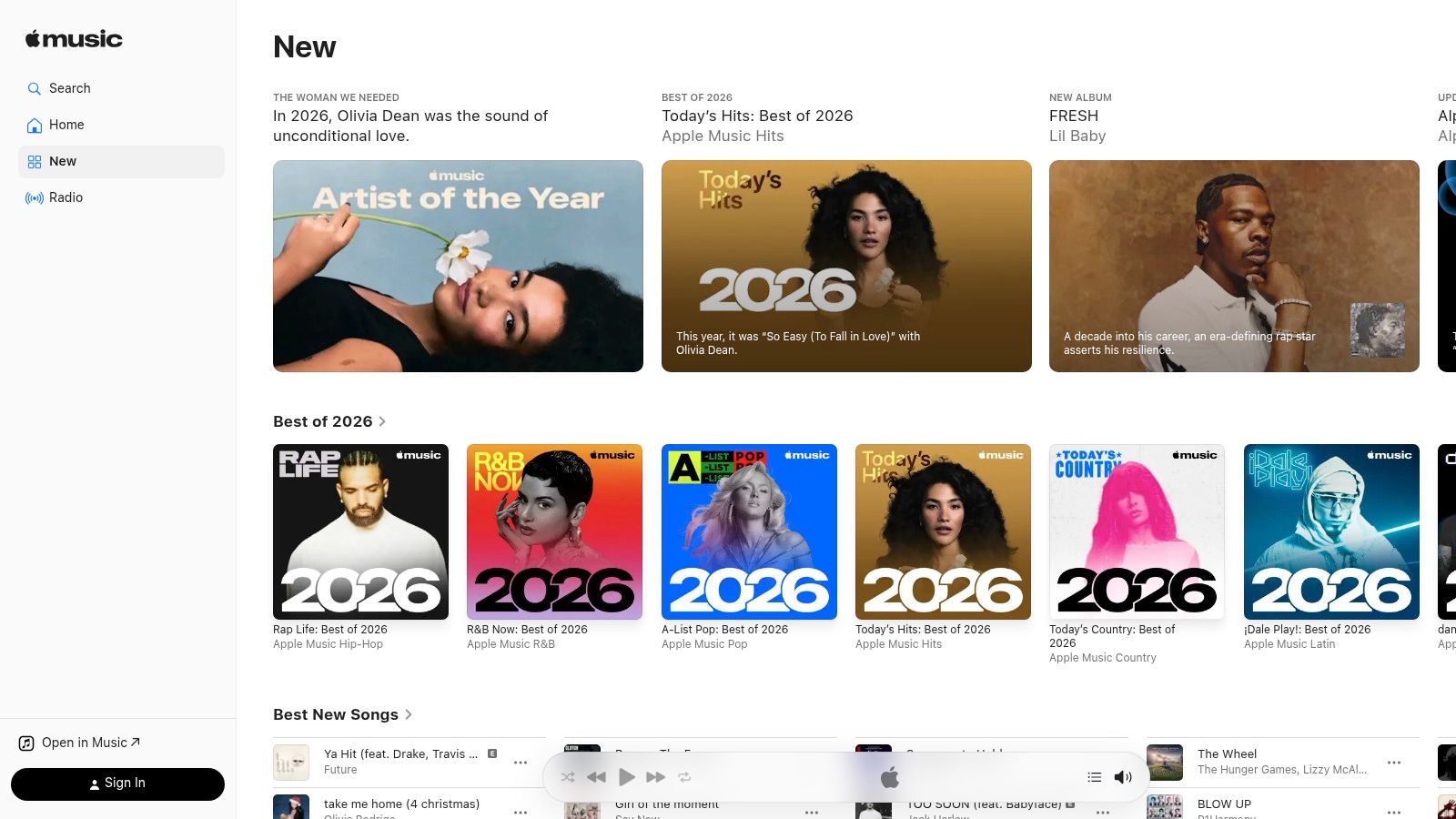
That structure helps an artist in two ways. Editorial placement still carries weight, and radio gives a track context that a shuffled queue can't. A listener who hears your record introduced by a host remembers the name in a way they don't remember a track that autoplayed.
Choosing between the surfaces
- Discovery Station: low effort and taste-led, good for repeat exposure to a listener who already matches you.
- Genre and New browsing: deliberate, better for a release with a clear category.
- Radio: the closest thing to old-fashioned airplay, with a host framing the track.
The friction is access. A subscription is required for the full catalog and the discovery features, so casual listeners can't wander in, and the experience is smoother on Apple hardware than off it even though the app runs across web, Android, Windows, and selected third-party devices. Recommendation quality still depends on how much history a listener has handed the service.
For a release with a strong single and a clean genre story, Apple Music is worth pitching through editorial channels. For an odd, uncategorizable record, expect the programmed surfaces to pass and the personal ones to do the work.
6. Audius
Audius removes the two things that stop a curious listener: a paywall and a subscription. Basic streaming is free for artists and listeners, search covers tracks, artists, albums, and playlists with filters, and listeners can like, collect, and share what they find. Artists may offer paid content, but basic use doesn't require payment.
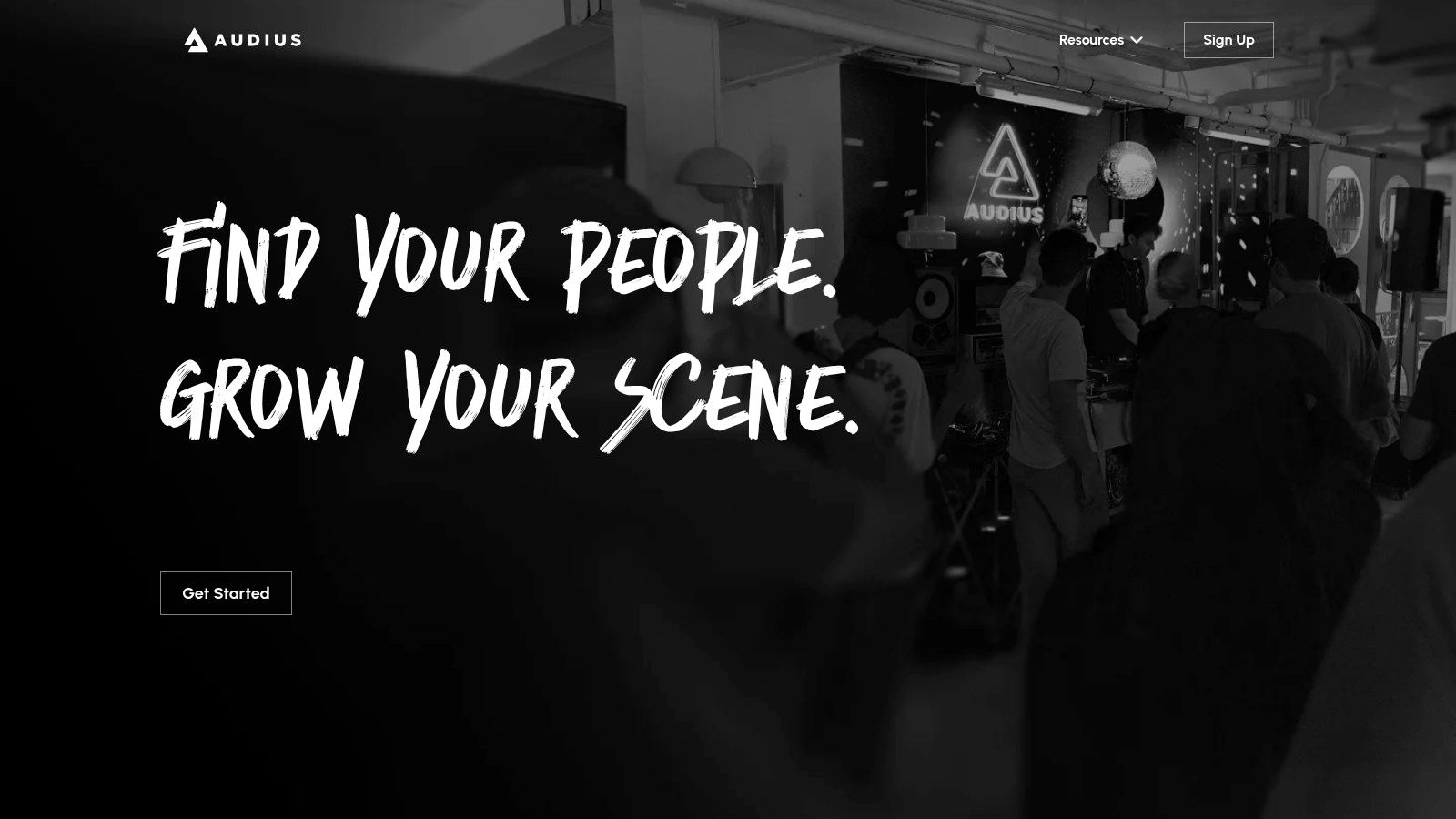
The pitch is community uploads and artist participation, which makes it a reasonable place to test a record that isn't widely distributed yet. It works as a leak detector for scenes. If a sound is building somewhere, uploads tend to appear here before they appear anywhere official.
The honest limits
- Catalog depth varies by genre: electronic and hip-hop uploads are far easier to find than quieter, more specialized work.
- Activity is uneven: some corners are busy, others go quiet for weeks, so a release can land in an empty room.
- It's often a second home: plenty of artists treat another service as the primary release channel, so the version here may lag.
Treat it as a sampling ground rather than a growth engine. Upload a track, watch whether it collects saves and shares from people you don't already know, and use that as evidence about the record itself. Audius costs nothing to try, which is exactly why the bar for staying should be real engagement rather than the fact that uploading was easy.
7. Deezer
Deezer's discovery surface is Flow, a personalized stream that keeps playing instead of asking the listener to choose. Flow Tuner then lets that listener adjust what Flow serves, which puts the feature somewhere between broadcast radio and a recommendation feed.
That control matters more than it sounds. A review of fairness and diversity in music recommenders finds that listeners value platforms for recognizing their taste and then criticize the same platforms for limited diversity and control, with popularity bias and demographic bias showing up as recurring failures that can favor established artists and particular nationalities.
What that means for a smaller artist
- A tuned stream can widen or narrow: the more input a listener gives, the less the feed defaults to the biggest names.
- Explicit goals beat implicit signals: a listener who asks for less mainstream music is reachable, while one who never adjusts anything stays in the same loop.
- Regional availability changes everything: plan details and catalog vary by country.
The weakness is deliberate browsing. If someone wants to read about a scene, compare labels, or dig through a release calendar, Flow won't help them, and a paid plan may be needed for the complete listening experience. Deezer rewards music that fits a mood and a tempo more than music that needs a story.
8. Last.fm
Last.fm is a companion, not a destination. It builds a profile from what you play, known as scrobbling, then uses that history to suggest artists and related music through artist and listener pages. Registration is free, and most of what makes it useful works on a basic account.
For an artist, the value is indirect. Last.fm shows how listeners move between artists, which is a cleaner picture of scene adjacency than a follower count on any single platform.
The cold-start problem it exposes
Collaborative recommendation depends on behavior: saves, skips, replays, shares, and overlapping listener activity. OnesToWatch's breakdown of recommendation engines describes the resulting cold-start disadvantage for artists who don't yet have enough interaction history for the system to act on. A strong track with no behavioral trail stays invisible, not because the song is weak but because there's nothing for the recommender to compare it against.
That's the same wall on every platform in this list, and it's the one worth planning around. Early listeners who finish the track, save it, and come back are the raw material. Bursts of attention that don't repeat teach the system nothing.
The practical limits are straightforward. Reliable tracking requires a connected service, app, or browser tool, and recommendations are only as good as the activity recorded. Last.fm is not a full streaming catalog, so use it to read the map rather than to build the audience.
9. Mixcloud
Mixcloud is built around the long form: DJ mixes, radio shows, podcasts, and the specialist presenters who stitch tracks together. Genre and show discovery, charts included, does the work that search does elsewhere.
That shape suits club and electronic scenes better than any playlist. A two-hour mix can introduce eight artists in context, with a selector explaining the thread. A listener who hears your track inside a set they already trust has a reason to look you up that a shuffled queue never gives them.
Where it fails as a growth tool
- No on-demand singles: listeners come for shows rather than for one track, so your catalog has to be findable somewhere else.
- Supply-dependent discovery: what you get out depends on which mixes and shows get uploaded.
- Region limits: some content is unavailable in some places.
The right use is placement, not broadcasting. Getting a track into a mix by a selector whose audience overlaps yours does more than uploading your own hour-long set with no distribution behind it. Free account access covers the basics, with paid features varying by plan, and Mixcloud is worth the time only if you have a scene to plug into.
10. Hype Machine
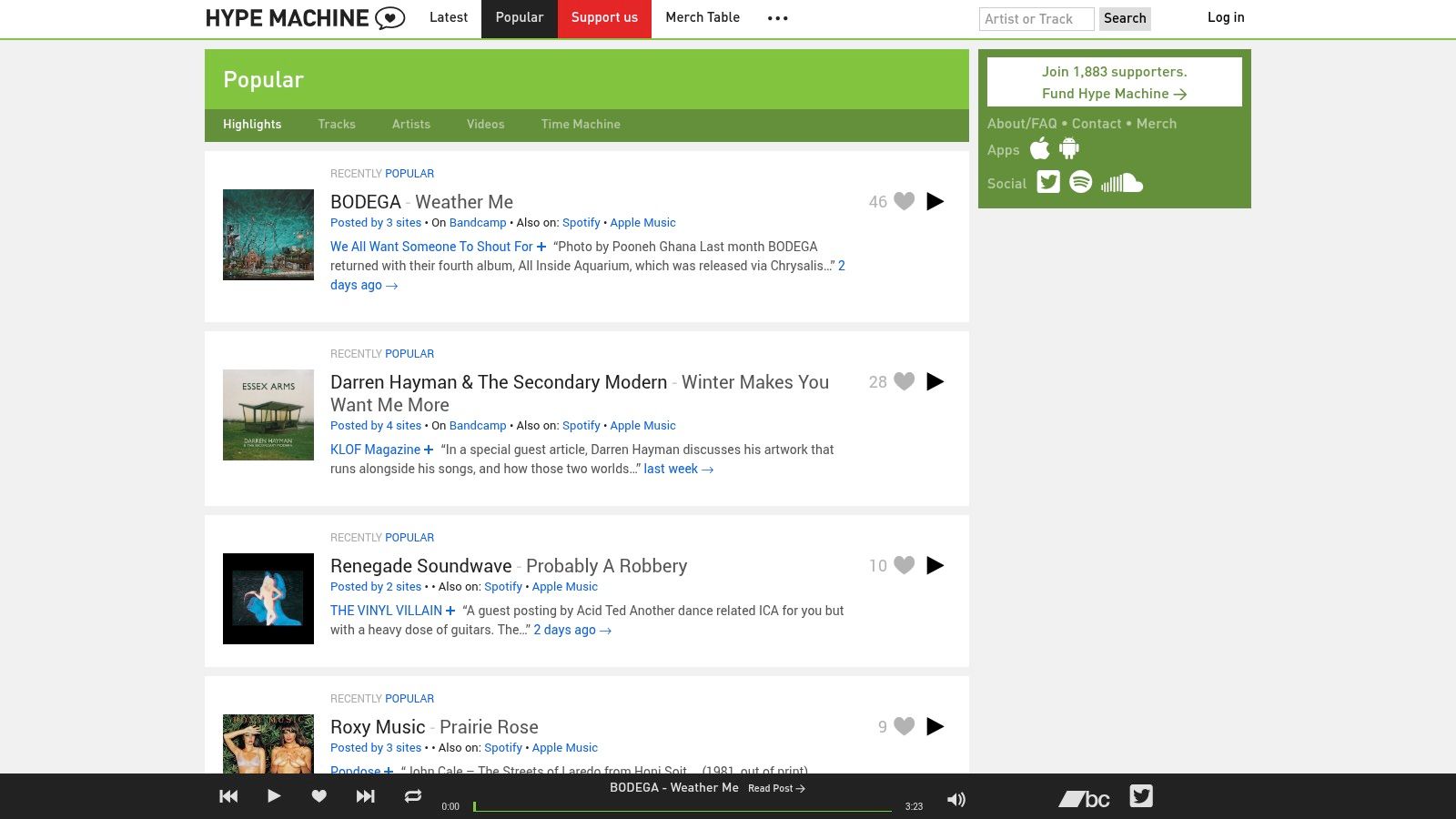
Hype Machine is the closest thing left to reading the blogs yourself. It aggregates music posts from hundreds of sites, ranks popular tracks by what listeners favorite, and highlights artists getting repeated attention. The curation is written by people, and that is the entire point of it.
Whether human curation beats a feed is testable, and someone tested it. An analysis covering 9,778 random premium subscribers, 4,136 newly discovered songs, and 1,952,195 discovery events found that human-curated playlists were generally more effective than algorithmic recommendations at suggesting satisfying, relevant content, while algorithms performed better at surfacing relevant unfamiliar music, including releases by foreign or low-popularity artists, according to this study of playlist and algorithm performance. Both are useful. They solve different problems.
Reading the signal without overreading it
- Coverage is context: a write-up tells a listener why the record exists, which a feed never does.
- Indexing limits everything: a scene the aggregator doesn't track won't appear no matter how good the record is.
- Attention isn't reach: a flattering post can sit beside almost no streams.
For release week, Hype Machine is a check on whether anyone is writing about you, not a channel you can switch on. Pitch the writers who already cover your corner, and pair it with the wider set of music promotion tools so one good post isn't the whole plan. Another route into adjacent audiences is to reach new fans through fellow bands, which mirrors what a blog recommendation does at a smaller scale. Hype Machine runs on listener support, which tells you something about how durable this model has been.
How the 10 Music Discovery Platforms Differ at a Glance
The split that matters is listener intent: recommendation engines push likely matches, while browsing tools reward a listener who goes looking. Use the Best For column to choose the job before judging catalog size.
| Item | Best For | Free Access | Discovery Style | Key Limitation |
|---|---|---|---|---|
| SoundCloud | Underground scenes and emerging artists | Listening is open; most artist promotional tools sit behind a paid plan | Uploads, charts, recommendations, and social discovery | Large upload volume can make relevance and quality inconsistent |
| Bandcamp | Independent releases and direct artist support | Previews available; some music requires purchase | Genre and location browsing, editorial picks, and artist pages | Not an unlimited on-demand streaming service |
| Spotify | Ongoing personalized music discovery | Ad-supported listening | Personalized playlists, editorial curation, and genre or mood browsing | Free listening has ads and fewer playback controls |
| YouTube Music | Finding live versions, covers, and remixes | Free access with mobile playback limitations | Recommendations, search, mixes, and music videos | Official releases and user uploads may be hard to distinguish |
| Apple Music | Editorial playlists, radio, and personalized discovery | Subscription required for the full experience | Taste-based recommendations, editorial curation, and radio | Full catalog and discovery require a subscription |
| Audius | Independent uploads and community-led music | Free basic access | Search, filters, and community interactions | Catalog breadth and activity vary by genre |
| Deezer | Low-effort personalized listening | Full experience may require a paid plan | Personalized Flow stream with recommendation controls | Plan availability varies by country |
| Last.fm | Tracking listening habits and finding related artists | Free account and basic features | Scrobbling-based recommendations and artist connections | Requires connected tools or services for reliable tracking |
| Mixcloud | DJ mixes, radio shows, and electronic music scenes | Free account access; paid features vary | Creator-led shows, genre browsing, and charts | Less suited to playing individual tracks on demand |
| Hype Machine | Music-blog coverage and emerging online interest | Listener-supported, so readers fund the site directly rather than through a streaming subscription | Aggregated music posts and listener-favorited tracks | Coverage depends on indexed music sites |
Building a Discovery Mix That Matches Your Release Plan
No single platform covers every stage of an artist's growth, so the useful question is which one does the job in front of you. Discovery is distributed rather than centralized. IFPI's 2023 Engaging with Music study, which surveyed more than 43,000 people across 26 major music markets, found audio streaming at 32% of total listening time against 31% for video streaming, with listeners using more than seven different methods on average.
That is the operating condition. A release plan built on one platform is a plan to stay invisible to most of your potential audience.
Assign each platform a job
- Release week: Spotify's Release Radar and the YouTube Music version catalog put the record in front of people who already opted in.
- Between releases: Mixcloud sets and Hype Machine coverage keep a name in circulation when there's nothing new to promote.
The test that matters: after the first week, count how many listeners came back without a prompt. Repeat behavior is the only signal that a platform put your track in front of the right person.
Platform similarity runs both ways. The same instinct that sends a listener hunting for artists who sound like the one they just heard is what makes a melody-based search tool work, and Drumloop AI's melody search guide covers that side of the problem. Build the mix, assign the jobs, and judge each platform by who comes back.