
Fake Followers Explained: How to Spot and Remove Them
A 2017 study of millions of active English-speaking Twitter users estimated that 9% to 15% were likely bots, compared with Twitter's public estimate of fewer than 5% of accounts being spam or false, according to academic research on fake social-media accounts. The gap points to a useful starting idea: a follower total isn't the same thing as an audience.
Table of Contents
- What Counts as a Fake Follower
- Signs That Point to Fake Followers
- How to Screen Follower Clusters Step by Step
- How Fake Followers Distort Reach and Engagement
- What SoundCloud's Rules Prohibit
- Measuring Real Listener Quality Over Time
- How to Report and Clean Up Suspicious Followers
- Build a Real Listener Base Before Your Next Release
What Counts as a Fake Follower
The term fake follower can describe several different situations, so no single profile clue or test settles the question. A person can be real and still have no interest in your music. An account can look active and still contribute no plays, comments, or lasting connection. For an artist, the useful distinction is between a visible count and people who show meaningful interest in the sound.
| Follower type | Who it is | What it adds |
|---|---|---|
| Genuine listener | Plays, comments, and repeat visits | |
| Dormant account | A real or old profile that its owner no longer uses | A count with little or no activity |
| Mass-created account | A profile made in bulk, often with similar names or details, rather than maintained by an interested listener | A count with no listening |
| Purchased or sold account | A profile acquired for a fee, with no genuine interest in the music | A count with no engagement |
| Incentivized follower | A short-term count with uncertain interest |
The categories overlap in their effects. A dormant account might belong to a real person who once liked your music, while an incentivized follower might listen later and become a genuine fan. A real account can also be a poor listener: the person controls the profile, checks in now and then, and never presses play on your tracks. That is the season-ticket holder who never attends. The seat is taken, but the room stays quiet. The label alone does not tell you what an account contributes. Look at whether the person returns to your tracks, responds to specific music, or connects with the scene around your sound.
The image below illustrates why follower counts need more context than a single number.
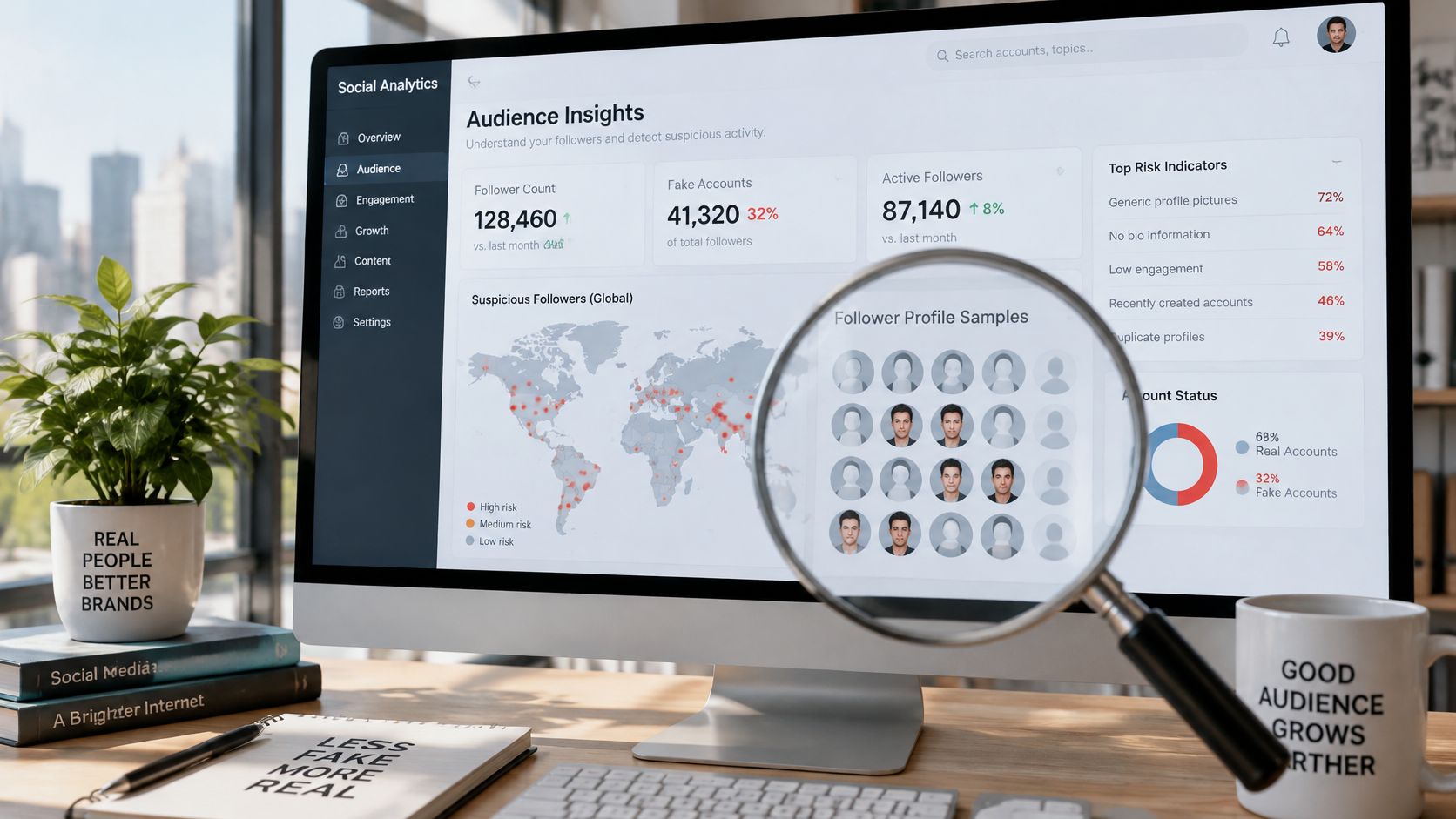
Definitions change the figures people report. Platforms and researchers use different methods and definitions when they count spam or fake accounts, so published figures are not directly comparable.
For an artist, the practical conclusion is that a follower total does not automatically measure audience size. Assess relevance and behavior alongside the count. Three questions sit behind that assessment: Is the account real? Is it connected to music like yours? Does it listen? Those questions separate, and a clean answer to the first does not guarantee a useful answer to the other two.
Signs That Point to Fake Followers
A thin profile isn't proof that an account is fake. Some real listeners prefer not to post, and a quiet account might still return for every release. Treat profile clues as a comparison: one detail may be ordinary, while several weak clues appearing together are more worth reviewing.
| Signal | Healthy pattern | Suspicious pattern |
|---|---|---|
| Account age | Accounts spread across several years | A large share created in the same few weeks |
| Profile completeness | Photo, bio, and public tracks | Blank bio, default image, and no uploads |
| Activity history | Posts, likes, and plays over time | |
| Engagement on your tracks | Plays and comments that fit your audience size | |
| Growth shape | Gradual rise connected to releases | Sudden spike with no release or promotion behind it |
If you're trying to determine whether a profile image has been reused, a reverse image search can help you check whether the same picture appears elsewhere online. Treat the result as one clue, not a verdict. A shared image may have an innocent explanation, and an original-looking image doesn't establish that someone is a listener.
Practical rule: Add an account to a review list when several weak signals appear together. Don't block someone based on one profile detail.
How to Screen Follower Clusters Step by Step
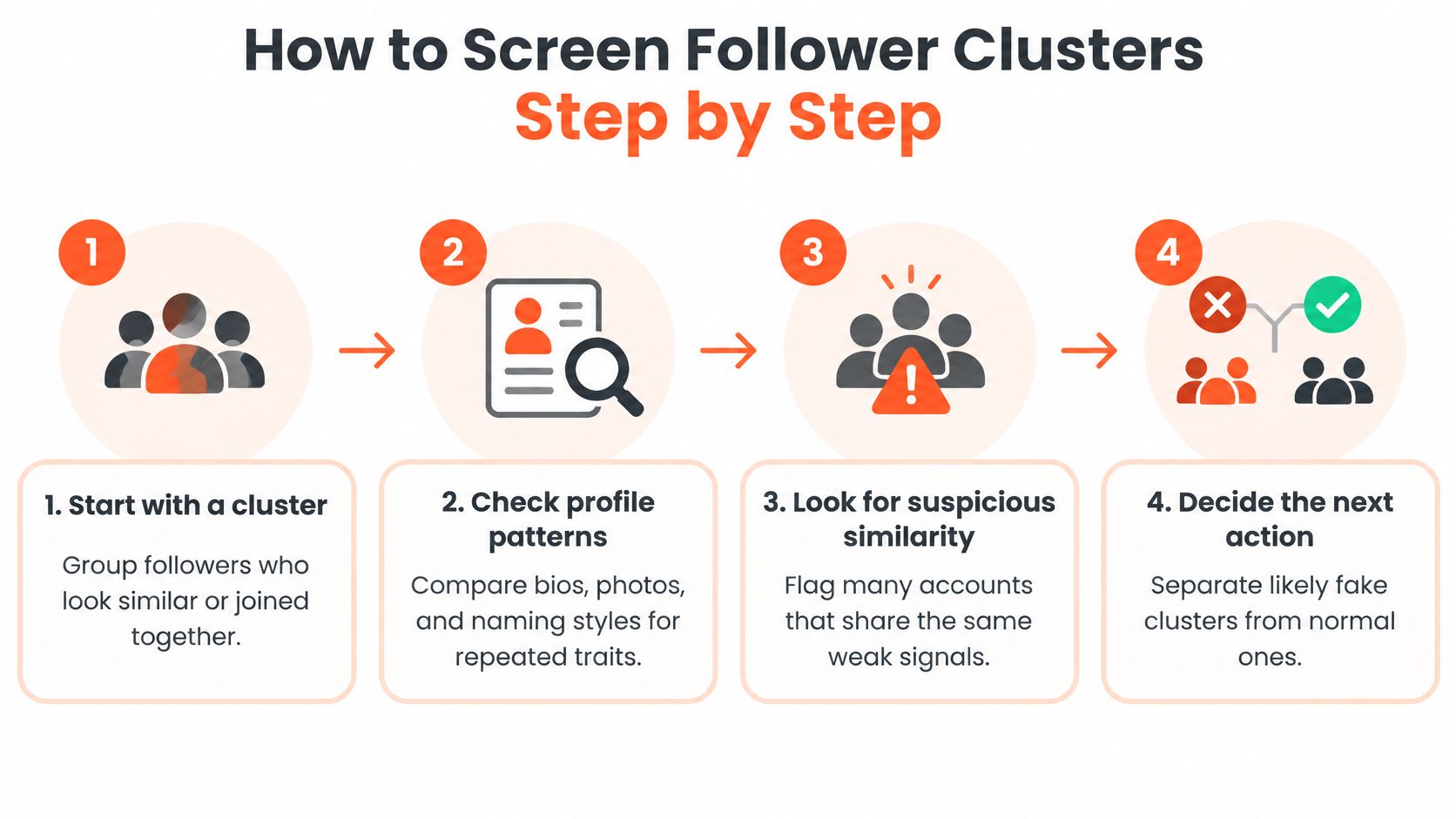
A single account can look unusual for an ordinary reason. Similarities across a group are more informative, especially when many accounts appear together and show overlapping interests or activity. The aim is to find clusters that deserve a human review, not to label every account in a cluster as fake.
Start with the follower list you can access. Record the accounts you're assessing and note join dates where the platform shows them. This gives you a consistent set to compare instead of relying on memory.
Group followers by the week or month they joined. Use the same time window across your list. Groups make it easier to notice a concentration of new accounts that would be harder to spot one profile at a time.
Flag periods with unusually large groups. Compare those periods with your release and promotion calendar. A release can explain a jump; a surge without a clear connection is a reason to investigate further, not a conclusion by itself.
Compare the accounts' shared interests. Check whether many members engage with the same small set of artists or track names. Shared tastes can be normal in a music scene, so note whether the overlap looks relevant to your genre.
Look for similar timing in their visible activity. If multiple profiles appear and act within the same narrow window, record that as a cluster signal. Timing alone can't tell you why it happened, but it can help prioritize a review.
Rank clusters by size and overlap. Give more attention to groups that are both sizable and similar in several ways. Don't judge individuals solely because they belong to a group you've flagged.
Review the highest-priority clusters by hand. Look at profile details, listening history, and comments for evidence of genuine interest. Then decide whether to keep the accounts, report clear spam, or set the cluster aside without action.
The infographic summarizes a practical way to review groups of suspicious followers.
How Fake Followers Distort Reach and Engagement
Artist A has 10,000 followers and averages 40 plays per track in its first week. Artist B has 2,000 followers and averages 800 plays in the same period. In this hypothetical comparison, B has a much smaller count but a stronger listening response. The figures illustrate how to think about audience quality, not a benchmark every artist should expect.
An inflated number can make it harder to read the signals that matter:
- Engagement can look weaker than it is. If many followers don't listen, interact, or return, your audience count may make a release appear less compelling than the response from actual listeners.
- Claims can lose credibility. Promoters, labels, or playlist curators may question your audience if the follower count doesn't match track activity or meaningful responses.
- You can lose sight of the listeners who matter. A large count can distract you from the people who return, comment about particular tracks, or help your music reach others.
The U.S. Federal Trade Commission's Consumer Review Rule addresses the commercial use of fake influence indicators, not just the existence of a suspicious count. It prohibits buying or selling fake indicators, including followers or views generated by bots or hijacked accounts, when the buyer knew or should have known they were fake and they misrepresented commercial influence or importance. The FTC's warning materials state that violations may lead to federal litigation and civil penalties of up to $53,088 per violation.
For an artist considering a paid partnership, the distinction matters: a high count alone isn't the complete legal test, but knowingly using fake indicators to misrepresent commercial influence can create real exposure. Share audience figures you can explain, and pair them with evidence of actual listener response.
What SoundCloud's Rules Prohibit
A follower can be a real person while the method used to increase an artist's numbers still misrepresents popularity or activity. The relevant question isn't only who the followers are. It's also how the account's activity was generated and whether the method is permitted.
SoundCloud's Terms of Use, updated in September 2025, prohibit services or techniques intended to misrepresent popularity or activity, including adding followers and repetitive actions carried out on a user's behalf. The terms apply to actions taken through services and other means, and violations can lead to account termination or other action. The SoundCloud Terms of Use also identify prohibited ways of registering accounts, playing content, messaging, commenting, and acting on a user's behalf.
This is why an inflated follower count and misrepresented activity aren't quite the same issue. The count tells you what appears on a profile; the rules also address the activity used to create an impression of popularity. If you're assessing a growth method, ask whether you could explain exactly how each new follower arrived to a platform reviewer or promoter without hesitation. For a wider perspective on account growth approaches, read about a SoundCloud account growth strategy.
Measuring Real Listener Quality Over Time
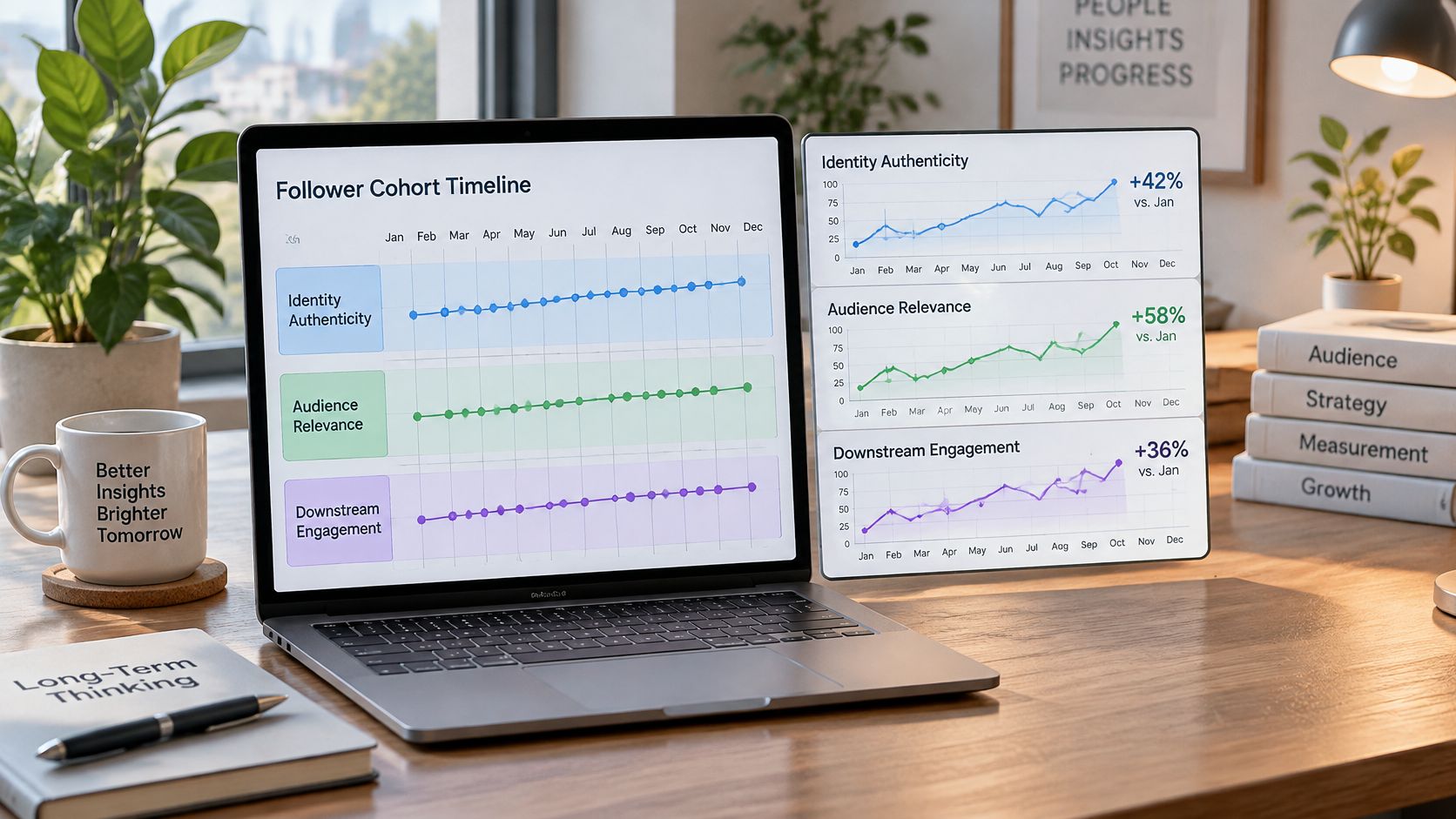
Follower quality has three dimensions: identity authenticity, audience relevance, and downstream engagement. These answer different questions. Is this likely a real account? Does this person fit your music and scene? Do they listen or respond over time? A genuine account can still be a poor listener if the music isn't relevant to them or they never return.
Instead of trying to assign a single authenticity score, group new followers by the month they joined and observe each cohort over 7-, 30-, and 90-day windows. A 2025 review of account-detection approaches describes profile, network, behavior, and content signals, while noting the limits of using those signals separately. That supports a more useful approach for artists: track whether a group connects with your music, not just whether it looks legitimate.
| Metric | Check at | Healthy sign |
|---|---|---|
| Repeat plays from new followers | 7 days | Listeners return to a second track |
| Comments and reposts | 7 and 30 days | Comments mention specific tracks |
| Playlist additions | 30 days | Curators in your genre add your music |
| Follower retention | 30 days | |
| Scene or location match | 30 and 90 days | Listeners come from your scene and target cities |
| Engagement on later releases | 90 days | Earlier cohorts still listen to new tracks |
A quiet listener who returns for each release can be more valuable than a highly active account with no connection to your sound. Likewise, an account can be genuine but never play your music. Keep identity, fit, and listening separate when you interpret the numbers. For more ways to think about SoundCloud engagement, focus on actions that show an actual connection to a track, not just a profile visit or a visible count.
The simplest dashboard can be a spreadsheet with one row per cohort and one column for each metric. Review it once a month, compare groups over time, and note which releases or activities brought in listeners who stayed.
How to Report and Clean Up Suspicious Followers
Report accounts when you see clear spam or fake signals, not because a listener is quiet. A real person may have a sparse profile or rarely comment, and neither trait alone means they're harming your audience.
- Open the suspicious account's profile. Check that you've selected the account you intend to report before taking action.
- Choose the Report button. SoundCloud says you can report from the account's profile page, notifications, or messages.
- Report spam comments as you delete them. If an account left spam on one of your tracks, report it while removing the comment.
- Understand what the report does. SoundCloud says reporting blocks the account from interacting with you and removes its previous comments, likes, or reposts from your content.
- Record the report and check your audience later. Log the account name and date, then review the relevant cohort in your dashboard after 30 days.
These reporting options and their effects are described in SoundCloud's guide to reporting a spam account. A report affects that account's ability to interact with you, so reserve it for clear cases. Don't use reporting as a way to clear out inactive fans. If someone appears to be a real listener but doesn't post often, leave the account alone unless other evidence points to spam.
Build a Real Listener Base Before Your Next Release
A larger follower count will not help your release if most accounts are real but indifferent, or relevant but never pressing play. Treat your listener base as three filters: a real account, a fit with your sound, and evidence of listening. A real profile can still be a poor listener, and that distinction matters more before a release than a sudden spike in numbers.
Before release week, make the base concrete:
- Name your target artists. Choose accounts whose listeners already support the sound you make, not the biggest names in your genre.
- Review a small set daily. A focused batch is easier to judge for relevance than a long list.
- Check listening signals. Look for repeat plays, saves, and comments that suggest a person returns to music like yours.
- Keep the pace controlled. Steady daily activity is easier to sustain than a burst before a release.
- Set a review date. Pick two measures, such as repeat plays and follower retention, and check them 30 days after the release.
If you also sell merchandise, a separate guide to ethical social media growth for Shopify covers that storefront context. For a closer look at turning profile visits into repeat listeners, see this guide to organic follower growth.