
SoundCloud Artist Guide

Your master is finished, the artwork is ready, and you're about to announce the release. Then you open a playlist submission form and realize you still need a delivery date, accurate genre tags, rights documentation, and something more useful than a paragraph calling the track your best work yet.
Playlist pitching is a release-management job before it's a writing job. A strong pitch gives an editor or curator enough accurate information to judge fit quickly. A successful placement then needs a separate test: did those listeners save the track, return, or become part of your audience?
Table of Contents
- Work Backward from Your Release Date
- Check Eligibility Before You Pitch
- Spot and Avoid Pay-for-Placement Offers
- Research Curators and SoundCloud Playlists
- How to Write a Pitch Editors Can Use
- Email and DM Templates for Curator Outreach
- Confirm Your Pitch Plan Before Release Day
Work Backward from Your Release Date
Release timing milestones for a playlist pitch
| When | Action | Why it matters |
|---|---|---|
| 30 to 45 days before release | Schedule the release in your distributor | SoundCloud recommends this window for review and editorial consideration |
| At least 4 weeks before go-live | Set a future go-live date with complete metadata | Allows delivery processing and review |
| 7 days before release (minimum) | Submit the unreleased track in Spotify for Artists | The unreleased-track editorial route closes once a song is out |
| Up to 5 business days | SoundCloud review period | Leaves room for rights or documentation questions |
| Release day | Track goes live and the pitch ledger starts | Starts the measurement window |
SoundCloud's distribution guide recommends scheduling 30 to 45 days ahead, with at least four weeks when targeting a specific go-live date. Use the longer planning window when the release involves collaborators, samples, or metadata you haven't finalized.
The review period isn't the entire delivery process. Your distributor must approve the submission, platforms must process it, and you need access to the upcoming recording before you can complete an editorial pitch. Leaving no room between those steps makes a minor correction expensive.
Set the delivery date before the announcement
Prepare the track title, main artist, composer, content rating, audio language, songwriter information, and ISRC before submitting the release. Check spelling against your existing artist profiles, especially when collaborators have similar names.
For Spotify, its playlist editors' guidance recommends pitching at least seven days before release, which also makes the submitted track eligible for Release Radar. Treat that as a submission floor, not the day to begin distributor delivery.
Say you're planning a single for a Friday in mid-March. In that hypothetical schedule, set up distributor delivery in early February and aim to file the Spotify pitch during the final week of February, provided the recording has appeared in your account. You've then left room to correct a credit or investigate a missing delivery.
Calendar rule: If your delivery, review, and pitching tasks don't fit before release, move the release date rather than compressing every task into the final days.
Keep the announcement, artwork approvals, and listening links on the same music release strategy calendar. Open the pitch ledger during preparation, then begin logging listening results when the track goes live.
Check Eligibility Before You Pitch
A track can be ready to submit while the artist profile is not. Check that you can access the correct Spotify artist profile before scheduling an editorial pitch. A first release may be needed to establish that profile, so don't assume you can pitch before it is available.
| Channel | Requirement | Limit |
|---|---|---|
| Spotify editorial pitching | Active, accessible Spotify artist profile | A first release may be needed to establish the profile |
| SoundCloud monetization | Original content you own all rights to; covers, remixes, mashups, DJ sets and podcasts are excluded | Longer than 30 seconds and shorter than 10 minutes |
| SoundCloud Amplify | Artist Pro subscription, opt-in and a public track | Under 10 minutes; initial test to about 100 matched listeners, with possible expansion to up to 1,000 more |
| Distributed release metadata | Title, main artist, composer, content rating, audio language, songwriter information and ISRC | Release date must be in the future |
These are separate workflows, with different eligibility rules. SoundCloud's partner-profile guidance covers managing artist profiles on partner platforms; it does not set a second-release threshold for Spotify pitching.
Check the paperwork behind the audio
A finished master does not establish permission to distribute every recording or composition it contains. Keep sample licenses and collaborator approvals with the release files, ready if a reviewer asks for them.
SoundCloud monetization has its own rules. Eligible original content must be longer than 30 seconds and shorter than 10 minutes, and review generally takes up to five business days, according to SoundCloud's monetization guidance. Those exclusions apply to monetization eligibility, not to every playlist curator's submission criteria.
Amplify is a separate SoundCloud route. Its guidance describes an initial audience of approximately 100 matched listeners, possible expansion to 1,000 additional listeners, and a limit of 30 track submissions per day. Engagement can make a track eligible for Buzzing, but expanded distribution and playlist inclusion are not guaranteed.
Before submitting, check:
- Profile: You can access the correct artist profile.
- Rights: Sample permissions and ownership documentation are ready.
- Recording: The track meets the length rules for the channel.
- Delivery: Credits, ISRC and future release date match across your files.
Eligibility and audience size are separate questions. According to Spotify for Artists, 74% of artists added to a Spotify editorial playlist in 2024 had fewer than 100,000 monthly listeners. A modest audience does not rule out a pitch.
Spot and Avoid Pay-for-Placement Offers
A guaranteed playlist slot sold for money isn't an editorial submission. The attraction is obvious: you exchange an uncertain review for an apparently certain result. What you can't verify is whether that result comes from interested listeners.
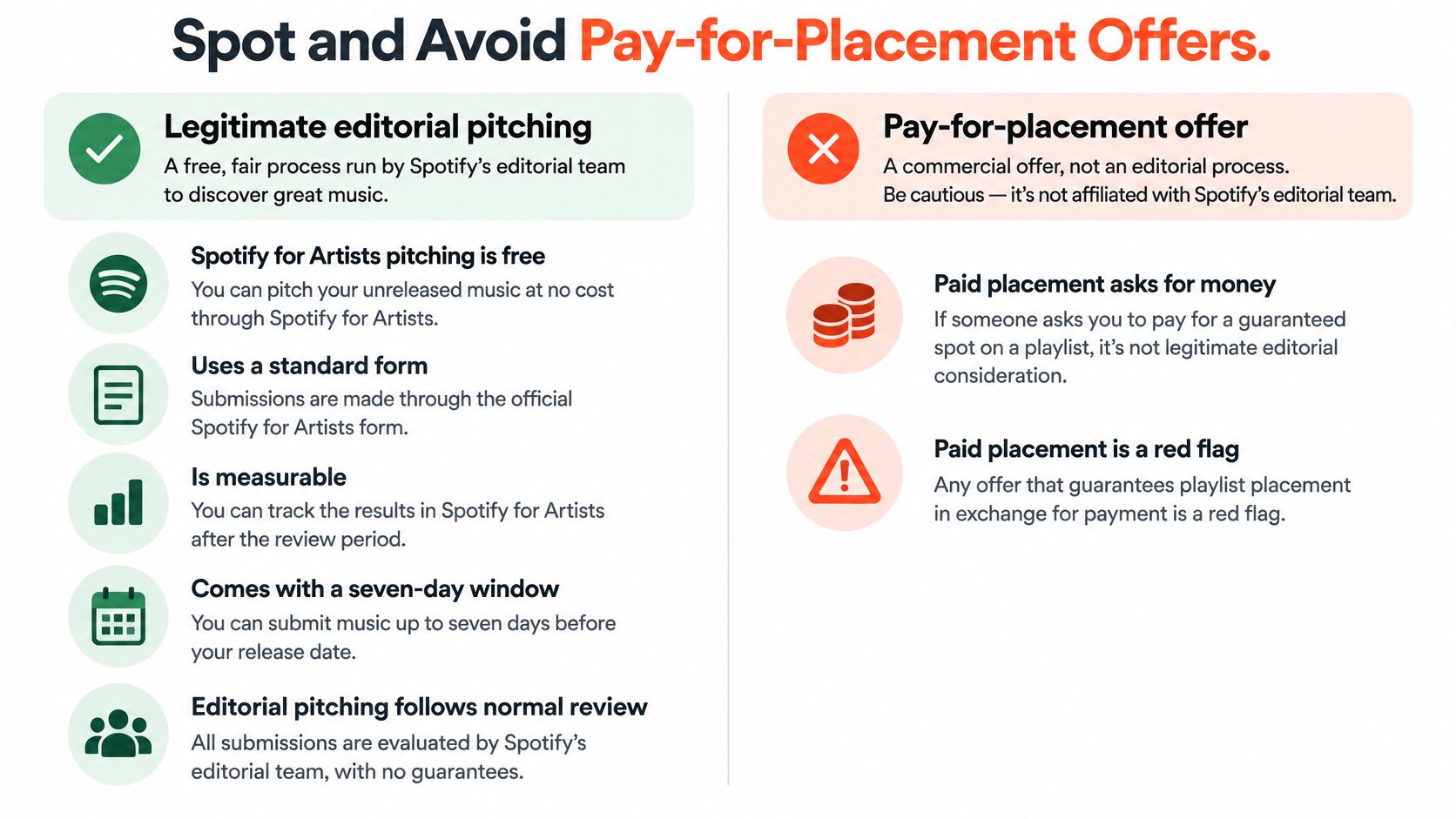
Compare the offer, not the sales pitch
- Pay-for-placement offer: The seller asks for money in exchange for inclusion. Certainty is the selling point, but payment doesn't establish audience quality or legitimacy.
- Immediate refusal: Decline requests for your account password, guaranteed official placement, or an explanation that relies entirely on screenshots of stream totals.
Spotify states that artists can't pay for official playlist placement. Artificial listening can expose a release to removals or account penalties, and it also makes your campaign records less useful: you can't judge genuine audience fit from manipulated activity.
Say a curator requests a fee for a playlist with few followers, no clear submission history, and no explanation of its audience. The small follower count alone isn't the problem. The combination of payment for inclusion and no credible account of listener fit is enough to refuse.
Paying someone to research audiences or organize outreach is different from buying a promised playlist slot.
Evaluate any music promotion service by its actual work and reporting. Be cautious about playlists with no credible listener history, and investigate sudden traffic from unfamiliar regions rather than treating every increase as a win.
Research Curators and SoundCloud Playlists
Build a shortlist that matches the recording you're releasing, not the audience size you wish you had. A restrained house track belongs beside similarly paced, similarly produced music, even if the larger playlist has a more tempting follower count.
Open each playlist and listen to its recent additions. Record the last update, follower count, and whether the newly added tracks share your genre, energy, vocal style, and production approach. Follower count helps describe the playlist, but it doesn't prove that anyone will listen to your addition.
Keep only targets you can justify
- Current activity: Favor curators who still update their playlists. An abandoned playlist is a weak outreach priority.
- Audible fit: Check transitions between tracks. Your song shouldn't require a dramatic change in mood or listening context.
- Submission access: Find contact details through the curator's profile bio, linked website, or official submission form.
- A specific reason: Write a short explanation of fit before drafting the message. If you can't, remove the target.
For SoundCloud, compare tracks of similar length and production as well as genre. A DJ-focused extended mix and a concise vocal single may share influences while serving different listening sessions.
Notice artists appearing on Buzzing and inspect the surrounding scene, but don't mistake that visibility for a curator contact route. Audience-response distribution and independent playlist submissions require different actions.
Keep a target tab in your ledger with the playlist name, platform, genre, last-updated date, submission channel, and fit explanation. Read the stated submission rules before writing anything. A manageable list you can personalize is more useful than a directory of loosely related playlists.
How to Write a Pitch Editors Can Use
Treat the pitch as structured metadata first and a paragraph second. Editors need to understand what they're hearing, where it belongs, and which parts of your release story are relevant.
Spotify's pitching instructions allow up to three genres and recommend submitting an unreleased recording at least seven days before release. Submit earlier when delivery has been unpredictable.
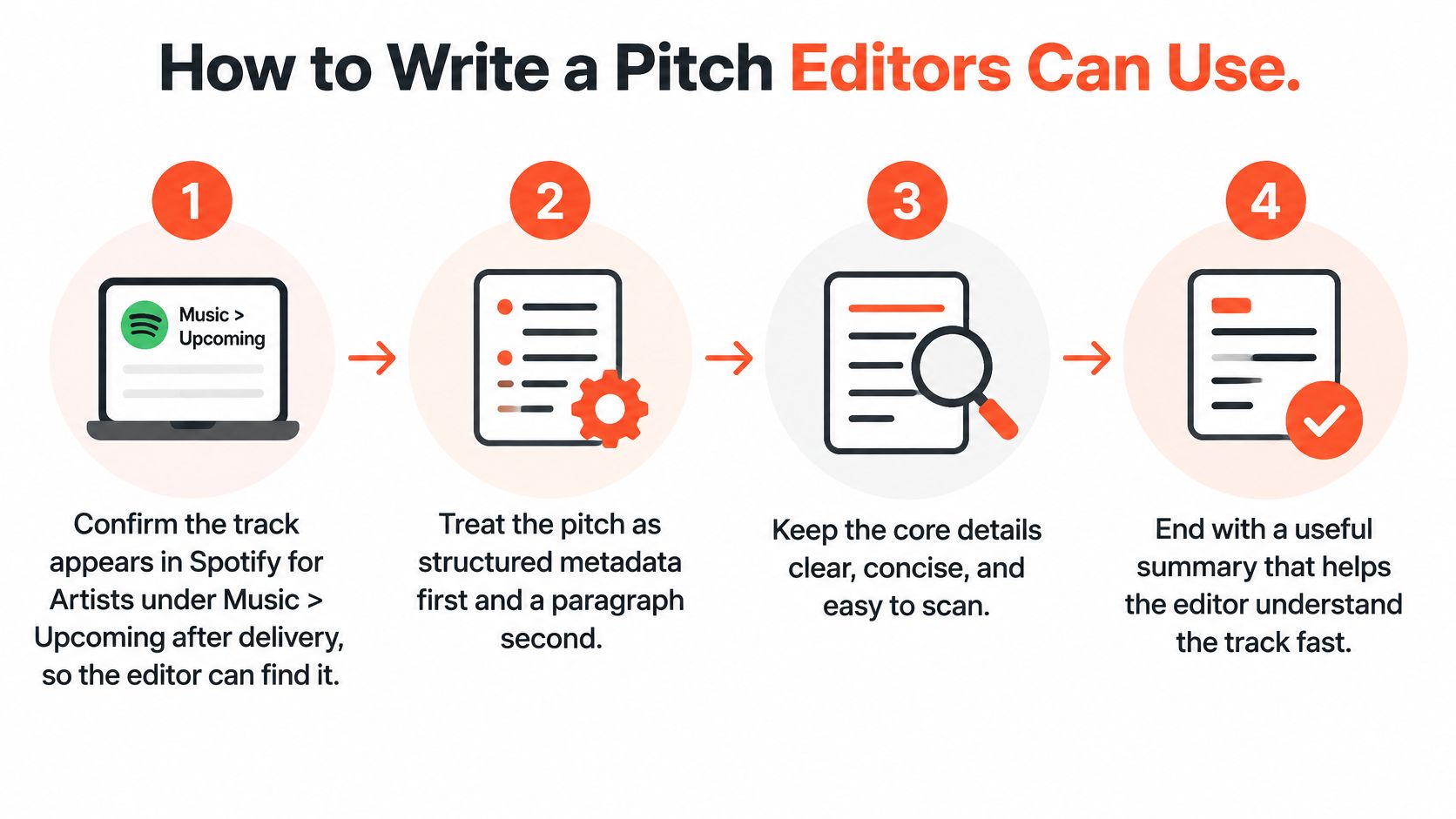
Build the factual version first
Confirm delivery. Look under Music > Upcoming in Spotify for Artists. If the recording isn't there, investigate delivery rather than polishing text you can't submit.
Choose defensible genres. Select only labels you can hear in the recording. Calling a drill track acoustic pop won't make it relevant to more editors.
Name the mood and listening situation. Late-night driving or a warm-up set gives more direction than a claim that the song suits everyone. Match that description to the arrangement, not just the lyrics.
Check instruments, collaborators, and recording status. Identify the sounds and people that define the track, and disclose whether the recording is a cover. Separately verify that your artwork description matches the uploaded image.
Explain cultural context and location. Name the place or scene when it informs the music. Don't turn a vague influence into a claim of belonging.
Add regional fit where supported. Editors can see pitches globally. Include meaningful audience geography, not a wish list of markets.
Describe confirmed promotion. Summarize dated video, show, press, or social plans. Distinguish booked activity from something you hope will happen.
Compare the text with the audio. Remove unsupported claims, contradictory tags, and exaggerated momentum. The final paragraph should agree with every structured field.
Pitch metadata fields and checks
| Field | What to enter | Check before sending |
|---|---|---|
| Genre (up to three) | Only genres the track actually sounds like | Would a listener of each genre recognize the track? |
| Primary mood | A mood that matches the audio | Does it hold across the opening and drop? |
| Listening situation | A concrete scene, such as late-night driving | Can you hear that scene in the opening? |
| Instruments and collaborators | Instruments and featured artists on the recording | Matches distributor credits |
| Cover art | Whether the art is original | Matches the uploaded file |
| Cultural context and location | The place and scene the music comes from | Stated only where true |
| Regional fit | Markets beyond home where an audience exists | Supported by listener evidence |
| Release promotion | Dated videos, shows, press, or posts | Dates are confirmed and still upcoming |
Turn the evidence into readable copy
For a hypothetical bedroom-produced house track:
Bedroom-produced house built around swung drums, rounded bass, and a featured vocalist's restrained hook. The arrangement suits late-night listening rather than peak-time sets. A performance video is confirmed for release day.
That's useful without inventing momentum. If you adapt it for email outreach, MailGenius's guide to email subject line capitalization can help keep the subject readable rather than shouty. Formatting supports the facts; it doesn't replace them.
Email and DM Templates for Curator Outreach
A curator email should make fit and the next action obvious. Don't ask the recipient to read your full biography before they can hear the track.
Subject: Playlist consideration, [Artist], [Track]
Hi [Curator],
I'm sending an indie dance track for [Playlist]. Your recent addition of [Artist and track] caught my attention because its dry drums and understated vocal sit close to this recording.
[Track] pairs a rubbery bassline with clipped percussion and a restrained sung hook. I produced it at home around a vocal about leaving a familiar city.
It releases on [confirmed date]. Listening reference: [private streaming link].
Would you consider it for the playlist?
Thanks,
[Artist name]
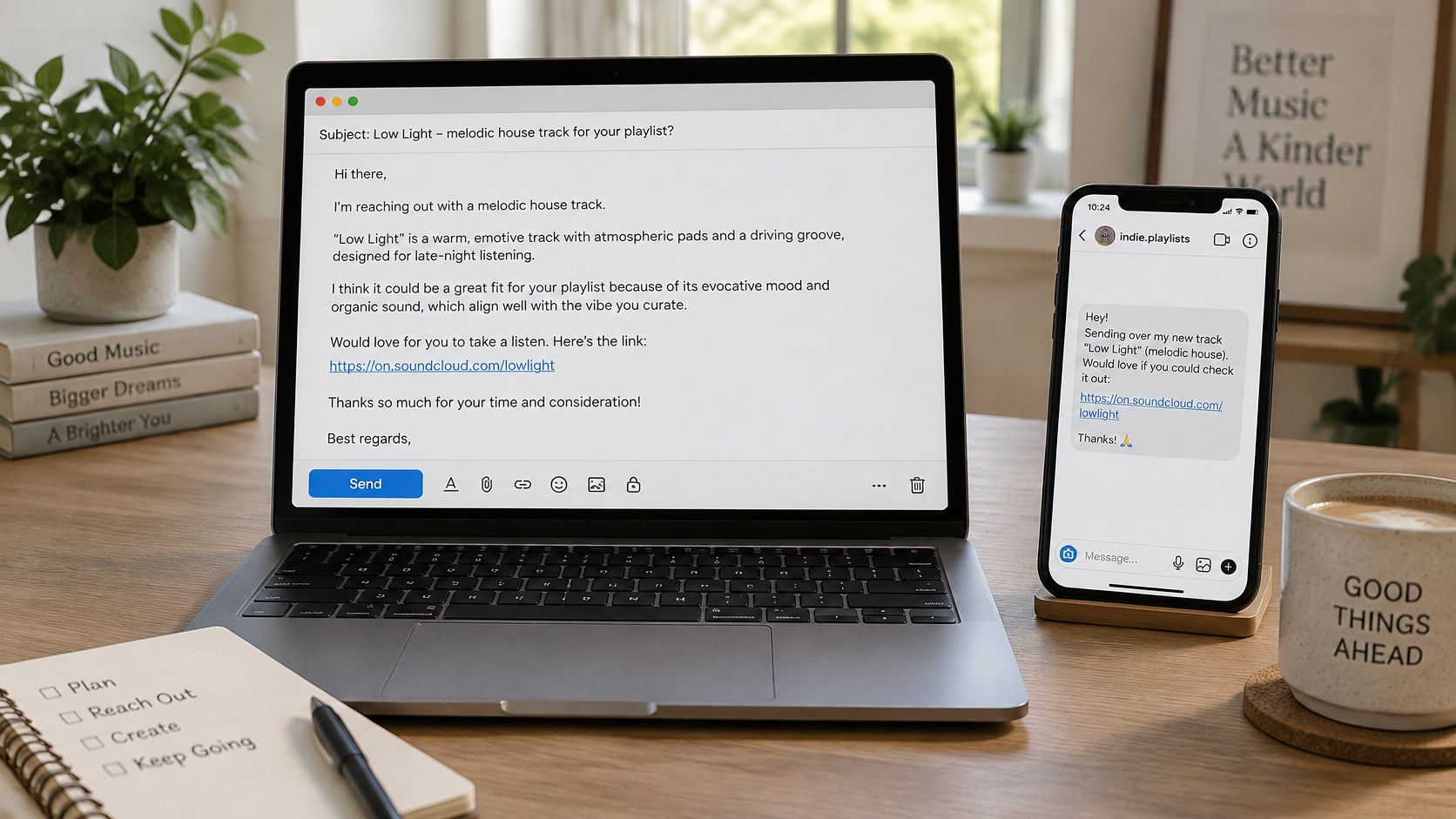
Respect the order a curator reads
The subject identifies the submission. The opening establishes genre and playlist fit, the middle describes the sound and story, and the listening reference gives access without hunting through attachments. Finish with a clear request and your artist name.
A short DM should ask permission rather than deliver the entire campaign:
Hi [Name], is [Playlist] open to submissions? Your recent addition of [Track] fits the dry drums and understated vocals on my upcoming indie dance single. May I send a private listening link?
Use the curator's preferred channel. If their bio directs submissions to a form, a DM asking them to bypass it creates extra work.
- Personalize the evidence: Mention an actual recent addition, not a generic compliment.
- Keep claims consistent: Use the same genre and release details as your metadata.
- Remove the biography dump: Keep only background that explains this recording.
- Avoid mass sends: Change the fit explanation for each recipient, not merely the name.
If your draft sounds demanding or overly formal, use Pure Write's guidance to improve your professional email tone. Keep your own vocabulary and delete anything that sounds like sales copy.
Keep the reminder short: identify the earlier submission, repeat the listening reference, and ask whether it's suitable for consideration. Don't add guilt, urgency, or a demand for feedback.
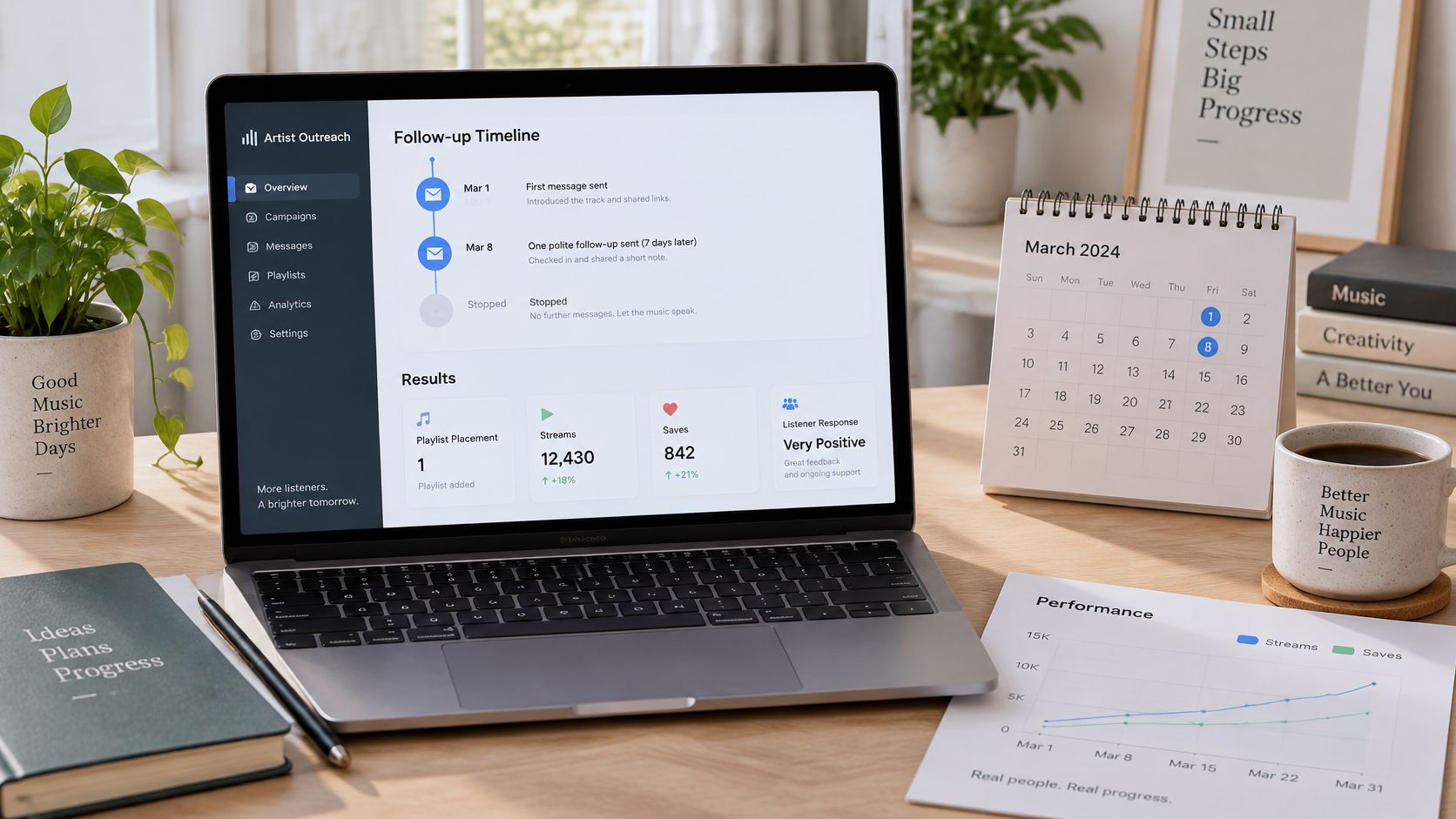
Record outcomes without inventing causality
Your pitch ledger should contain release date, submission timestamp, metadata selections, target territories, channel, response, inclusion, and post-placement performance. Spotify's playlisting guidance distinguishes legitimate submission from paid-placement promises and warns about artificial-streaming risks.
Post-placement metrics and what they reveal
| Metric | What it shows | Warning sign |
|---|---|---|
| Saves per listener | Whether listeners want to keep the track | Many plays with few saves |
| Repeat-listener rate | Whether listeners return after the first play | Listeners who never come back |
| Playlist-driven streams | How much playlist exposure contributes | A sudden spike from unfamiliar regions |
| Skip and completion behavior | Whether the track holds attention | High skips or low completion |
| Follower conversion | Whether listeners become followers | Placement with no follower gain |
| Geographic fit | Whether listeners are in targeted markets | Traffic concentrated outside target territories |
Use skip and completion information only where your reporting tools expose it. Don't infer unavailable metrics from a stream total.
Annotate social posts, press coverage, shows, and other campaign activity beside placement dates. If several happened together, describe the resulting growth as campaign performance rather than attributing it all to a playlist.
A playlist add is a distribution event. Returning listeners are evidence of audience fit.
I recommend a 30-day post-release measurement window, compared with the same window for your previous release. Note major differences in promotion or release format so the comparison remains honest.
Read SoundCloud engagement through that same lens: activity matters when relevant listeners show sustained interest. Raw stream volume alone isn't a result.
Confirm Your Pitch Plan Before Release Day
Choose one primary pitching channel for this release: Spotify for Artists or a relevant independent SoundCloud curator. Commit to managing it through the next month rather than opening more outreach channels than you can research and measure.
That focus doesn't mean stopping other promotion. It means knowing which submission you're testing and keeping a clean record of what happened.
Make the next action unambiguous
- Confirm eligibility. Verify profile access, rights documentation, suitable recording length, and a release date that's still in the future.
- Lock the calendar. Leave room for distributor review, platform delivery, and the editorial submission deadline before announcing the date.
- Write metadata before outreach. Make the email repeat the recording's factual description instead of adding stronger claims.
- Log the submission. Record its timestamp, channel, target territories, and the exact version of the pitch you sent.
Relevant audience selection also matters outside playlists. With SCHelper, you choose target artists whose listeners already match your sound and scene. We're not affiliated with SoundCloud, and listener discovery is separate from editorial selection.
Don't make acceptance the only useful outcome. A declined pitch can still leave you with cleaner metadata, a better-qualified curator list, and a clearer understanding of which listeners respond.
Choose this month's channel and log the first pitch before starting another round of research. Once that submission and its results are recorded, you can plan the next release with evidence rather than writing a more enthusiastic paragraph.
SCHelper offers focused listener recommendations to help you grow a fresh profile, promote mixes, or build a listener base between releases. Visit SCHelper to choose target artists aligned with your sound and add relevant listener discovery to your playlist-pitching plan.