
Music Promotion Service Buyer's Guide for 2026

More followers is the advice music-promotion services sell most easily. It's also a poor way to decide whether a service is helping your career. A follower who never listens again, shares a track, or responds to your work is a number on a profile, not a developing fan relationship.
The smarter question is whether promotion reaches listeners who fit your sound and whether those listeners come back. That means judging a service by audience relevance, meaningful engagement, retention, account safety, and transparency, not by the speed at which a dashboard count rises.
Table of Contents
- Why Follower Counts Lie About Music Promotion
- The Three Types of Music Promotion Services
- Comparing Service Types Against Real Evaluation Criteria
- How to Measure Whether Promotion Worked
- Five Evaluation Criteria Before You Buy
- Matching Service Type to Real Artist Scenarios
- Why Controlled Targeting Beats Fast Automation
- Buyer's Checklist and 30-Day Verification Plan
Why Follower Counts Lie About Music Promotion
More streams or followers don't automatically mean a promotion campaign succeeded. A poorly matched or incentivized audience can inflate visible numbers without creating repeat listeners, and questionable activity can expose an artist to moderation or royalty-related consequences. The risks of SoundCloud follower bots and safer alternatives deserve attention before you pay for a service that promises fast growth.
The financial context is clear. IFPI reported that global recorded-music revenue reached US$29.6 billion in 2024, with streaming responsible for 69% of that total; it also reported more than 750 million users of paid streaming subscription accounts worldwide (IFPI's account of the industry's digital transformation). Streaming is not a side channel. It's where much of music discovery and listening happens, which makes ongoing engagement more useful than a one-time bump in reach.
SoundCloud's own analytics give artists a better way to assess that engagement. They include plays, play duration, likes, reposts, comments, shares, downloads, listener locations, traffic sources, repeat behavior, and audience retention (SoundCloud's artist insights overview). That range matters because a follower count alone can't tell you whether people listened, returned, or interacted.
The buying question: Which service can help you find relevant listeners, measure what they do, and build on the response?
Use five criteria throughout your evaluation: targeting precision, audience quality, account safety, process transparency, and artist time investment. A service that can't explain its targeting or help you judge the results isn't a reliable growth strategy, however persuasive its headline numbers look.
The Three Types of Music Promotion Services
The category label matters because a self-serve tool, an agency, and a platform-native feature place different decisions in your hands. This overview of online music promotion can help you think about how promotion fits alongside your release and audience-building work.
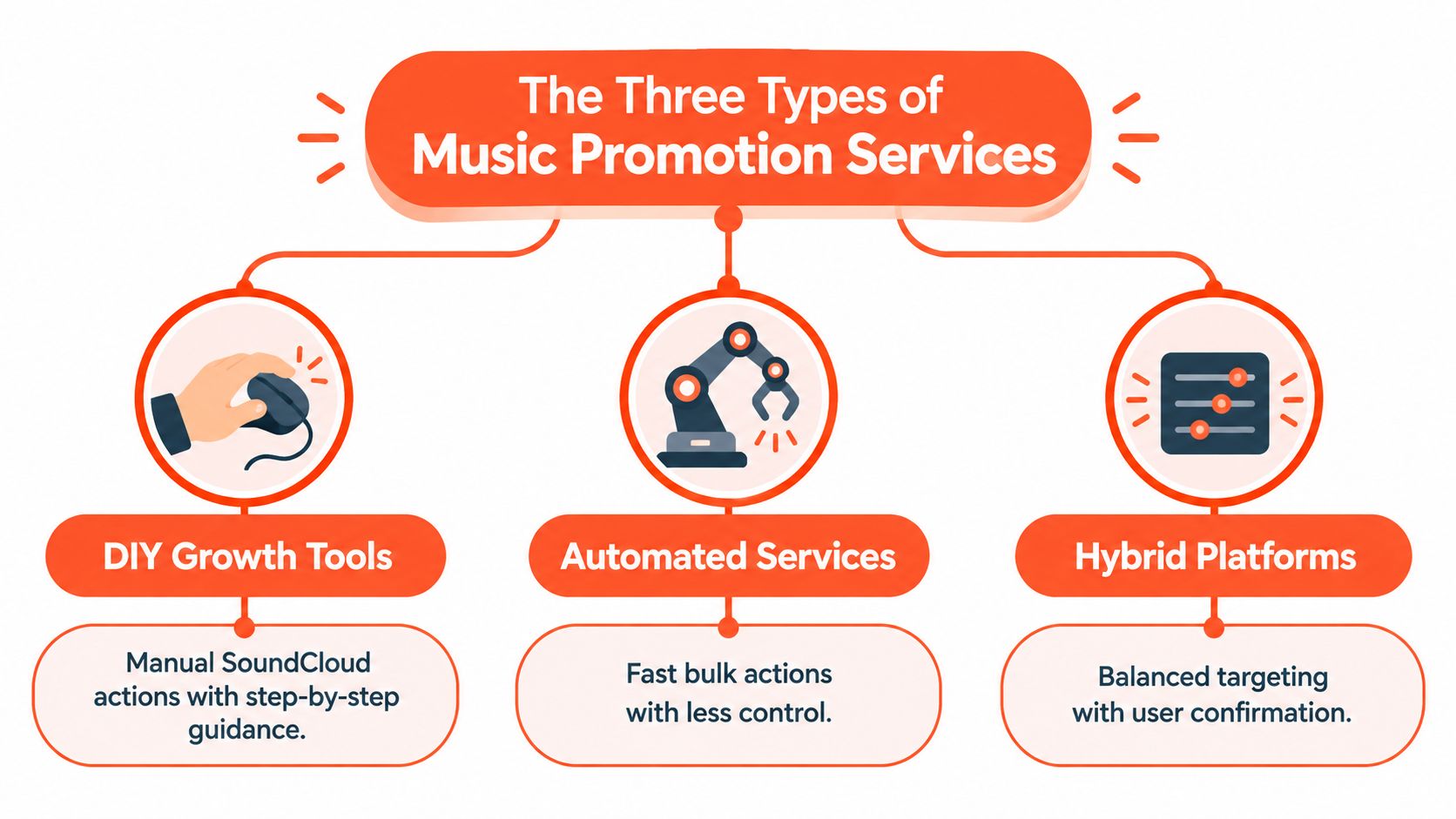
DIY growth tools
DIY tools give artists a structured way to carry out promotion themselves. A SoundCloud-focused tool might surface listeners who follow similar artists, then let the artist review a shortlist and confirm any follow or unfollow actions. You keep control over who you approach, but you still need to make time for review and judge whether the resulting listeners are relevant.
SCHelper is one example of this model. It offers curated SoundCloud listener recommendations based on selected artists, genre, and scene, with user-confirmed batch actions and a secure OAuth connection. That describes its workflow, not a guarantee of audience growth. You still need to check your analytics and decide whether the people you reach engage with your music.
Agencies and automated services
An agency takes on more of the work, typically handling campaign planning or execution on an artist's behalf. That can suit artists who need outside support and have room in their budget, but the artist may have less direct control over targeting and day-to-day decisions. Ask what actions the agency will take, what reporting it provides, and whether it can show how listeners were selected.
Automated services promise to handle actions with little ongoing input. Convenience isn't a substitute for clarity. If a provider won't explain its methods, limits, or account controls, don't assume that bulk activity is safe or useful.
Platform-native options
Platform-native features operate inside a music platform's own environment. SoundCloud analytics, for example, can help artists review traffic sources, listener behavior, and engagement. These features are useful for measuring performance, but analytics alone won't do the work of finding and contacting relevant listeners.
Choose the category that matches the job. An artist who wants direct control may prefer a DIY workflow. Someone seeking hands-off campaign management may consider an agency, while an artist who wants to understand existing audience behavior should start with platform-native analytics.
Comparing Service Types Against Real Evaluation Criteria
| Criterion | DIY Tools | Agencies | Platform-Native |
|---|---|---|---|
| Cost structure | Tool or subscription fees, with the artist managing the work | Campaign or service fees; confirm what's included | Often tied to platform features or access |
| Targeting precision | Can be high when recommendations are curated and reviewed | Depends on the agency's methods and reporting | Strong for understanding existing traffic, not necessarily for outreach |
| Account safety | Depends on login security, action controls, and daily limits | Depends on the agency's access and procedures | Uses platform-provided tools and permissions |
| Transparency | Strong when actions and targeting are visible to the user | Varies; require clear reporting and explanations | Strong for available platform analytics |
| Artist time investment | Moderate; the artist reviews and confirms activity | Lower day-to-day effort, but requires oversight | Low for reviewing data, higher if used to plan outreach |
The table is a starting point, not a reason to buy by category alone. A DIY tool can be safer and more transparent than a poorly managed campaign, but only if it explains how it works and keeps the artist in control. Agencies can reduce hands-on work, yet their value depends on whether they share meaningful reporting instead of presenting a reach total without context.
For a niche artist, targeting precision deserves particular scrutiny. Ask whether recommendations relate to similar artists, genre, or scene, and whether you can inspect the accounts before taking action. Broad exposure may sound attractive, but it's less useful if the audience has little reason to care about your music.
If a service can't tell you what it will do, who it will reach, and how you can stop it, don't pay for it.
Account safety is not just a login question. Check whether the service requests your password, whether it performs actions without your confirmation, and whether it describes sensible activity limits. Don't assume that an agency is safer because a person is involved, or that software is unsafe because it's software. The operating method matters.
Finally, match the service to the time you can commit. A self-serve product still requires review and follow-up; an agency still needs your direction and oversight. Compare the value of that time with the amount of control you're willing to give up.
How to Measure Whether Promotion Worked
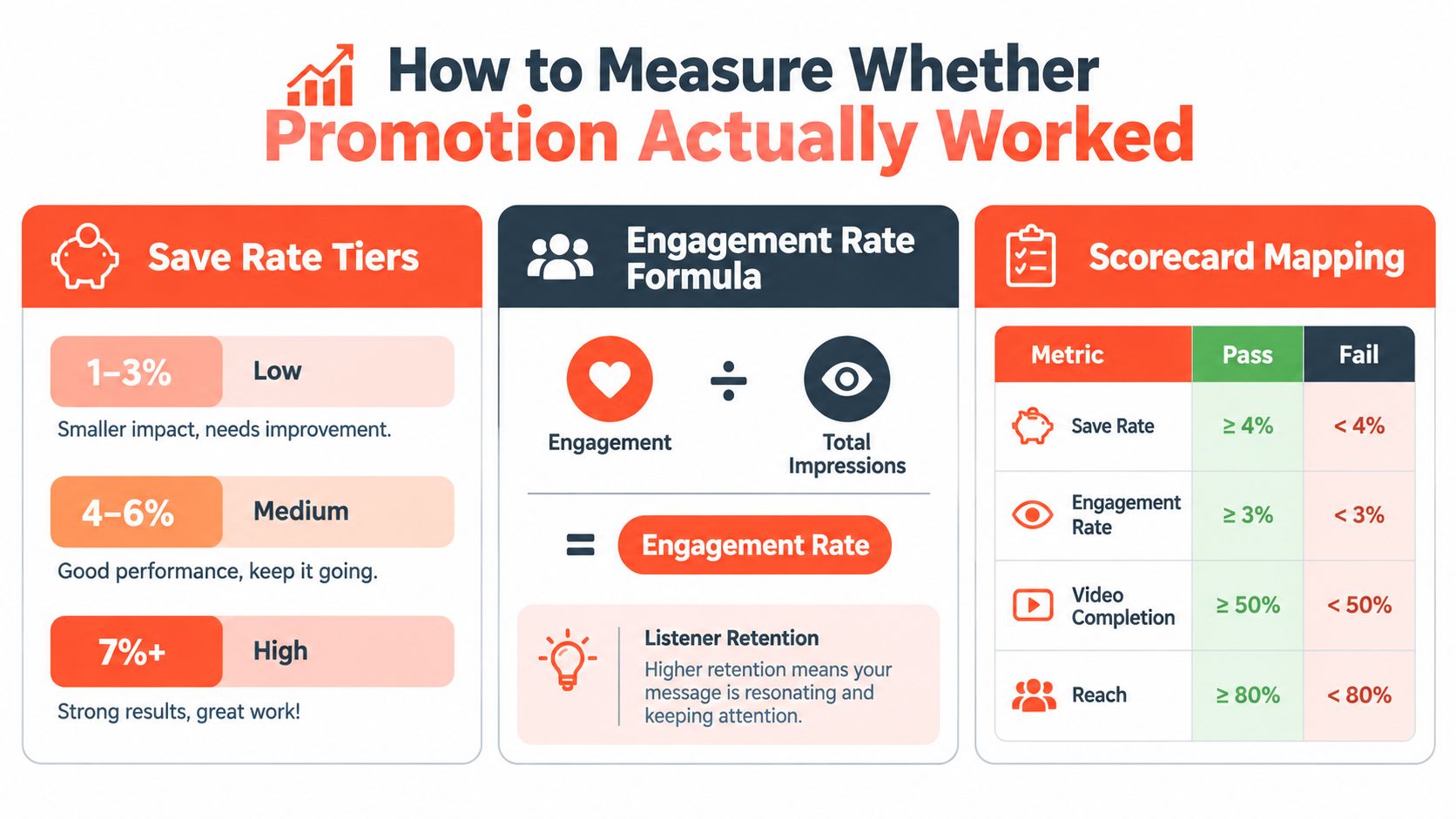
A larger follower count can mask a weak campaign. Judge promotion by whether relevant listeners discover your music, take meaningful actions, and return. Track profile visits, follows, reposts, comments, saves where available, repeat plays, and listener retention. SoundCloud's artist insights show acquisition and engagement signals, including traffic sources and audience behavior, as noted earlier.
One published independent-artist benchmark describes save rates below 1% as weak, 1–3% as typical, 3–5% as strong, and above 5% as highly engaged. It defines engagement rate as total likes, comments, shares, and saves divided by reach (independent-artist streaming benchmarks). Treat these ranges as directional, not promises. Genre, geography, catalog maturity, and release type all affect listener behavior, so compare like with like.
Build a useful scorecard
Measure these signals against your own baseline:
- Qualified-visitor conversion: How often do profile visits from relevant listeners become follows?
- Actions per new follower: Do new followers repost, comment, save, or return to your tracks?
- Repeat listening: Do listeners come back after discovering a release?
- Retention and source: Which traffic sources bring listeners who continue engaging?
A follower spike with flat reposts, comments, and repeat plays signals poor audience fit. The campaign may be adding people who have little interest in your sound. Compare similar-artist recommendations with untargeted discovery activity over the same release window. That makes it easier to separate campaign results from background traffic.
For a wider framework on attribution and reporting, review influencer attribution and reporting. Apply the same discipline to music promotion: trace where attention came from, what listeners did next, and whether they returned.
Five Evaluation Criteria Before You Buy
A polished website can't make a service safe or accountable. Before entering payment details, check how the provider accesses your account, controls its actions, and handles problems.
Login method: Prefer a secure authorization flow, such as OAuth, that doesn't require you to hand over your SoundCloud password. Ask what permissions the connection uses and how you can revoke access. A provider asking you to share a password with no clear account controls is a serious red flag.
Automation posture: Find out whether you review recommendations and confirm actions, or whether the tool runs unattended. User confirmation gives you a chance to reject irrelevant accounts and keep activity intentional. Reject services that won't explain whether they act automatically.
Daily limits: Look for clear, conservative limits and an explanation of how batches work. A trustworthy provider shouldn't promise unlimited activity or pressure you to maximize action volume. If it won't state its guardrails, you can't judge the account risk.
Refund and cancellation: Read the terms before you subscribe. The policy should say what happens if the service doesn't function and how to stop renewal. Vague language or a cancellation process that's hard to find is a reason to walk away.
Support responsiveness: Confirm that a real contact channel exists and that the provider offers usable help. Try asking a specific question about account access or campaign reporting before buying. If no one can explain the workflow, don't trust the service to resolve a problem later.
The same due diligence applies beyond SoundCloud. This guide to Instagram growth service reviews offers a useful reminder to compare how growth providers work, not just the numbers they advertise. For a broader look at practical options, see these music promotion tools, then apply the same questions about access, controls, and evidence.
Matching Service Type to Real Artist Scenarios
A first-time artist, a working DJ, and a label manager don't need the same workflow. Choose based on the work you need done and the amount of control you want to keep.
The new independent artist: You've released a track and want to find listeners who already follow artists in your lane. A DIY growth tool can make sense if you're willing to review recommendations and take action yourself. Pair it with SoundCloud's native analytics so you can see whether new visitors return or interact, rather than treating an initial follow as proof of success.
The active DJ: You release regularly and need a repeatable way to maintain profile activity between drops. A controlled self-serve workflow may fit if you can review a shortlist consistently. If you're short on time, consider agency support, but insist on clear targeting details and reporting that ties the campaign to listener actions.
The label manager: You're overseeing several SoundCloud profiles and need consistent oversight. An agency may take execution work off your plate, but it can be difficult to judge across a roster without account-level reporting. A tool with transparent workflows and multi-account management may be more suitable if your team can review and confirm actions for each profile.
Don't buy the most hands-off option by default. If you have time but want structure, retain control. If you need someone else to execute, pay for accountable management, not just a promise of reach. In every scenario, decide in advance which listener behaviors would justify continuing.
Why Controlled Targeting Beats Fast Automation
Fast automation can make a campaign look busy without making its audience more relevant. Controlled targeting starts with listeners who follow similar artists, then gives the artist a chance to review each recommendation and confirm an action. That method takes attention, but it also gives you a clearer connection between who you approached and what happened afterward.
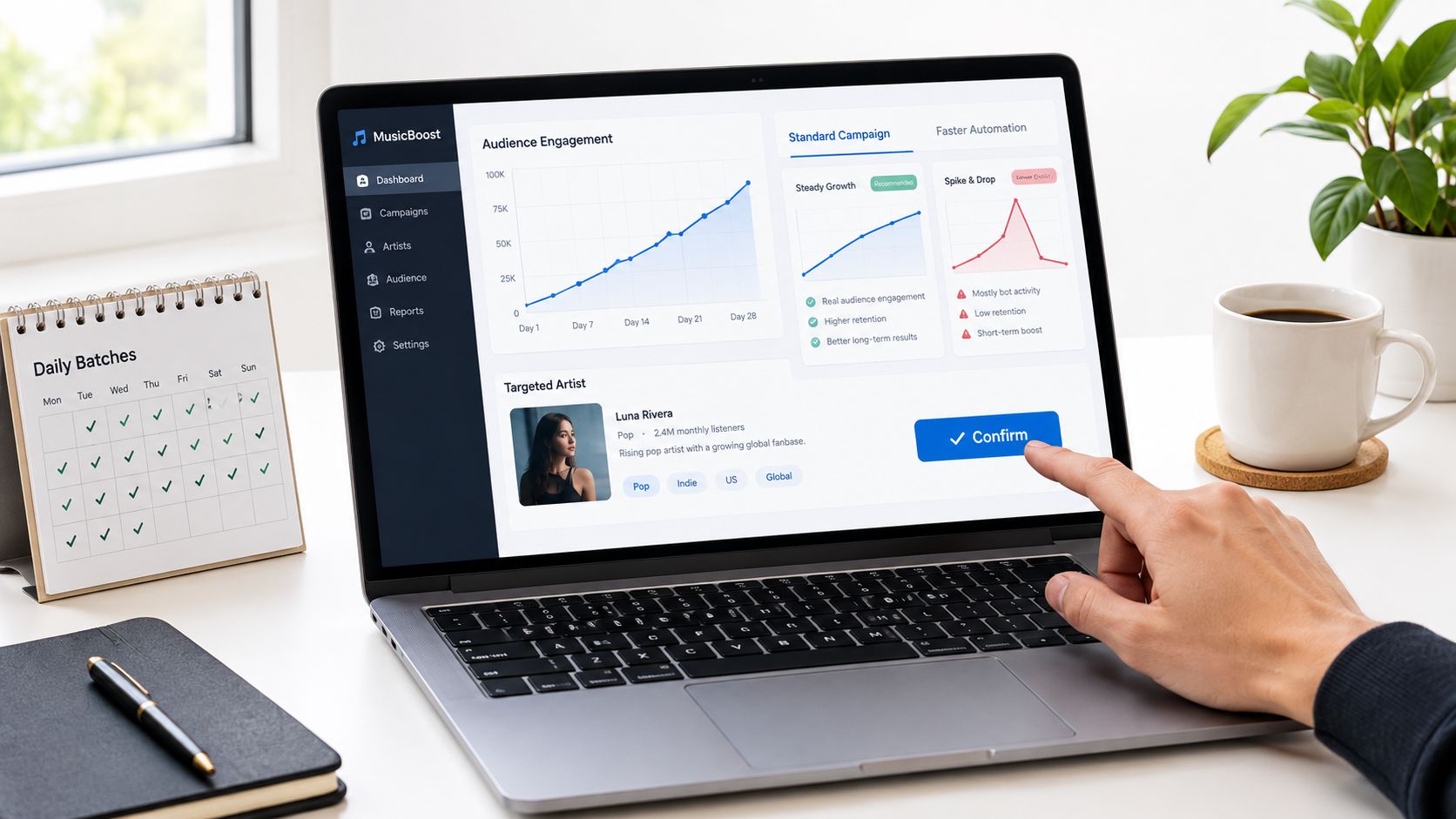
That matters on SoundCloud because discovery can be interactive. Listeners can follow, like, repost, comment, and communicate directly, giving artists ways to build on an initial visit instead of relying only on a stream. A relevant listener who comes back or responds is a better prospect than an account acquired through a broad, unreviewed burst of activity.
SoundCloud's first Music Intelligence reporting found that music released within the previous 18 months represented 46.5% of listening on the platform, compared with an industry average of 26.7% (SoundCloud's first Music Intelligence report). For independent artists, that supports a practical approach: don't treat release day as the entire campaign. Keep discovering and engaging with appropriate listeners after launch, while avoiding repeated contact with the same accounts.
Build a cadence you can review, not a spike you can't explain.
Streaming manipulation is estimated to affect roughly 5–10% of streaming-market revenue, and industry proposals such as minimum-stream thresholds can disproportionately affect smaller artists whose catalogs don't consistently reach high volume (industry discussion of risks to smaller artists). That context is another reason to reject services that sell activity without explaining the audience or method. Controlled, human-reviewed promotion won't guarantee results, but it gives you a more defensible process and clearer evidence to evaluate.
Buyer's Checklist and 30-Day Verification Plan
Before you subscribe, make each answer easy to verify:
- Access: Does the provider use a secure authorization method rather than asking you to share your password?
- Control: Can you review recommendations and confirm actions yourself?
- Limits: Are daily batches and activity guardrails explained?
- Terms: Are refunds, renewal, and cancellation policies clear?
- Support: Can you reach someone who can answer specific questions?
- Measurement: Can you track where listeners came from and what they did next?
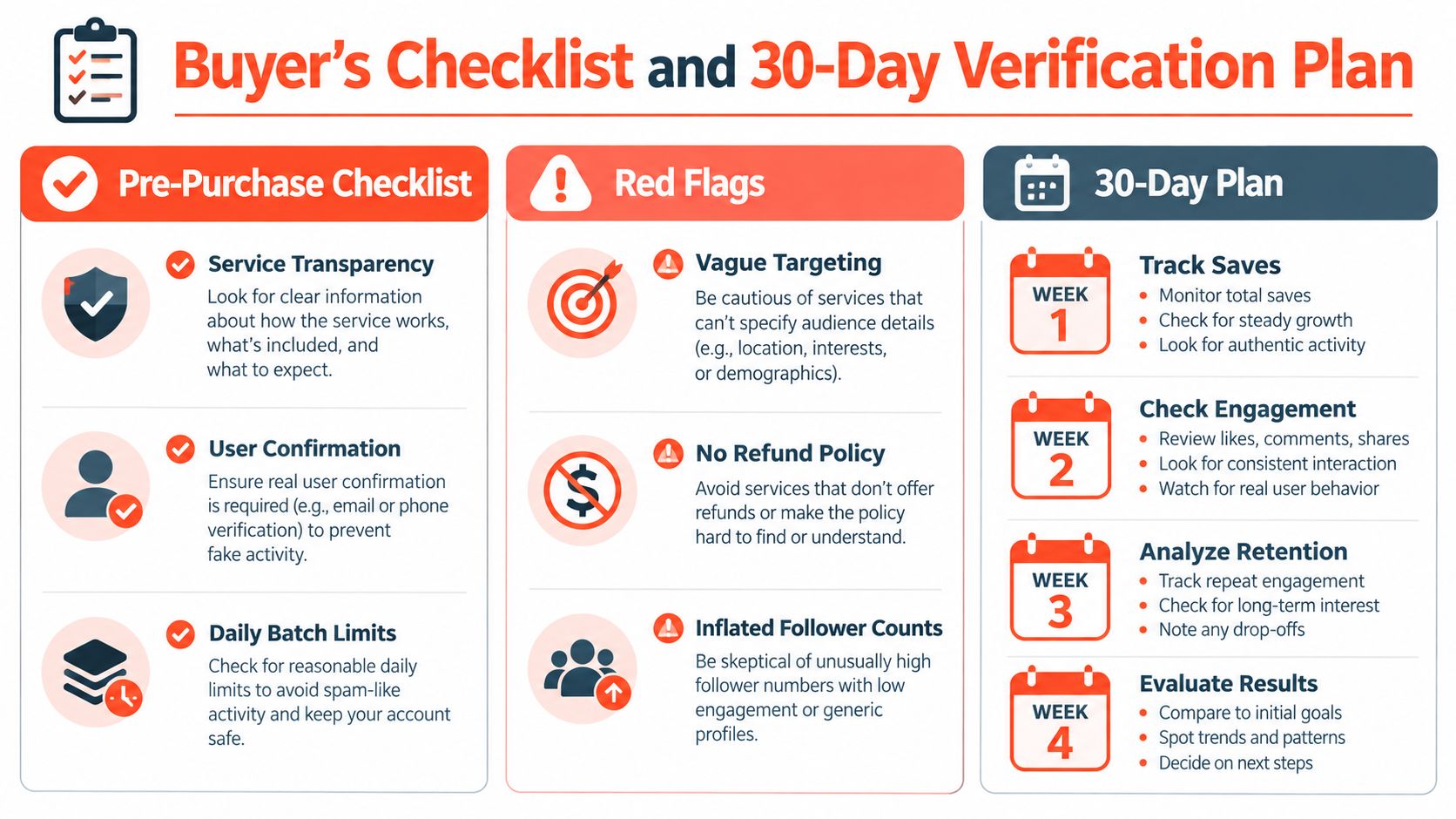
Red flags that disqualify a service
Walk away if a provider promises guaranteed popularity, hides its methods, requests password sharing without clear safeguards, or sells follower volume without explaining audience relevance. No refund information, no usable support channel, and actions performed without your knowledge are also disqualifiers. Don't let a low price distract you from an opaque workflow.
Verify with a consistent measurement plan
Start by recording a seven-day pre-campaign baseline for profile visits, follower conversion, reposts, comments, saves where available, and repeat listening. Then run consistent daily recommendation batches for four weeks, changing as little as possible about your release activity and targeting so that comparisons remain useful. These time periods are a practical test design, not industry benchmarks.
At the end, compare qualified-visitor-to-follower conversion, saves or reposts per 100 new followers, comments per 1,000 profile visits, and repeat-listener retention over 28 days. Those campaign measures are proposed scorecard units, not claims about typical performance. If follower growth rises while meaningful actions and repeat listening stay flat, stop and reassess the audience fit or the service itself.
SCHelper provides curated SoundCloud listener recommendations, secure OAuth access, and user-confirmed follow and unfollow batches for artists who want a controlled discovery workflow. If that matches the way you want to build an audience, visit SCHelper and review its targeting and account controls before choosing a plan.