Online Music Promotion: Channels, Strategies, and Workflows
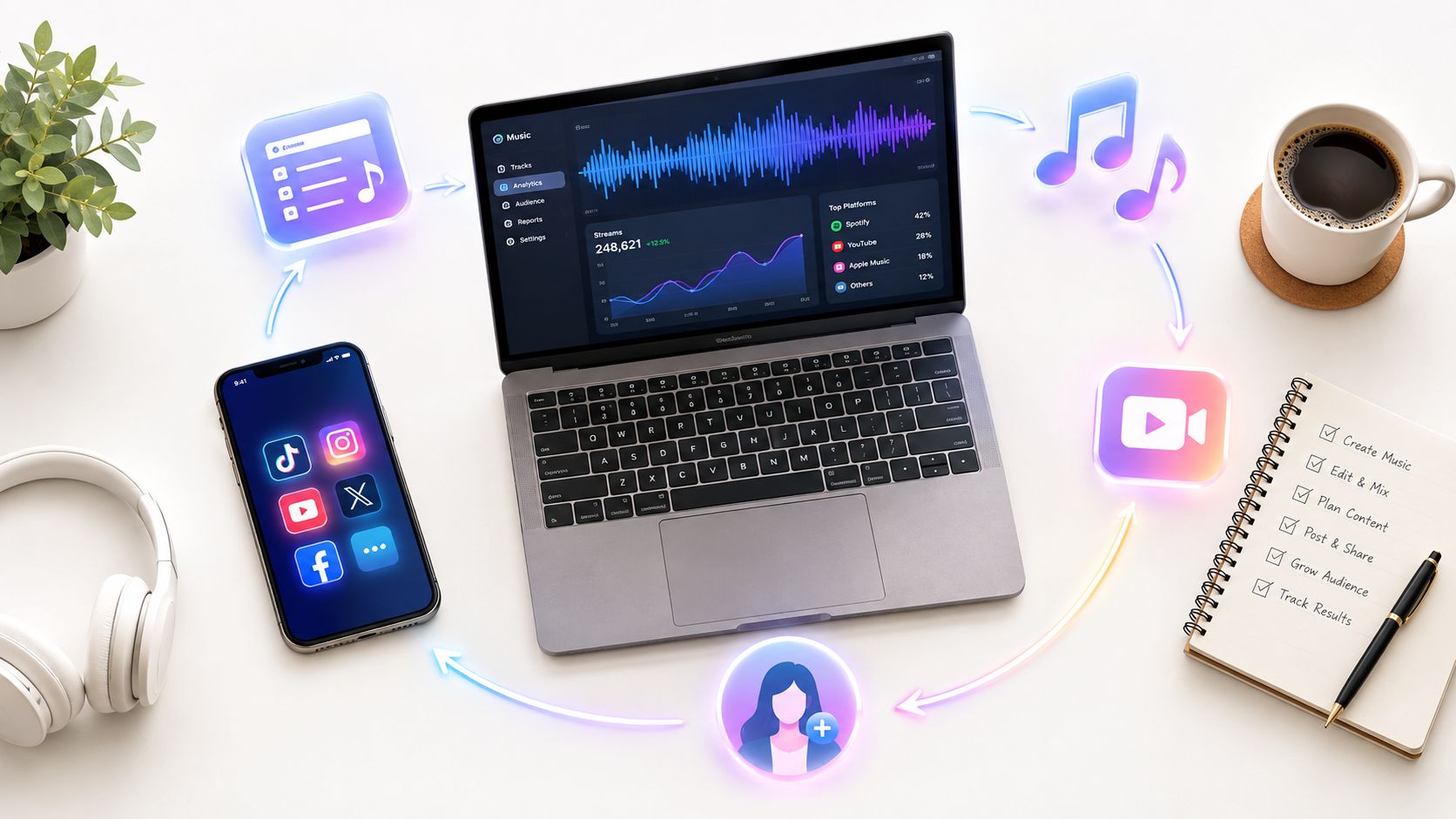
You know the feeling. The track is finished, the cover art is exported, the links are in every group chat you can reach, and for a few hours it looks like something is happening. Then Tuesday arrives, the chat goes quiet, the spike flattens, and you're left wondering why a song that felt alive in the room feels invisible online.
That's usually not a music problem. It's a matching problem. Online music promotion works when the right track reaches the right listener in the right context, then gives platforms and people enough signal to keep the connection going. The listener ecosystem is broader than one feed or one playlist. IFPI's 2023 Engaging with Music study found that people use more than seven different methods to engage with music on average, and that short-form video platforms accounted for 54% of all time spent watching short-form video being connected to music, with 16 to 24-year-olds leading engagement there at 82% (IFPI report). That's the reality behind the post-release silence, the song isn't failing to exist, it's failing to stay matched.
Table of Contents
- The Release-Day Trap Most Artists Fall Into
- What Online Music Promotion Really Means Today
- The Main Channels That Actually Move the Needle
- Why Similar-Artist Targeting Beats Generic Genre Targeting
- Reach Tactics versus Workflow Tactics in Practice
- A Repeatable Daily Workflow for Independent Artists
- Metrics That Actually Show Promotion Is Working
- Putting It All Together Before Your Next Drop
The Release-Day Trap Most Artists Fall Into
The midnight launch ritual looks productive because it's loud. A producer pastes the link everywhere, a singer asks friends to stream it, a few strangers click, and the numbers twitch just enough to feel hopeful. By Tuesday, the flurry has stopped, and the artist is staring at a feed that no longer seems to remember the song.
The trap is treating release day like the campaign instead of the opening of the campaign. One concentrated burst can create activity, but it rarely creates behavioral relevance, which is what keeps a track circulating after the first push. If the people who click don't resemble the listeners who normally stay with that style, the traffic may look real and still fail to convert into repeat listens.
Promotion has to behave like a system
A better mental model is a loop. You identify listeners who already care about adjacent artists, you bring them a track that fits their habits, and their next action tells the platforms whether the match was real. That's why short bursts underdeliver compared with consistent, measured work. Relevance compounds when the same artist keeps showing up in the same scenes, profiles, and listening pathways.
A useful outside reference is check out House of Lyrics, which collects practical promotion ideas, but the bigger lesson is simpler, promotion has to survive past the launch post. If the only plan is “announce, boost, repeat,” the campaign depends on attention you don't control. If the plan is a repeatable matching process, each release feeds the next one.
Practical rule: if a tactic can't be repeated next week without feeling fake or chaotic, it's probably a spike tactic, not a system.
What Online Music Promotion Really Means Today
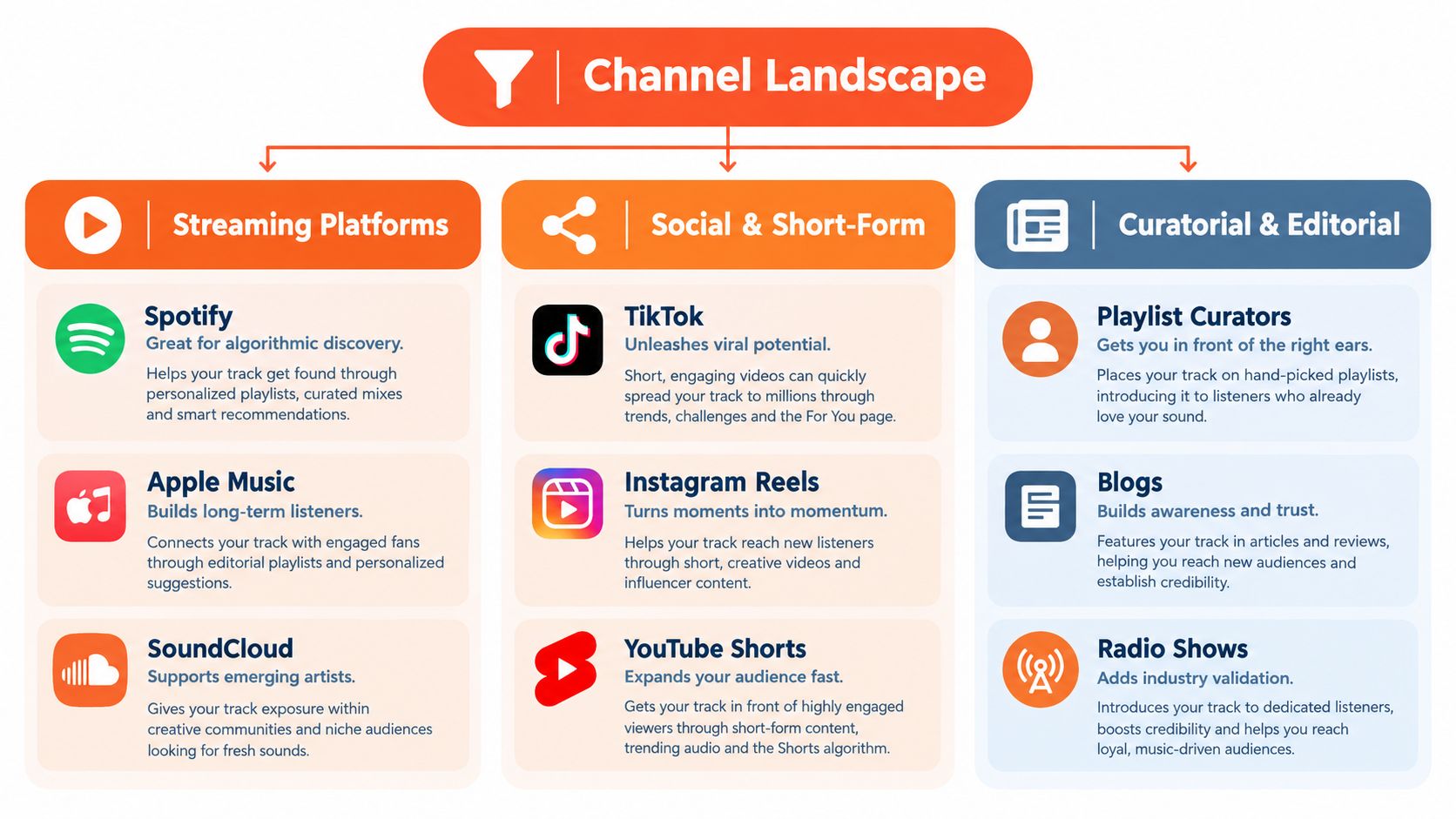
A release can look busy and still miss the point. The job is to put a song in front of listeners whose habits already fit it, then watch whether they save it, revisit it, and treat it like part of their routine. That shift from reach promotion to relevance promotion changes the whole campaign.
Platforms already work that way. Recommendation systems read plays, skips, likes, dislikes, playlist adds, and track reactions, then use those signals to decide what appears next (SAGE study). So the campaign begins before the first listen, with who sees the track, and it continues after the listen, with what those people do next. A follower count matters less than profile visits, presses on play, saves, reposts, and return listens.
Reach tells you who saw it, relevance tells you who stayed
Independent artists rarely have the budget to buy broad awareness. They need promotion that produces its own proof. A listener who already follows a similar lane, opens the profile, and saves the track sends a much stronger signal than a random account that taps once and leaves.
Each channel plays a different role in the matching loop. Streaming profiles carry the long-term identity, short-form video creates discovery spikes, and editorial or scene-based attention gives the track credibility before it reaches a wider audience. If one channel is carrying everything, the campaign stays fragile.
Strong campaigns let each channel do its own job. Streaming should hold attention, social should create first contact, and editorial should add trust. That mix turns promotion into a series of small, qualified matches instead of a blur of empty clicks.
The Main Channels That Actually Move the Needle
Streaming platforms are where a campaign starts to stick. Subscription services sit at the center of the modern market, and the U.S. recorded-music business reached $17.7 billion in 2024, with streaming-related formats generating $14.9 billion, or 84% of total recorded-music revenue (RIAA report). That does not mean streaming should carry every part of the strategy, but it does mean the song has to perform well inside that system if you want the work to last.
Short-form video plays a different role. Music sits deep inside short-form behavior, so TikTok, Instagram Reels, and YouTube Shorts should be treated as music channels, not side bets. Short-form video is the discovery flare; the finish line comes later, at the profile visit, the save, the stream, and the repeat play.
Editorial and community channels add trust
Playlists, blogs, radio shows, DJs, producers, and scene accounts do something a cold post cannot. They explain why the song matters in a social context. That matters because listeners often need more than sonic similarity, they need a reason to care now. If you want a practical breakdown of channel-specific discoverability, see what FLYP covers, especially if your plan includes video-led discovery.
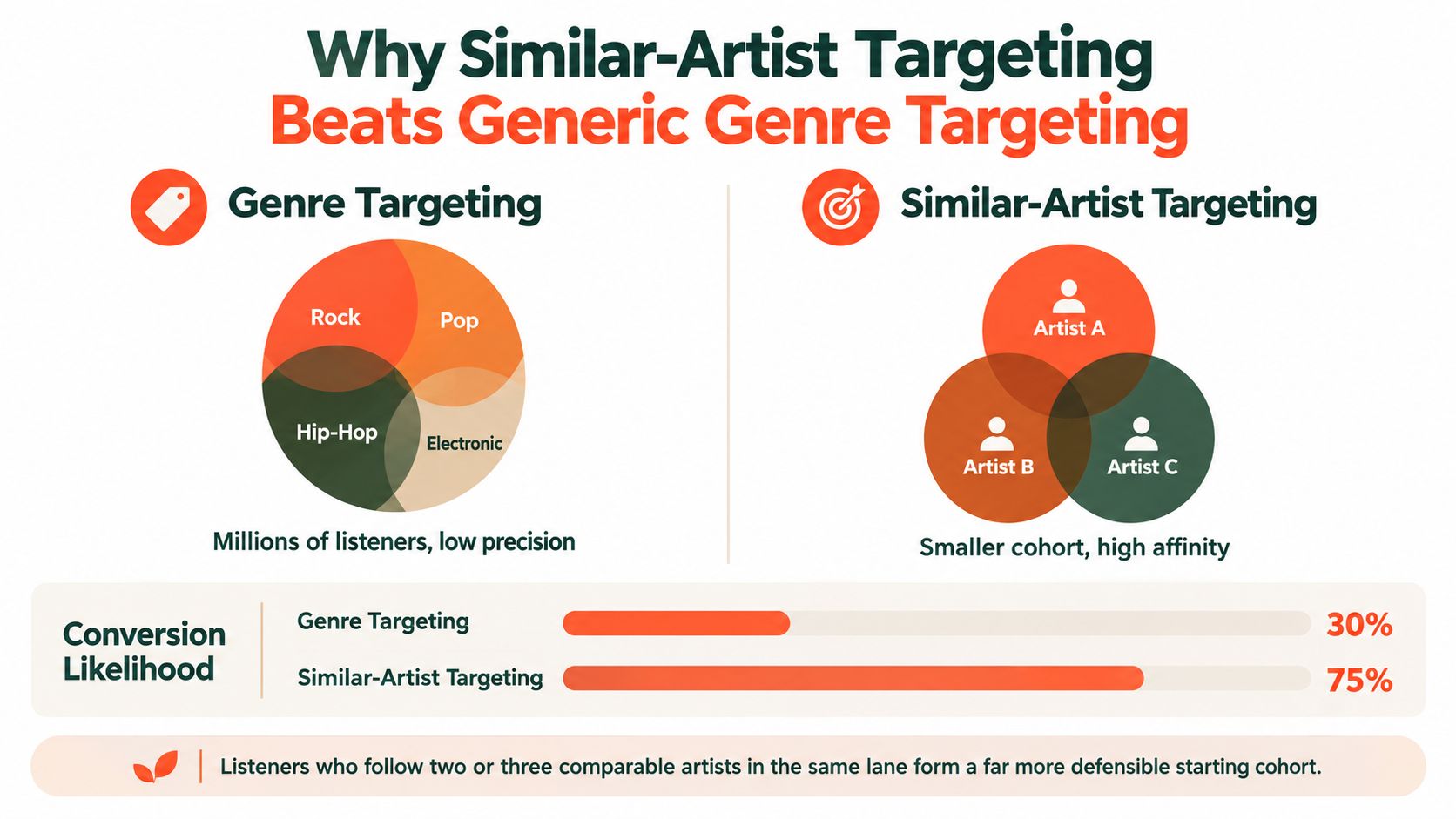
The problem with putting too much money or attention into one channel is simple, each one solves a different part of the matching loop. Streaming turns attention into listening identity. Social video creates first contact. Editorial and community channels add legitimacy.
When one channel is forced to do every job, the campaign gets noisy and easy to ignore. The stronger setup uses each channel for the step it handles best, then lets the listener move forward on their own terms.
Why Similar-Artist Targeting Beats Generic Genre Targeting
Genre targeting sounds broad and efficient, but it usually stays too loose to convert. A listener who likes "rock" may prefer arena rock, indie rock, post-hardcore, or folk-rock. A listener who already follows two or three comparable artists in the same lane gives you a much cleaner match, because the overlap is visible in what they listen to and save.
The better targeting model has two parts. First, choose listeners based on musical similarity. Then narrow by recency of engagement, because timing shapes whether they notice the release at all. Large-scale streaming research using 282,000 new music releases found that recommendation performance depends on both listener genre preference and content age preference (ACM study). That is why a campaign built around five closely related reference artists usually beats one built around a generic genre label.
Build the cohort before you push the song
Start with reference artists that sit close enough to your release that a fan could plausibly save both without contradiction. Then look for fresh engagement around those artists, recent comments, reposts, new followers, playlist activity, and active profiles rather than dormant names that have not shown signs of listening in a while. The goal is to find people already in motion, not to spray the song at anyone who once clicked a related tag.
The strongest starting cohort is usually smaller than artists expect. That is a strength, not a weakness. It gives the algorithm a cleaner pattern and gives you a more honest read on whether the record connects. Once that first cohort responds, you can widen to adjacent audiences with better signals and a steadier launch.
Working rule: if you cannot name the listeners by their nearby artists, the targeting is probably still too broad.
Reach Tactics versus Workflow Tactics in Practice
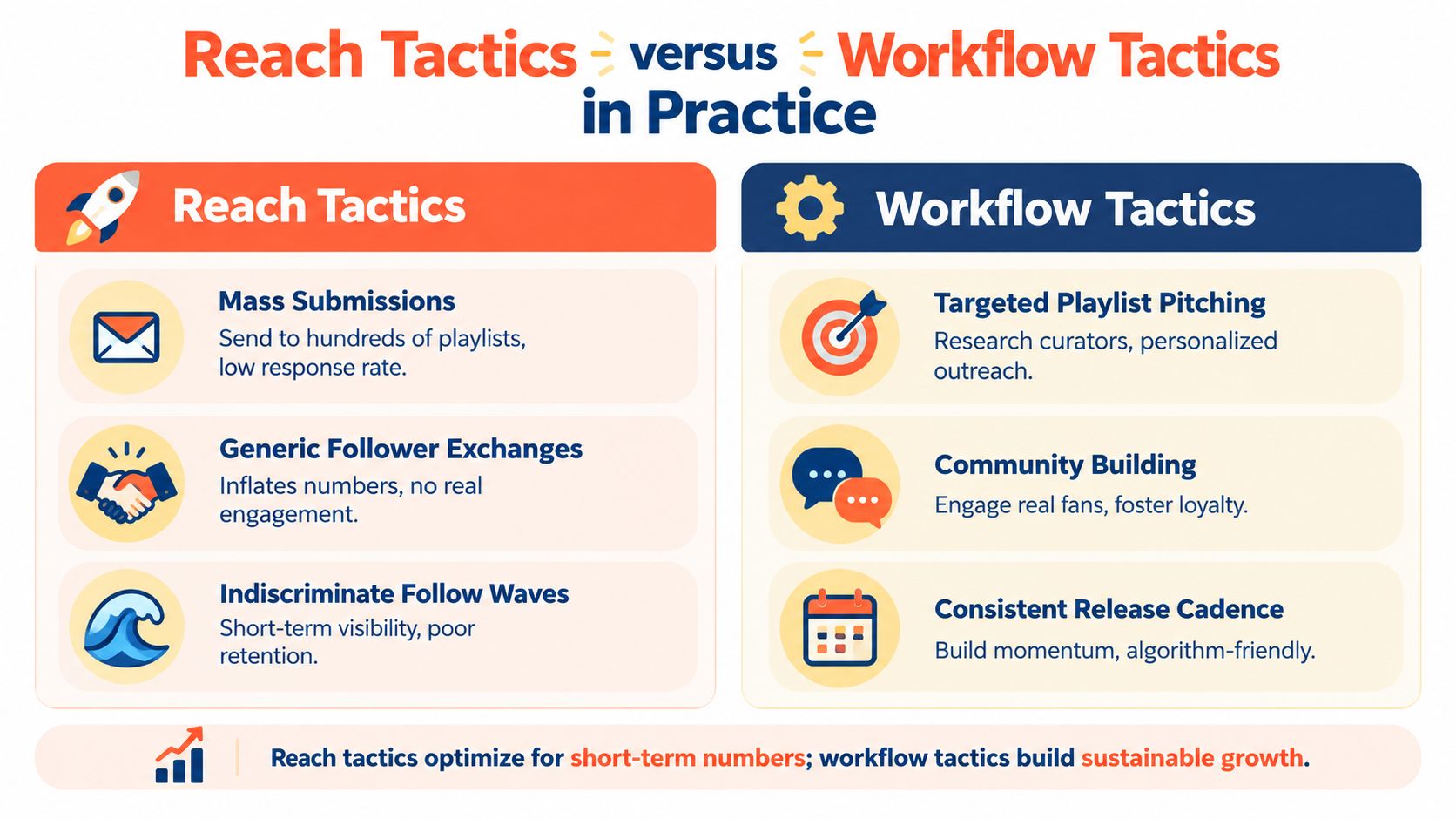
A lot of promotion advice still rewards the wrong behavior. Mass submissions, generic follower exchanges, and indiscriminate follow waves can create motion, but they rarely create durable listening. Reach tactics are built for visible volume. Workflow tactics are built around listeners who keep showing up.
Workflow tactics are slower, and they usually produce cleaner signals. Curated recommendations, manual confirmation, conservative daily batching, and exclusion filters keep the focus on actual listener fit. SoundCloud is a useful example of why that matters. Its 2025 Music Intelligence Report found that tracks released within the previous 18 months represented 46.5% of listening on SoundCloud, compared with 26.7% across the wider recorded-music market, which points to a platform audience that is unusually open to recent music (SoundCloud coverage). The same report also found that 51% of A&Rs had discovered artists on SoundCloud who later became commercially successful.
A simple decision rule
If a tactic depends on volume, speed, or the hope that generic activity will convert later, skip it. If a tactic helps you identify relevant listeners, confirm them manually, and pace your activity so the account stays steady, keep it in the plan. For artists working on SoundCloud, one practical option is SCHelper, a web-based workflow that uses secure SoundCloud OAuth, daily listener recommendations, and batch follow or unfollow actions after user confirmation.
You can also compare tools in this music promotion tools overview if you want a broader field view. The key is which approach keeps attention tied to listener behavior that can repeat, instead of activity that only looks busy.
A Repeatable Daily Workflow for Independent Artists
The cleanest workflow is boring on purpose. Start by picking a small set of reference artists whose audiences overlap with your sound, then check who's recently active around them. You're looking for people who still behave like listeners, not accounts that were active once and now mostly reshare promotions.
Run the list in small batches
Build a shortlist from those listeners, then review it in batches instead of letting the list sprawl. Exclude accounts that already engaged recently, filter out obvious promo-heavy profiles, and keep the action pace controlled. On a practical level, that means manual confirmation, OAuth-based connections only, and no password sharing, because the workflow should mirror what a careful artist would do by hand.
After the list is screened, engage with a few comments, reposts, or reactions from the same cohort. Keep the contact relevant and stop before it starts looking like automation. If you're looking for a tool-oriented breakdown of that kind of daily routine, this music streaming promotion guide gives a useful frame for controlled activity without the chaos.
Guardrail: if the outreach feels too repetitive to do manually for a few days in a row, it's probably too aggressive for release week.
The final piece is discipline. Use daily caps, keep the list fresh, and don't re-hit the same account after it has already engaged. That's what makes the workflow compound. It protects the account, keeps the audience quality high, and gives each new release a cleaner starting point than the last one.
Metrics That Actually Show Promotion Is Working
A screenshot of follower growth can flatter almost any campaign. It also tells you very little about whether listeners are returning, saving, or sharing. The metrics worth watching are the ones that show whether the recommendation loop is moving in the right direction, because those are the signals platforms can act on.
What to track instead
| Metric | What it measures | Why it matters |
|---|---|---|
| Profile visit rate | How many targeted listeners move from a mention or outreach touch to the artist page | It shows curiosity strong enough to leave the feed |
| Repeat-listen rate | Whether listeners come back after the first play | It tells you the track held attention, not just clicks |
| Save and repost rate | Whether the listener considered the song worth keeping or sharing | It's one of the clearest signs of relevance |
| Engagement per relevant contact | How much response each targeted listener produced | It helps separate good outreach from noisy outreach |
| Follower conversion over 7-day and 30-day windows | Whether the campaign turned discovery into a durable relationship | It shows if the listener actually stayed connected |
The point is simple. Recommendation systems read behavior, while vanity metrics read nothing the platform can use. The streaming personalization research cited earlier found that human-curated playlists were generally more effective than algorithmic recommendations for relevant suggestions, while algorithmic curation worked better for unfamiliar and less-popular foreign artists. That makes a strong case for tracking both the machine signal and the human signal. If the song gets discovered but not saved, or saved but never revisited, the campaign is attracting attention without building listener fit.
Measure what platforms can act on
Look for the numbers that tell you what to do next. If profile visits are high but repeat plays are weak, the targeting is probably close, but the song or context needs work. If saves and reposts are strong but profile visits are thin, the opening hook or pitch is probably underperforming. That gives you a better read than asking how many followers a campaign added.
Putting It All Together Before Your Next Drop
The cleanest decision rule is straightforward. Start with similar-artist affinity and recency, run a controlled daily workflow with manual confirmation, support the release across streaming, short-form video, playlists, and scene networks in the roles they're good at, and judge success by repeat behavior rather than raw counts. That keeps the campaign tied to listener fit instead of release-day noise.
The practical version is simpler than most artists think. Pick the next 14 days, choose a small batch of reference artists, and keep your actions conservative and relevant. As this independent artist marketing guide suggests, the work between releases matters just as much as the day the track drops, because a steady pattern teaches the platforms what kind of listener belongs with your music.
The artists who win online usually aren't the loudest for one morning. They're the ones who keep turning the right profiles into repeat listeners, then keep that pattern alive release after release.
If you want a more controlled way to turn similar-artist audiences into real SoundCloud listeners, SCHelper is built around that daily workflow. It helps artists find relevant accounts, review them in batches, and keep promotion tied to real behavior instead of noisy spikes. Visit SCHelper to see how that kind of release-day discipline can fit your next drop.