10 Music Promotion Tools Compared for Artists in 2026

You can do everything “right” on release day and still end up with the wrong traffic. A track goes live, plays trickle in, the listeners don't match the song, and you still can't tell whether you needed better SoundCloud growth, smarter playlist and curator pitching, or a better smart link to capture fan data. That's why music promotion tools have to be judged by the job they do, not by how busy they make your dashboard look.
For independent artists, the useful stack is simple. One tool should help you find the right listeners on SoundCloud. One should help you pitch curators or creators. One should capture intent with a smart link. The best releases use tools that solve different stages of the same drop, instead of asking one platform to do everything at once. Spotify's fan study also makes the timing point clear, since profiles get 77% more visits when new music drops, so launch windows matter more than random activity.
Table of Contents
- 1. SCHelper
- 2. Promote on SoundCloud
- 3. RepostExchange
- 4. Groover
- 5. SubmitHub
- 6. Playlist Push
- 7. SoundCampaign
- 8. Feature.fm
- 9. Linkfire
- 10. Hypeddit
- Top 10 Music Promotion Tools, Feature Comparison
- Matching Each Tool to Your Next Release
1. SCHelper
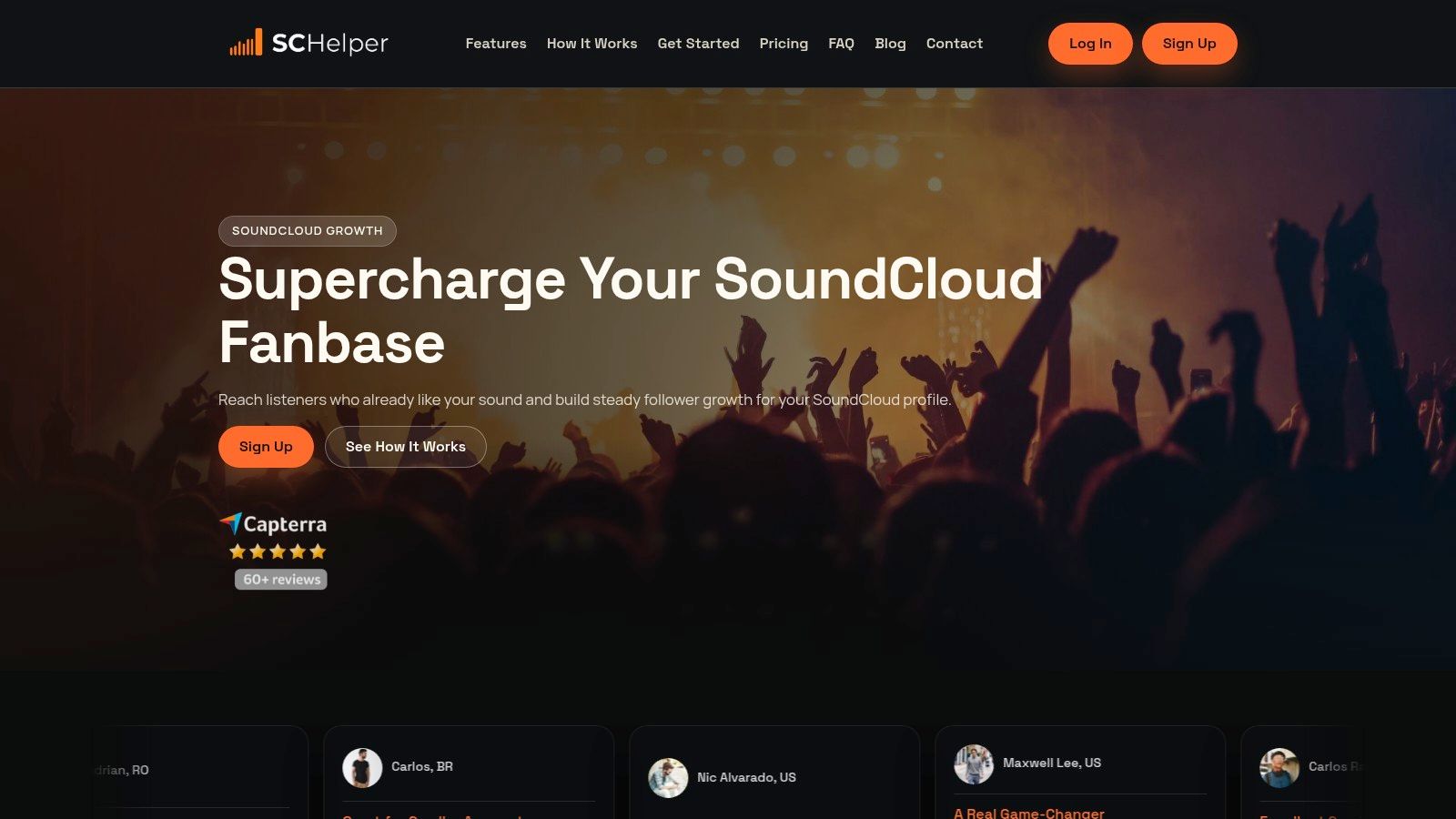
If your problem is SoundCloud growth and you want a controlled daily workflow, SCHelper is built for that job. It uses secure SoundCloud OAuth, so you do not hand over a password, and it suggests listener recommendations based on the artists, genre, and scene you choose. That matters because the goal is not just more activity, it is more of the right activity. The pricing is straightforward on SCHelper, with 1 month for $9.99, 3 months for $26.99, and 6 months for $53.99.
Why it fits a real release workflow
The workflow is deliberately plain. You open the dashboard, review a small batch, confirm the follow and unfollow actions you want, and keep the cadence steady. That suits release weeks where you want repeatable discovery instead of random bursts. It also matters for teams handling more than one profile, because each SoundCloud account needs its own subscription, so the cost adds up fast if you run multiple artists.
Practical rule: use SCHelper for targeted discovery, then measure whether those listeners come back, not just whether they follow once.
The trade-off is clear. SCHelper is not a push-button growth hack, and it should not be treated like one. It works best when you review recommendations daily, keep your targeting tight, and accept that results depend on the track and your consistency. For independent artists, DJs, producers, and small managers who want controlled SoundCloud discovery, that is a fair exchange.
Where it helps most
- Targeted listener discovery: Useful when you want accounts that already follow related artists.
- Safer workflow: Useful when you want confirmation before actions are taken.
- Multi-account handling: Useful for small teams, as long as separate subscriptions fit the budget.
If you want to turn a thin start into steadier profile activity, SCHelper is the first SoundCloud growth tool I would test.
2. Promote on SoundCloud
If you want the cleanest on-platform option, SoundCloud's own promotion tools are the least complicated route. You're staying inside the platform, using creator controls tied to the track itself, and working with the same environment where the release already lives. That makes it a good fit when you care more about official placement than cross-platform reach.
The main advantage is predictability. SoundCloud's pricing page ties promoted track access to the artist plan, with up to 2 promoted tracks per month on Artist and unlimited on Artist Pro. That's useful if you want a clear quota instead of a credit system or an outside marketplace.
What it does well, and what it doesn't
SoundCloud promotion fits artists who already have strong artwork, a solid mix, and a track that belongs on the platform. It won't solve weak targeting, and it won't push your music outside SoundCloud. If you need reach on TikTok, playlist marketplaces, or creator-led channels, this isn't the whole answer.
The upside is compliance and simplicity. No third-party login. No side workflow. No confusion about whether you're using the platform in the way it expects. For artists who prefer official tools, that's a real advantage.
SoundCloud is strongest when the release already has a clear fit, because the tool can only amplify what the track gives it.
In practice, I'd use this when the release is built for SoundCloud listeners and I want a native option that pairs neatly with the rest of the account. If your campaign needs audience discovery plus wider creator exposure, it's better as one layer in the stack than the whole stack.
3. RepostExchange
RepostExchange is the SoundCloud-native option for artists who understand repost culture and want a credit system instead of paid one-off blasts. It's built around earned or purchased credits, so the entry point is lower than many paid promotion services, and you can start without making the whole campaign feel like ad spend. That makes it useful for testing whether your release can travel through creator networks.
The mechanism is straightforward. You request reposts or run campaigns, and members earn credits by taking part in the community. The practical value is that it gives you a measurable exchange layer around a SoundCloud release, which pairs well with audience discovery work elsewhere in your stack. For a deeper look at how this fits into a broader workflow, the article on SoundCloud promotion networks is a useful companion.
The real trade-off
RepostExchange can help your track move through the right circles, but repost quality will vary by partner. That's the main limitation. A repost from a creator whose followers don't match your sound isn't much better than a random impression.
It works best when you've already done the audience-prep work. If SCHelper has helped you identify the kinds of listeners who actually engage, RepostExchange can extend that activity into a broader repost layer. It's a better fit for artists who want a community mechanic than for artists who want a polished ad-style funnel.
- Best for: SoundCloud creators who want credit-based repost distribution.
- Less useful for: Artists expecting uniform engagement from every repost.
- Most effective when: You target carefully and keep the campaign relevant to your scene.
The verdict is plain. RepostExchange is useful, but it's not magic. It's a community tool, which means the result depends on how well your track fits the people you reach.
4. Groover
Groover is a submission platform for artists who want direct contact with curators, playlist owners, blogs, labels, and other industry contacts. The pitch is simple, you buy credits called Grooviz, send the track, and get structured feedback. That makes it a solid tool for testing a song with tastemakers before you spend more on broader promotion.
The main strength is transparency. You know you're working inside a credit system, and the reply structure keeps the process from turning into endless cold outreach. For artists who need a repeatable pitching routine, that predictability is worth a lot more than vague promises.
Where Groover earns its place
Groover is useful when you've already decided the song is ready and you want outside reactions fast. It's also good when you need to pitch across different types of contacts in one workflow, not just playlists. The downside is cost creep, because the bill grows when you start targeting dozens of curators per release.
It's also not the right tool if you're looking for broad audience discovery on SoundCloud. This is a pitching product, not a growth assistant. I'd treat it as a release validation tool, then move the track into whichever audience-building layer makes sense next.
Practical rule: use Groover when you need feedback and placement opportunities, not when you need a cheap substitute for audience research.
The value here is workflow discipline. Groover makes it easy to keep pitching organized, but the artist still has to choose targets carefully. That's where the return lives.
5. SubmitHub
SubmitHub is the more established marketplace for artists who want a broad pool of playlist curators, blogs, labels, and other music contacts. The platform's dual credit system gives you a free path and a paid one, which makes it easier to test without committing all at once. For artists who like clear submission rules, that structure matters.
The paid side is the part I'd pay closest attention to. Premium submissions come with response rules and automatic credit returns when curators don't meet the requirements. That doesn't guarantee coverage, but it does reduce the feeling that you're paying into a black box.
When it makes sense
SubmitHub works best when you have a strong track, a clean pitch, and time to keep track of replies. It's better for deliberate release planning than for last-minute panic pitching. It also fits artists who want to compare feedback across multiple curators instead of relying on one contact list.
The limitation is budget. If you want meaningful reach, the paid side adds up. Some details are also only visible in-app or at checkout, which means you need to read carefully before you commit. That said, the platform still earns a place in a release stack because it gives you structure, accountability, and a broader pitching surface than random DMs.
- Use it for: organized curator outreach.
- Watch for: cumulative spend across multiple submissions.
- Avoid it for: casual “spray and pray” campaigns.
If you're building a serious release routine, SubmitHub is a disciplined pitching tool, not a shortcut.
6. Playlist Push
Playlist Push is for artists who want a more managed campaign and don't mind paying for it. You set a budget, choose targeting, and the platform routes the song to vetted Spotify playlist curators or TikTok creators. That makes it a hands-off option for artists who'd rather buy scale than run every outreach step themselves.
The upside is obvious. Once the assets are in place, the workflow is straightforward. You're not spending your afternoon emailing curators or chasing responses, and the reporting gives you a clearer post-campaign view than most DIY approaches.
The cost of convenience
The trade-off is entry cost. This is not the cheapest part of a release stack, and paying for a campaign doesn't mean you'll get placements. If the song doesn't fit the target audience, no amount of clean setup changes that.
That's why I'd use Playlist Push only when the track already has a strong case for playlist placement or creator-led exposure. It's best for artists who need a scalable push and are willing to buy that scalability. For smaller budgets, you may get more out of tighter pitching plus a smart link than out of a broad campaign.
Practical rule: buy managed reach only after you've confirmed the track can hold attention, because weak fit gets expensive fast.
Playlist Push is valuable because it reduces labor. It isn't valuable because it guarantees outcomes. That distinction matters.
7. SoundCampaign
SoundCampaign stands out because it combines several promotion paths in one place. You can work on Spotify playlist pitching, TikTok creator campaigns, and done-for-you Meta ads without splitting the campaign across separate accounts. That can simplify planning when you want playlist visibility and paid social under one roof.
The platform also uses a pay-per-review style for playlist pitching, with credits returned when promised reviews don't happen. That kind of policy matters because it gives you a clearer boundary between what was delivered and what wasn't.
Good for mixed-channel campaigns
SoundCampaign makes the most sense for artists who want to test more than one channel without building a stack from scratch. If your release needs creator content plus playlist exposure, it saves time to manage both in the same interface. It's also useful if you want guidance on ad budgets instead of guessing at spend.
The downside is that pricing visibility isn't always immediate, so you need to go in with patience. And like every tool in this category, the result depends on the song, the genre, and the target. No single campaign style fixes a weak record.
That's why I'd put SoundCampaign in the middle of the pack. It's flexible and broad, but it's best when you already know what kind of attention you're trying to buy. If you don't, the extra options can become noise.
8. Feature.fm
Feature.fm is a smart-link and pre-save platform built for artists who want to turn traffic into measurable actions. It's not just a place to park links. It gives you release pages, bio links, email capture, retargeting pixels, and attribution reporting, which means you can see what happens after a click instead of guessing.
That makes it useful if your release traffic comes from multiple places. A listener from SoundCloud, a curator, and a social post can all land on the same destination, and you can still track the behavior. For campaigns that need clean fan-data capture, that's a real advantage.
Where it earns trust
Feature.fm is strongest when you care about measurement. It helps you see which actions came from which source, and that matters when you're trying to understand whether your promotion tools are converting. The platform also supports music-specific use cases like pre-saves, contest pages, and tour links, so it's not a generic landing-page clone.
The limitation is that the deeper retargeting and export features sit behind paid tiers. If you only need a basic page, that's manageable. If you want the whole analytics stack, you'll need to budget for it.
I'd use Feature.fm when the release has enough traffic to justify attribution tracking and I want a smarter path from attention to action. It's one of the better choices when the goal is not just clicks, but usable fan data.
9. Linkfire
Linkfire is the broader, label-friendly smart-link option for artists and teams that need more flexible routing. It handles bio links, pre-release pages, release pages, ticket links, reward links, and playlist links in one place. That makes it a strong fit for rosters, managers, and anyone juggling multiple campaign destinations at once.
The core value is control. You can use conditional redirects, territory management, QR codes, and retargeting pixels, which gives you more operational flexibility than a basic link-in-bio setup. For teams running several artists, that flexibility can save time and reduce chaos.
Best for teams, not just solo artists
Linkfire feels more like infrastructure than a growth gimmick. That's a good thing if you need stable reporting and the ability to manage many release types. It's also the kind of platform where the details matter, so I'd read the plan limits carefully before choosing a tier.
The trade-off is that it's more generalized than an artist-only tool. Some advanced features are gated to higher plans, and premium pricing may be more appropriate for bigger teams. That doesn't make it weaker, it just makes it more enterprise-shaped.
For a solo artist, Linkfire can still work well, especially if you want a polished destination page and are serious about analytics. The internal guide on music marketing tools is a useful next read if you're comparing it with other release infrastructure.
10. Hypeddit
Hypeddit is a music-focused growth suite that sits between smart links, fan data capture, and lightweight conversion tools. It gives you smart links, pre-saves, download and link gates, and optional AI-assisted ad setups, which makes it useful when you want to turn SoundCloud attention into an action you can measure. That action might be a follow, an email signup, or a gated download.
The appeal is speed. It's easy to deploy, and the tools are built for artists rather than generic marketers. For newcomers, that matters because you don't need a huge setup just to start collecting useful data.
The practical limit
Hypeddit works best when you already have some traffic to convert. It's not a substitute for audience discovery, and its ad features still require separate spend and testing. So if there's no audience flow yet, the gates won't do much.
That said, it's useful for release campaigns that need a simple action layer. If SCHelper drives relevant listeners into your orbit, Hypeddit can catch that interest and turn it into something trackable. The internal guide on SoundCloud download gates fits that workflow well.
Use Hypeddit when you want a quick conversion layer, not when you're still trying to build first contact.
That's the distinction that matters. Hypeddit doesn't replace growth, it helps convert it.
Top 10 Music Promotion Tools, Feature Comparison
| Tool | Core features | UX & Safety (★) | Value & Price (💰) | Target Audience (👥) | USP / Notes (✨) |
|---|---|---|---|---|---|
| SCHelper 🏆 | Daily curated listener recs; manual batch follow/unfollow; SoundCloud OAuth; PRO filters; multi-account | ★★★★☆; transparent workflow; controlled daily limits; refunds & support | 💰 1mo $9.99 / 3mo $26.99 / 6mo $53.99; volume discounts; instant access | 👥 Independent artists, DJs, producers, small labels, managers | ✨ Real-listener targeting; no password storage; controlled batching; rebuilt v3 stability |
| Promote on SoundCloud | Native promoted placements tied to tracks; integrated analytics & billing | ★★★★☆; official, platform-compliant | 💰 Included with Artist/Artist Pro plans (quota-based) | 👥 Artists wanting official on‑platform reach | ✨ Official placements + direct analytics & monetization integration |
| RepostExchange | Credit-based repost requests & campaigns; free tier; opt‑in manual actions | ★★★☆☆; community quality varies; manual opt‑in | 💰 Free forever tier; buy credits or earn starter credits | 👥 Artists seeking repost amplification via community | ✨ Credit economy for reposts; low barrier to start |
| Groover | Per-contact submissions via Grooviz; guaranteed replies or credit return | ★★★★☆; predictable replies (many within 72h) | 💰 Per-contact pricing (~2 Grooviz typical); packs & discounts | 👥 Artists pitching curators, blogs, labels, radios | ✨ Guaranteed written feedback; curated tastemaker network |
| SubmitHub | Dual credit system (Standard/Premium); auto refunds for Premium no-reply | ★★★★☆; clear rules & refund protections | 💰 Premium credits for prioritized reach; bundles & reporting | 👥 Artists seeking playlist/blog/media coverage | ✨ Premium response rules + automatic credit returns |
| Playlist Push | Budgeted campaigns to vetted Spotify playlist curators & TikTok creators | ★★★★☆; hands-off campaigns with reporting | 💰 Campaigns commonly several hundred $; scalable budgets | 👥 Artists wanting managed playlist/TikTok campaigns | ✨ Managed campaign engine with post-campaign reporting |
| SoundCampaign | Multi-channel: playlist pitching, TikTok creators, Meta ads | ★★★☆☆; centralized service but results vary | 💰 Pricing shown after campaign setup; combines services | 👥 Artists/labels seeking multi-channel paid promotion | ✨ Centralizes playlisting + paid social; credits for no-review cases |
| Feature.fm | Smart links, pre-saves, landing pages, email capture, retargeting pixels | ★★★★☆; strong attribution & conversion reporting | 💰 Free → paid tiers; 7‑day Pro trial; paid features for retargeting/exports | 👥 Artists measuring ROI & converting traffic to fans | ✨ Deep analytics, pre-save pages, retargeting & attribution |
| Linkfire | Bio/pre-release/release links, QR codes, retargeting, team & enterprise tools | ★★★★☆; robust analytics for rosters & labels | 💰 Trial available; Premium/Enterprise subscription pricing | 👥 Indie artists, labels, rosters, teams | ✨ Territory management, conditional redirects, team accounts |
| Hypeddit | Smart links, pre-saves, download/link gates, fan capture, AI ad templates | ★★★★☆; music-focused growth playbooks & gates | 💰 Affordable monthly plans; exposure via Top 100 feed | 👥 Artists converting SoundCloud interest into follows/emails | ✨ Download gates, Top 100 exposure & AI-assisted ad templates |
Matching Each Tool to Your Next Release
The easiest way to avoid wasted spend is to assign one tool to each job. Use SCHelper or another SoundCloud growth tool when the release needs better audience fit. Use Groover, SubmitHub, Playlist Push, or SoundCampaign when the release needs curator pitching. Use Feature.fm, Linkfire, or Hypeddit when you need a single smart link that captures fan data and lets you compare traffic sources cleanly.
That sequencing keeps the campaign from turning into a pile of overlapping logins. It also lets you judge each tool over the same window, which is the only fair way to compare them. If you test one tool for discovery, one for pitching, and one for fan capture in the same release cycle, you can see which part of the stack moved the needle. The Spotify benchmarks above are useful here because they remind you that saves, profile visits, and repeat listening matter more than impressions alone.
I'd also keep the budget fixed per release. Once you set the ceiling, don't keep adding tools just because the dashboard feels quiet on day two. A release can take time to convert, and changing the stack halfway through makes the result harder to read. If you want to compare a SoundCloud growth push against a curator campaign, run each one under similar timing and track the same outcomes.
Watch the cancellation terms before you commit. Check whether each platform charges per profile, per account, per credit, or per campaign, because those costs scale differently. SCHelper's separate subscription per SoundCloud profile is a good example of the kind of detail that matters before you onboard multiple accounts. The same caution applies to smart-link tools with paid analytics tiers and to curator platforms with hidden credit logic.
The best stack is the one that matches the release stage you're in right now. If you need relevant SoundCloud listeners first, start there. If the track is ready for outside validation, move to pitching. If the song already has attention, capture it with a smart link and measure what those listeners do next.
If you want a controlled way to find real SoundCloud listeners instead of chasing noisy reach, SCHelper is built for that job. It fits directly into the release workflow covered here, and it keeps the growth process focused on daily review, relevant discovery, and transparent controls. Visit SCHelper to see how it can support your next release.