
Organic Follower Growth on SoundCloud: A Practical Guide
The most popular SoundCloud advice is also the laziest. Post more, follow more, comment everywhere, and watch the number climb. If it doesn't climb, you're told you didn't hustle enough.
That advice confuses movement with audience building. A follower count can rise while plays stall, reposts disappear, and nobody returns for your next track. Real organic follower growth is slower, narrower, and much more useful. It's about finding listeners who already care about music like yours, giving them a clear reason to stay, and measuring whether they listen again.
Table of Contents
- Why the Follower Count Is the Wrong Goal
- What Organic Follower Growth Actually Means
- The Three Pillars of Steady Growth
- Manual Discovery Versus Curated Workflows
- How a Controlled Daily Workflow Runs in Practice
- Realistic Timelines and KPIs That Actually Matter
- A 90-Day Plan for Putting It All Together
Why the Follower Count Is the Wrong Goal
More followers used to mean more people saw your next post. That relationship has weakened across social platforms, and you can't build a release plan around it anymore.
Historical benchmarks put Facebook organic reach at about 16% of page followers in 2012, about 5.2% in 2020, and roughly 2.2% in 2025, an estimated 86% decline across that period, as shown in the historical organic reach decline benchmarks. A page with 10,000 followers might have reached around 1,600 followers per post under the earlier benchmark and only about 220 under the later one. Those are Facebook figures, not SoundCloud figures, but the structural point transfers. Feeds filter. Platforms test content with a fraction of an audience before widening distribution.
What Replaces the Count
On SoundCloud, distribution depends on who presses play, who likes or reposts, and whose activity surfaces your track to other listeners. A passive follower adds little to that chain. An active listener who follows similar artists, comments on tracks, and shares music can create several new discovery paths.
That's why a smaller, tightly matched audience often beats a larger, indifferent one. Your next release doesn't need to impress everybody who once clicked follow. It needs enough relevant listeners to generate early plays, saves, comments, and reposts.
A follower who never plays your music isn't reach. They're decoration on your profile.
The same quality-over-volume logic applies off SoundCloud. If you're building a visual presence alongside your releases, Veo3 AI's Instagram growth guide is a useful cross-platform reference for thinking about audience fit rather than raw accumulation.
Treat the count as a background indicator. The question is simpler and harder. Are the people following you the people most likely to listen to your next track, and can you prove it from what they do after they follow?
What Organic Follower Growth Actually Means
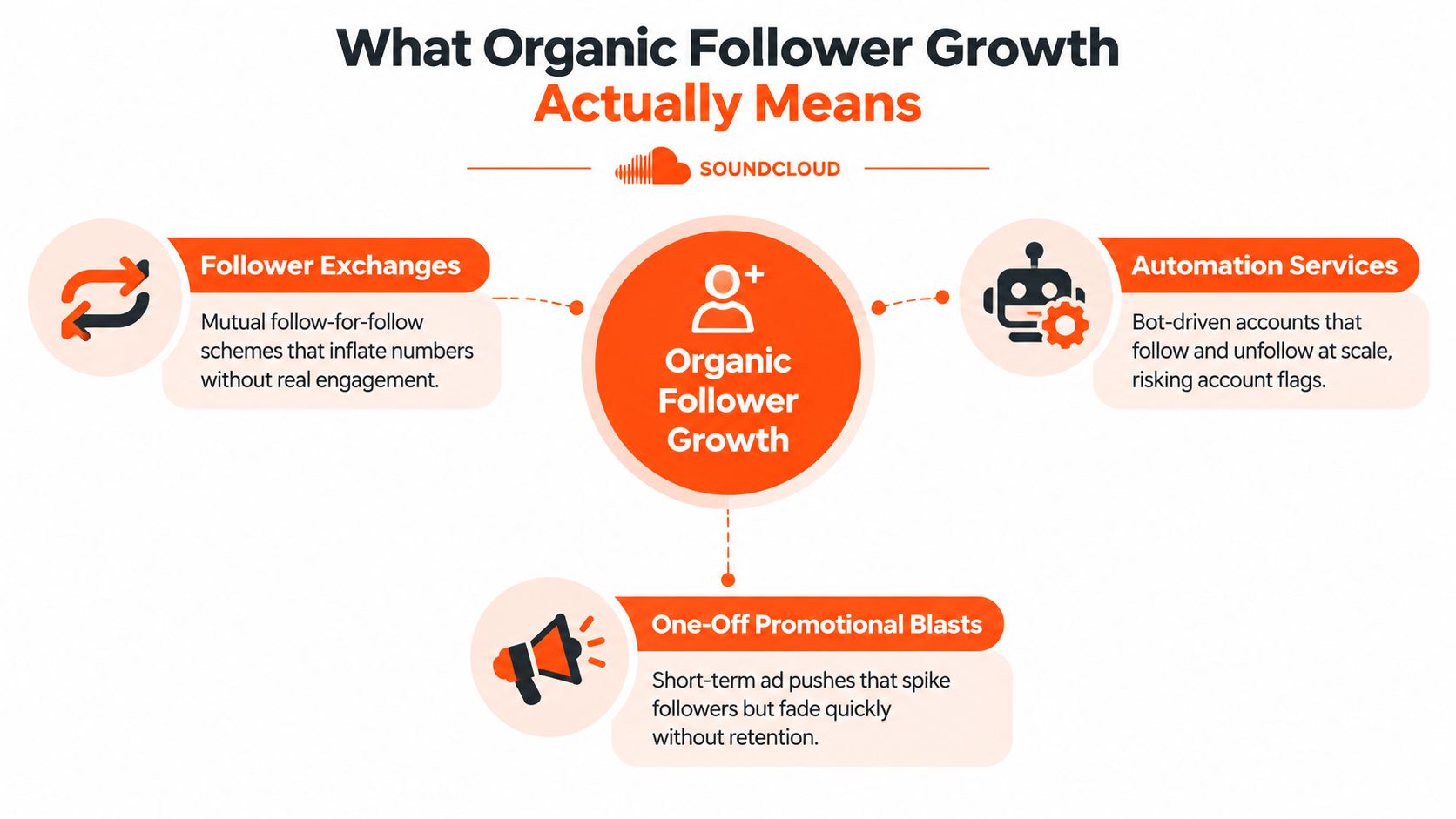
Organic follower growth means a real person finds your music, decides it's relevant to them, and follows without paid amplification or artificial pressure. Three conditions have to hold for that follow to mean anything.
- A real account: The profile belongs to an actual listener, not a shell built to inflate totals.
- A reasoned decision: They heard something, saw your profile in a relevant context, or found you through an artist they already trust.
- A plausible return: Their taste gives them a reason to play your future tracks, not just today's.
Anything that skips those conditions isn't organic, whatever the seller calls it. Follower exchanges trade one low-intent follow for another. Bot automation manufactures activity you didn't earn and can't retain. One-off promotional blasts can push a spike, but a spike without relevance usually decays into silent followers and unfollows.
Why SoundCloud Makes the Distinction Obvious
SoundCloud separates plays, likes, comments, reposts, and downloads instead of collapsing listening into one number. That separation tells you growth is multidimensional. A campaign that lifts followers but not first-track plays hasn't built an audience. It's built a list.
This gives you a practical test for any tactic, free or paid, manual or tool-assisted. Ask where the listener came from, why they might care, and what behavior you'd expect next. If you can't answer those questions, you can't evaluate the tactic.
The search starts with relevance, not volume. Listeners gathered around artists adjacent to your sound are far easier to qualify than strangers pulled from a broad genre tag, which is why finding real listeners on SoundCloud begins with similar-artist communities rather than platform-wide popularity.
Organic growth isn't defined by how hard the work feels. Manual work can still be spammy if it's indiscriminate. It's defined by consent, relevance, and downstream listening.
The Three Pillars of Steady Growth
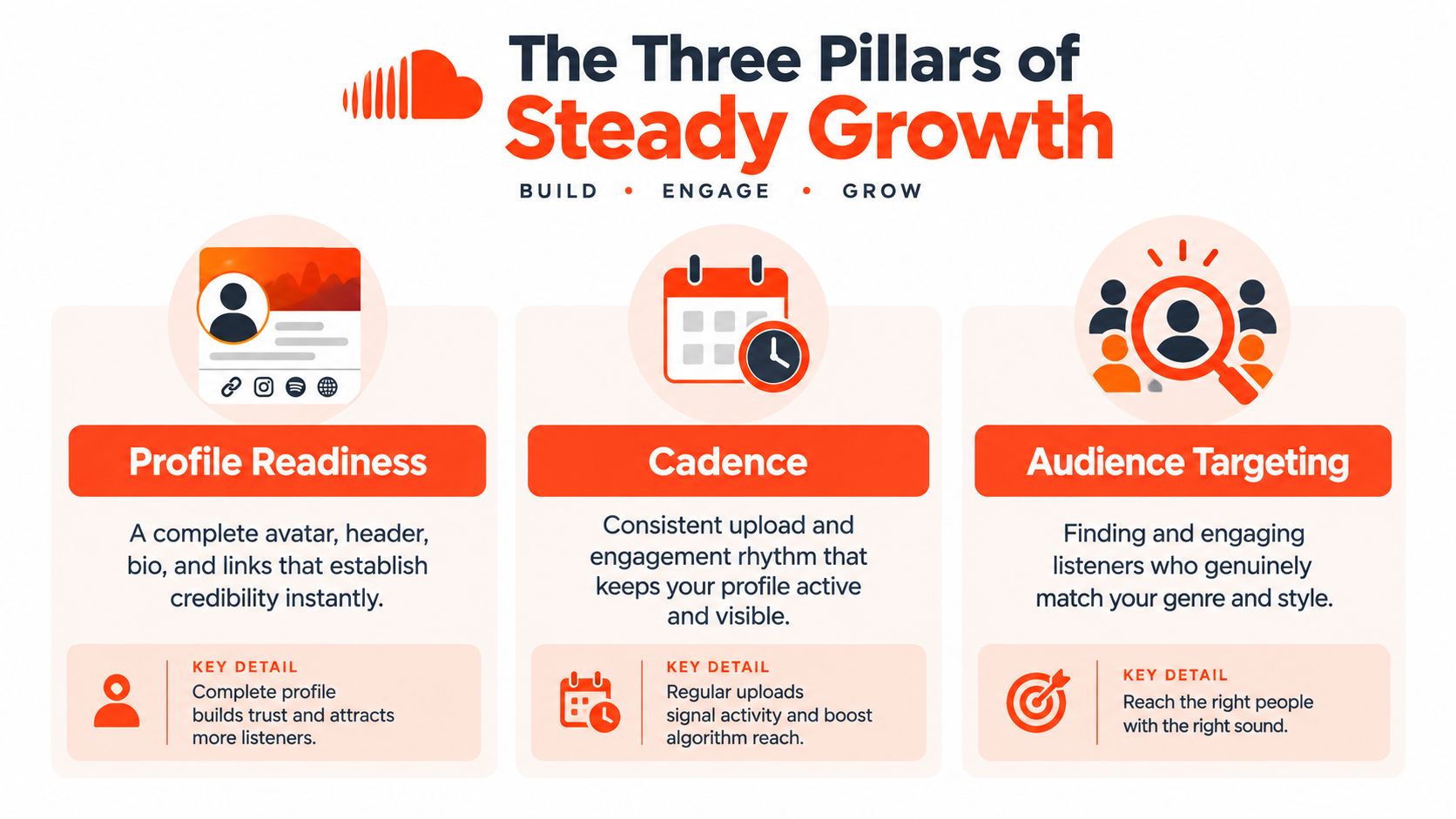
Steady growth doesn't come from one tactic. It comes from three surfaces working together, and weakness in any one of them caps the other two.
Profile Readiness
Most discovery ends at the profile, not the track. A listener clicks through, spends a few seconds deciding what you are, and either follows or leaves. Your avatar, header, bio, and top tracks have to answer three questions fast: what genre, what quality level, and why you rather than the next similar artist.
Pin your strongest, most representative work at the top. Don't lead with an experiment that needs explaining. A clear genre signal in your bio and track titles helps the right listener self-select, and it helps the wrong listener leave, which is also useful.
Content Cadence
Consistency gives recommendation systems more chances to test your music and gives listeners repeated exposure. Buffer's analysis of about 4.8 million channel-week observations across roughly 161,000 profiles found accounts publishing 10 or more times weekly averaged 32 additional followers per week compared with inactive weeks, according to the Buffer analysis of posting consistency and follower growth.
Don't read that as an instruction to flood SoundCloud. For an independent artist, a sustainable cadence might be one meaningful track, teaser, repost, or behind-the-scenes update each week, supported by short daily engagement. Judge yourself against your own inactive weeks, not someone else's viral outlier.
Audience Targeting
Genre labels are too broad to target with. Thousands of listeners sit under one tag, and most won't care about your specific sound. Target behavior instead. Who likes, reposts, and comments on artists who sound like you? Those active participants in neighboring scenes are your best prospects, even when they have small audiences themselves.
If you want a broader framework for turning that kind of targeting into a repeatable system, Taja AI's organic growth guide covers organic strategy beyond a single platform. The pillars reinforce each other. Targeting sends relevant visitors, readiness converts them, and cadence gives them a reason to stay.
Manual Discovery Versus Curated Workflows
You have three realistic ways to get your music in front of relevant listeners. Each one trades time, precision, and risk differently.
Passive posting costs nothing extra, but it depends entirely on whoever the platform happens to show your track to. It works when you already have momentum. For a new account with no repost network, it often means releasing into silence.
Manual discovery gives you full control. You browse similar artists, inspect their active listeners, listen to what those people engage with, and interact selectively. The targeting can be excellent. The cost is hours of repetitive searching, and quality drops when you get tired and start clicking indiscriminately.
A curated workflow compresses the search step. You still choose target artists and review recommendations, but you don't spend your evening assembling the list from scratch. SCHelper fits here as a research-and-relevance layer that surfaces listeners following similar artists, connects through secure SoundCloud OAuth, and requires manual confirmation before batch actions run. Treating any tool that way, as shortlist support rather than a substitute for judgment, is the distinction that matters when you evaluate a music promotion service for SoundCloud.
| Approach | Time Per Day | Targeting Precision | Key Risk |
|---|---|---|---|
| Passive posting | Minimal beyond uploading | Low, platform decides | No initial audience to test with |
| Manual discovery | High, search-heavy | High when done carefully | Fatigue leads to indiscriminate outreach |
| Curated workflow | Low to moderate, review-focused | High if target artists are well chosen | Reviewing carelessly turns curation into volume |
Practical rule: If a workflow removes your ability to say no to a bad-fit listener, it has removed the part that keeps growth organic.
Choose based on your constraint. If time is plentiful and your catalog is small, manual work teaches you your scene. If releases are steady but discovery time isn't, curation protects consistency. Passive posting alone is rarely a strategy. It's a hope.
How a Controlled Daily Workflow Runs in Practice
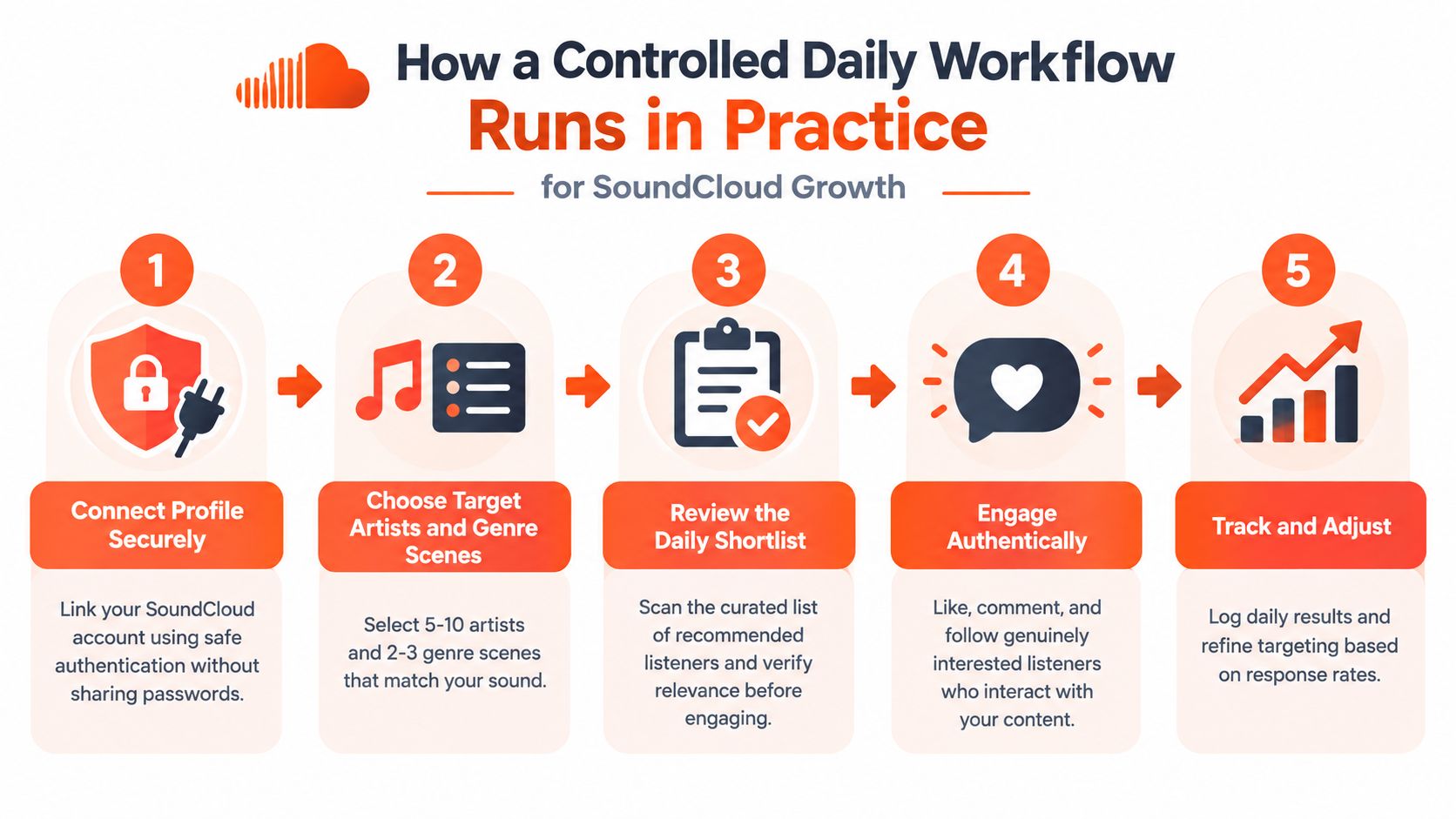
A controlled workflow is deliberately unglamorous. Same short session, same checks, same limits. That repetition is what makes results interpretable.
The Daily Sequence
- Connect securely: Link your profile through OAuth so you're not handing over a password, and confirm you can revoke access yourself.
- Set your targets: Pick a small set of similar artists and genre scenes that match your sound, not aspirational names several tiers above you.
- Review the shortlist: Scan each recommended listener for real activity. Recent likes, reposts, and comments on comparable artists matter more than their own follower total.
- Confirm a capped batch: Approve follow and engagement actions within a fixed daily limit. Nothing runs unattended.
- Clean up and log: Use unfollow and exclusion steps so you don't repeatedly approach the same accounts, then record which target artist the batch came from.
Why the Guardrails Exist
Daily action caps prevent the activity spikes that look unnatural and exhaust your best prospects in a week. PRO-only or exclude-PRO filters let you decide whether you want creators, listeners, or a mix, because those groups behave differently. Exclusion of previously engaged accounts stops the slow drift into pestering people who've already seen you and passed.
Keeping this routine organized across releases and platforms is its own operational problem, and comparing the best social media management tools can help if your promotion work spans more than SoundCloud. Inside SoundCloud, though, keep it simple. One shortlist, one review, one capped batch, one log entry. If you can't sustain it on a bad week, it's too complicated.
Change one variable at a time. Swap a target artist, keep the daily volume steady, and you'll know what caused any shift in response.
Realistic Timelines and KPIs That Actually Matter
Percentage growth gets harder as you get bigger, and your targets should reflect that. Socialinsider's analysis of about 35 million Instagram posts found accounts with 1,000 to 5,000 followers grew roughly 22% annually, while growth fell to about 11% for accounts with 100,000 to 1 million followers, per the Socialinsider benchmarks on follower growth by account size. Growing from 1,000 to 1,220 followers is 22% growth. The same percentage at 100,000 followers requires 22,000 new followers.
Those are cross-platform benchmarks, not SoundCloud promises. Use them to set sane expectations. A sustained 2% monthly increase compounds to roughly 27% over twelve months before churn. Early on, modest absolute numbers can still represent strong proportional progress.
Defining a Qualified Follower
Count followers in cohorts, grouped by the week and target artist they came from, then check them at 7, 30, and 90 days.
- First-track play rate: Did they listen after following?
- Repeat-listen rate: Did they come back for a second track or a later release?
- Engagement depth: Likes, comments, reposts, and playlist additions, not just a follow.
- Retention: Are they still following at day 90, or did they churn?
A useful summary metric is qualified follower conversion, calculated as new followers from target-audience interactions divided by target-audience profile visits. Segment it by genre, source artist, country, and campaign week.
If followers rise while repeat plays stay flat, your source is mismatched. The count is telling you the least interesting part of the story.
Listener sharing now carries weight that raw following doesn't. SoundCloud's Music Intelligence reporting says listeners who discover tracks through Liked By playlists are more than three times as likely to engage with those tracks, according to SoundCloud's Music Intelligence findings on listener discovery. One engaged listener who likes your track puts you in front of their audience. Ten silent followers don't.
A 90-Day Plan for Putting It All Together
Ninety days is long enough to separate signal from noise and short enough to keep you honest. Run it in three phases, and resist changing everything at once.
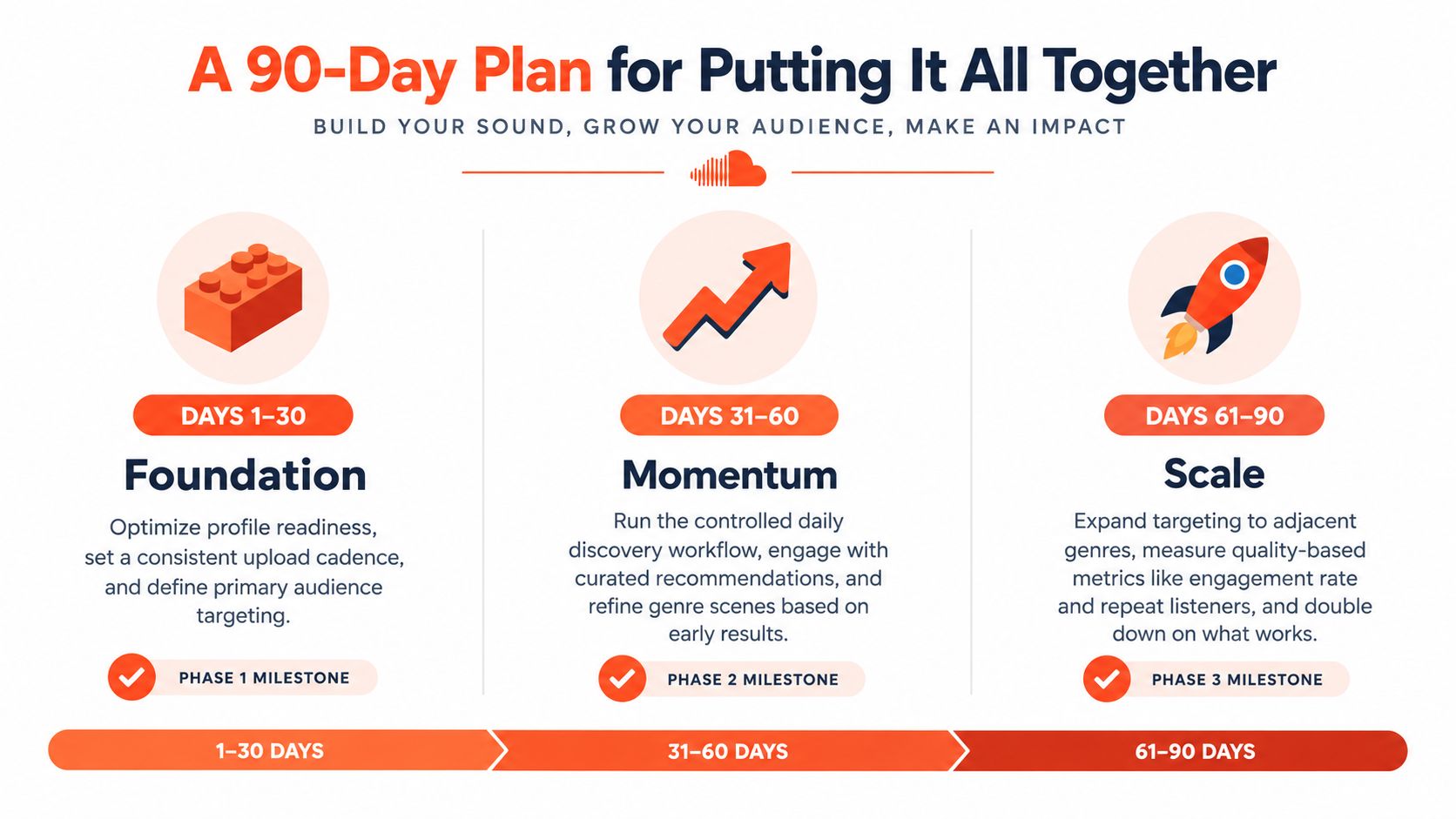
Days 1 to 30 Build the Foundation
Audit your profile first. Fix the avatar, header, bio, and pinned tracks before you send anyone there. Choose your initial target artists carefully, favoring peers whose listeners visibly like and repost rather than stars whose audiences are too broad to convert.
Record your baseline during this phase: current followers, plays per track, and engagement per release. Without a baseline, phase three becomes guesswork. This is also the right moment to map discovery against your wider release efforts, since how to promote music as an independent artist depends on the same profile and targeting decisions.
Days 31 to 60 Run the Routine
Start your sustainable release rhythm alongside the controlled daily workflow. Keep batch sizes and session length stable. Log every cohort by source artist and week, even when results look unexciting, because flat early data is still data.
Days 61 to 90 Decide From Evidence
Review your cohorts at the 30-day mark and beyond. Which source artists produced repeat listeners? Which produced follows that never played anything? Cut the second group without sentimentality and reallocate effort to the first.
Then make a deliberate budget decision. If you're using paid support, treat it as a defined campaign length, not a permanent dependency. Renew only if qualified follower conversion and repeat listening justify it. Cancel or pause if they don't. The plan ends with a choice you've earned the evidence to make, and that's the whole point of measuring quality instead of counting heads.
If you want that daily shortlist, similar-artist targeting, and review-before-action control without spending your evenings searching manually, SCHelper is built around exactly that workflow, with secure OAuth, capped batch actions, and exclusion controls for accounts you've already engaged. Start with a short campaign, track your cohorts for repeat plays and reposts, and let listener quality, not the follower count, decide whether to continue.