
Grow SoundCloud: A Practical Plan for Real Listeners

You've just uploaded a track you're proud of. The first day brings a few plays from friends, then the graph goes flat, and you're refreshing stats wondering why strangers who'd like this sound never find it. That gap is normal. To grow SoundCloud in a durable way, you don't need louder promotion. You need a weekly routine that finds listeners already close to your genre, turns their curiosity into repeat plays, and checks who's still listening after 30 days.
Table of Contents
- Weekly Growth Routine at a Glance
- Tracking Growth With Three Funnel Metrics
- How to Find Listeners Who Already Like Your Sound
- Engagement That Builds Real Fans
- Timing Releases for Sustained Discovery
- Turning Listens Into Earnings and Fan Value
- Confirm Your Plan and Start This Week
Weekly Growth Routine at a Glance
Start this on Monday and keep it boring. Consistency matters more than a heroic push you can't repeat next week.
Your default week
| Activity | Frequency | Time needed | Metric to track |
|---|---|---|---|
| Listener discovery session | 3-4 times a week | 30-45 minutes | Qualified prospects reviewed |
| Profile visits and genuine engagement | Daily | About 20 minutes | Profile-visit rate |
| Release-week promotion | First 7 days after release | 1-2 hours a day | Plays in the first 7 days |
| Catalog revisit and sharing | Weekly | About 30 minutes | Repeat plays on older tracks |
| Performance review | Weekly | About 20 minutes | Retained followers at 30 days |
Between releases, this runs under 30 minutes a day. During release week, expect roughly 60 minutes a day, sometimes more on the first two days. That's intentional. Early response is densest then, and you want to answer comments and visit listeners while the track is fresh.
The catalog revisit is the row most artists skip. Once a week, share or repost one older track, then check whether people play it again or move to another song in your catalog. Older tracks that keep earning repeat plays are assets. They give new listeners somewhere to go after your latest release.
How to judge the week
Don't judge it by follower count alone. A good week shows three things:
- Profile visits rising: More reviewed listeners are checking who you are.
- Older plays holding steady: Your catalog isn't going silent between releases.
- Retained followers: A small, stable number of new followers are still around after 30 days.
A few well-chosen listeners who play two tracks and come back next week beat a large number of empty visits every time.
Set up a simple activity log before your first discovery session. The metrics in the table are defined next, so you'll know exactly which columns to record from day one.
Tracking Growth With Three Funnel Metrics
Follower volume can rise while your audience stays shallow. You gain names, but nobody plays the second track. Three stage metrics fix that blind spot.
| Metric | Formula | How to set the target |
|---|---|---|
| Profile-visit rate | Profile visits ÷ qualified prospects | Set from your 7-day baseline |
| New followers ÷ profile visits | Set from your 7-day baseline | |
| Retained-follower rate | Followers still active after 30 days ÷ new followers | Track a 30-day cohort for each week of new followers |
SoundCloud publishes no universal benchmark for this funnel, and its Community Guidelines set rules for behavior rather than success rates. So build your own reference point. Record seven normal days first, then treat that 7-day baseline as your target to beat. For retention, group each week's new followers into a cohort and check that exact group on day 30.
If you want a model for disciplined baseline tracking outside music, Narrareach's guide to Substack analytics shows a similar habit of defining metrics before chasing growth.
Run one clean test
Compare two groups of target artists for 14 days. Hold your release timing and content constant, change only the listener source, and keep the group that produces more retained followers per reviewed prospect.
Decision rule: Change course when two consecutive 7-day baselines show falling conversion. Don't react to a single quiet day.
How to Find Listeners Who Already Like Your Sound
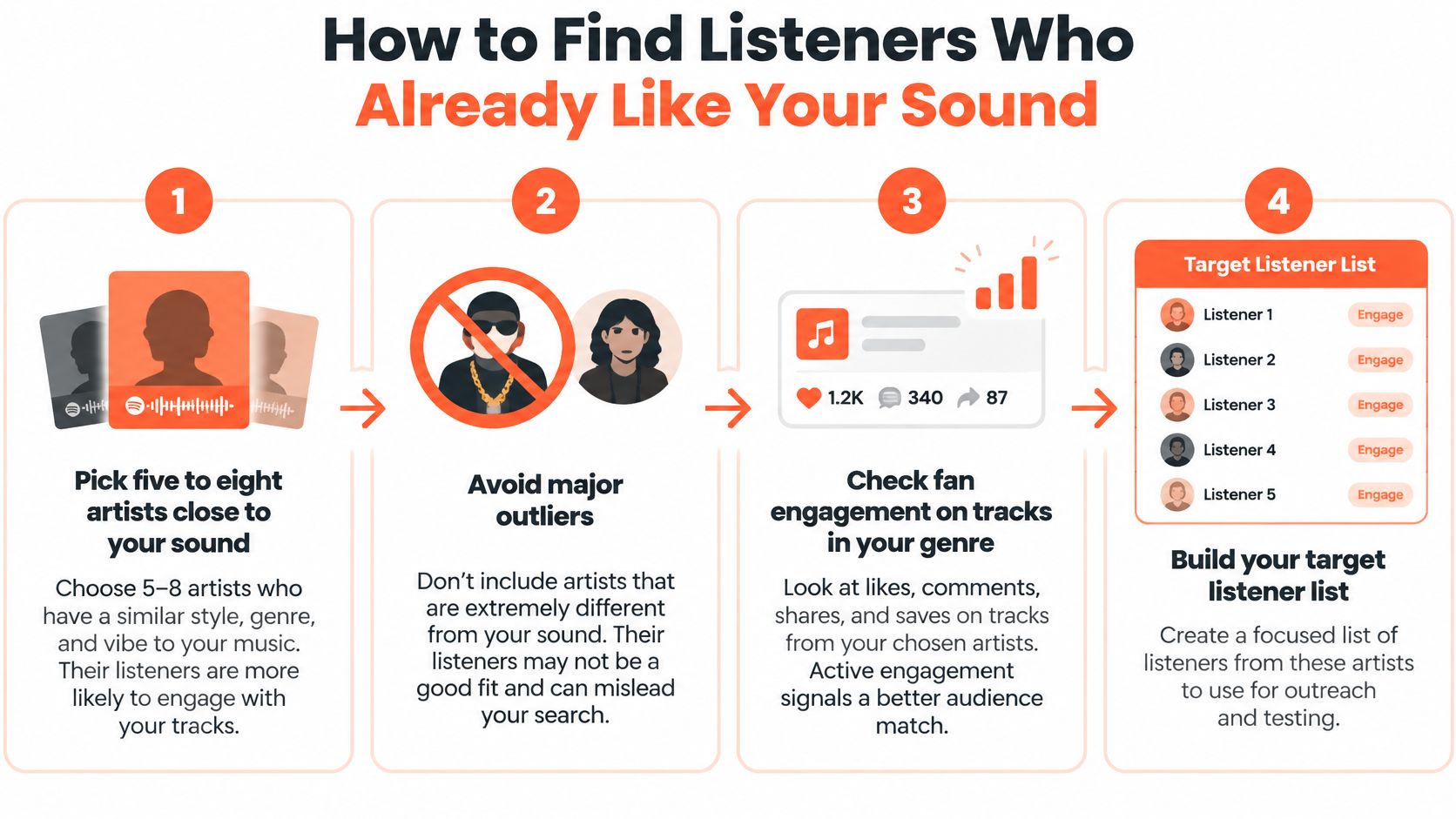
- Pick five to eight close artists. Choose artists whose sound sits near yours and whose listeners engage in your genre. Skip major names. Their audiences are too broad, and your track becomes noise to most of them.
- Skim recent listeners for fit. Open recent listeners on each artist's tracks. Look for genre match, location that makes sense for your scene, recent activity, and genuine signs like comments and reposts.
- Listen before you engage. Visit the strongest matches and play two of their tracks or liked tracks first. You'll quickly hear whether your sound belongs in their rotation.
- Log every prospect. Use a simple sheet with date, source artist, and your decision. That log feeds your profile visits ÷ qualified prospects calculation, so don't rely on memory.
- Cap the daily batch. Review 15 to 20 prospects properly rather than skimming a long list. If you can't listen and judge fit, the batch is too big.
- Don't recycle names. Skip anyone you engaged with in the last 30 days. Repeat contact wastes your limited time and annoys the listener.
Say you're a deep house producer. I'd start with mid-sized artists in your exact subgenre whose comment sections show repeat listeners, not a festival headliner whose fans span every electronic style.
You'll know it's working when reviewed listeners start commenting, playing, or revisiting your tracks within a few days. One-time plays are a start. Return behavior is the signal that overlapping taste is turning into your audience.
Engagement That Builds Real Fans
Finding the right listener is only half the work. What you say determines whether they remember you as a musician or as another account asking for attention.
Five habits that hold up
- Comment on a real detail: Mention the drop, a vocal line, or a sample choice. Don't leave a generic emoji or "great track" and expect a reply.
- Repost with intent: Repost only tracks you'd recommend to your own listeners. Your reposts teach people what your taste stands for.
- Message sparingly: Send a direct message only to listeners who've already played your music, and keep it to one sentence about a specific track.
- Use the Fans tool carefully: If you're eligible, spend messages on your most engaged fans first.
- Never copy and paste: Repeating the same comment across tracks reads as spam, even if your intentions are fine.
For that fourth point, SoundCloud describes its Fans tool as in beta for Artist Pro subscribers, with independent artists eligible in the month after monetizing, and capped at 50 messages per day in its Fans tool guidance. Treat that cap as a quality filter, not a quota to fill.
Our deeper notes on building SoundCloud engagement expand on comment and repost etiquette. The same quality-over-volume logic shows up in strategies for more TikTok interactions, where specific replies outperform broad outreach.
Don't count visits as fans. A listener who views your profile and never plays a track isn't a fan yet. They're a maybe.
Try a three-day test. Leave one specific comment per day for three listeners, then check within a week whether any of them play a track or reply. Replies, plays, and profile returns from the same people prove the approach works. A sudden jump in numbers without those returns doesn't.
Timing Releases for Sustained Discovery
Release day gets too much credit. SoundCloud's Amplify documentation says eligible new tracks are initially recommended to approximately 100 listeners whose profiles align with the sound, but the system cannot force listeners to finish a track. That first window is a test, not a guarantee.
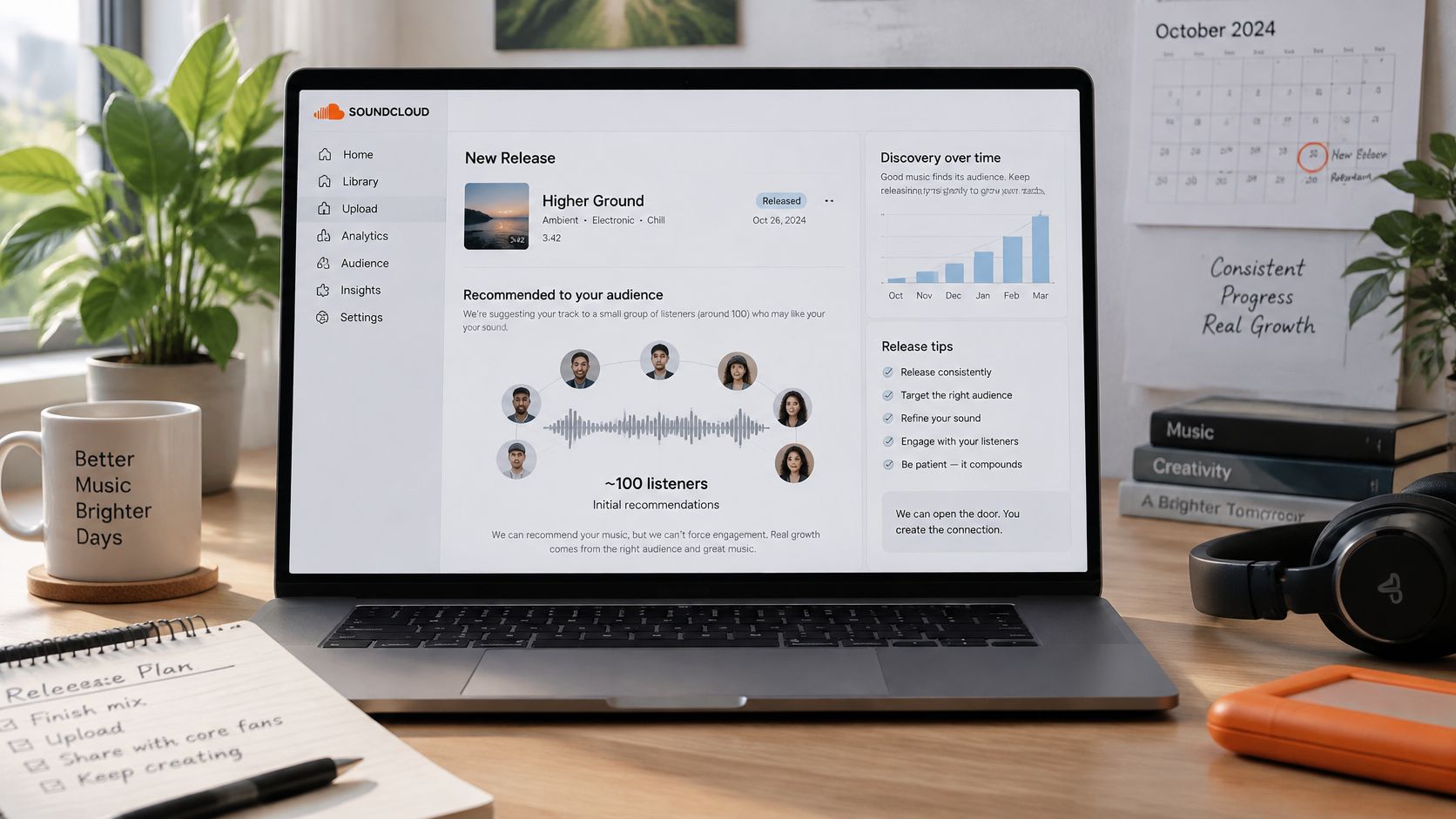
A phased plan after upload
- Two weeks before: Build a list of 20 relevant listeners with the discovery method. Mark each name with its source artist so you can judge which source performed.
- Days one to seven: Visit those reviewed listeners, leave specific comments, reply fast, and track plays daily. This is your heaviest week.
- Weeks two to four: Share the new release alongside your previous track. Listeners who liked the first one get a clear next step, and new listeners get depth.
- From month two: Revisit one older track each week through a repost or share. Check whether those plays are repeat listens, not just first clicks.
- Fix the opening: Keep the intro and first 30 seconds strong. More promotion won't repair weak completion if listeners leave early.
SoundCloud also describes "early days" recommendations for users with limited listening history and a Fan First system for newly uploaded Next Pro tracks. For a new artist, that means early listeners may include people still forming taste signals, while established fans can be reached more directly through Fan First. Plan for both, but don't confuse either with guaranteed reach.
Our music release strategy guide covers sequencing singles across a longer campaign.
Keep a track in active promotion only while it still earns repeat plays. When repeats stop, move your energy to the next release or a stronger catalog track.
Turning Listens Into Earnings and Fan Value
Growth feels different once you understand how SoundCloud pays. Under fan-powered royalties, earnings link to each fan's listening rather than one pooled model. SoundCloud considers how much of a listener's total monthly listening went to an artist, that listener's advertising or SoundCloud Go+ status, and its revenue share, and it states there's no minimum stream threshold to start earning in its fan-powered royalties guidance.
In plain terms, a fan who spends all their listening time on you directs that listener's relevant revenue toward you. A casual listener who splits time across dozens of artists splits value too. That's why retained, repeat listeners matter commercially, not just socially. Only plays on SoundCloud count.
| Requirement | What it means |
|---|---|
| Subscription | Artist or Artist Pro subscription with the SoundCloud for Artists dashboard set up |
| Rights | You own the track or hold the legal permissions for it |
| Track length | Longer than 30 seconds and shorter than 10 minutes |
| Excluded formats | Unofficial covers, remixes, mashups, DJ sets, audio recordings and podcasts |
| Payout method and tax form | Both required before the first payment |
| Payout threshold | Paid monthly once the balance reaches $25 |
| Review time | Up to five business days for monetization review |
Check eligibility before you promote. SoundCloud's monetization guidance requires rights you own or have permission to use, so send listeners toward original tracks that qualify. For context on how platforms differ commercially, see our SoundCloud versus Spotify comparison. If you sell other work as a freelancer, AmaJova's guide for freelance product sellers is a useful reminder to separate audience building from immediate sales.
Timing is the catch. SoundCloud's payout information says earnings are paid monthly once the balance reaches $25, first-time earners face about 45 to 60 days of setup, and then there's a standard two-month reporting delay. Audience growth doesn't create instant cash flow. Budget your patience accordingly.
Confirm Your Plan and Start This Week
Keep your first week deliberately small:
- Choose three comparable artists whose listeners match your sound.
- Set a 20-minute daily review and keep it for seven days.
- Record your 7-day baseline for profile visits and new followers.
- Wait until day 30 to check retention before changing your targeting.
If the manual routine is too slow to maintain, we built SCHelper as a web app for desktop and mobile browsers. It connects through SoundCloud OAuth, so your password is never shared or stored, and it gives you a daily shortlist matched to your genre and scene for your own review. The 1-month plan costs $9.99 for one account, and each connected account needs its own subscription.
SCHelper is not affiliated with SoundCloud. You review every recommendation yourself, and you're responsible for activity on your account. Before connecting any tool, confirm it uses OAuth, asks only for needed permissions, and never asks for your password. Keep a log of who you contacted and when.
Start the seven-day test this week, and only add a tool if the manual routine is too slow to keep up.
If you want that daily listener shortlist without building the spreadsheet and search routine by hand, SCHelper gives you curated recommendations based on artists close to your sound, with secure OAuth sign-in and full control over every review. Visit SCHelper to set up your first target artists and run your seven-day baseline this week.