
How to Get Reposts on SoundCloud: Relevance Beats Volume

Which repost moves a track: the one from the account with the biggest follower count, or the one from the account whose listeners already play your genre?
That distinction changes how you prospect, how you ask, and what you count afterwards. Learning how to get reposts on SoundCloud starts with admitting that the count was never the goal. The recommendation is.
Table of Contents
- Why Reposts Depend on Listener Fit
- Find Curators Whose Listeners Already Fit
- How to Earn and Ask for a Repost Step by Step
- Metrics That Show Whether Reposts Work
- Pace Your Asks and Start This Week
Why Reposts Depend on Listener Fit
The direct answer sits in documentation most artists never open. SoundCloud's Insights overview defines reposts as shares that push a track into other listeners' Streams. It's a distribution event, not a trophy on your profile. So the useful question before any outreach isn't "how many reposts can I collect" but "who is on the other end of each one".
Judge every repost by three outcomes rather than by the repost itself:
- Plays from the repost's audience. Did listeners who arrived through that account press play, or did the track sit unopened in their feed?
- Comments from people you don't know. A comment from a stranger is the clearest signal that a repost reached past your existing circle.
- Listener geography. Insights shows where the response came from, which tells you whether the repost travelled into your target cities or sideways into a market you can't serve.
The mindset shift: a repost is an editorial recommendation you earn through genuine interaction. Large numbers of loose connections don't guarantee one.
Find Curators Whose Listeners Already Fit
Start with the scene, not the biggest profile you can find. Write down genre, tempo range, city or region, and three to five artists whose listeners you want. A prospect's last few months of posts are the proof. The follower number is only a label. A similar artists finder maps the listeners around those named artists, so you stop guessing at hashtags.
Screen prospects in a fixed order
- List ten comparable artists or curators who already sit inside your scene. Comparable means a similar audience size and a similar sound, not the biggest name you can think of.
- Open their last three uploads. Check genre and tempo against your anchors. If two of the three drift somewhere else, they're a weak fit no matter how good their numbers look.
- Read the bio and their last dozen reposts. You're looking for taste: do they repost music that hangs together, or whatever lands in their inbox?
- Read the comments on two or three of their tracks. Real sentences from real listeners beat a follower count every time.
- Keep only the accounts that survive all four checks, then set a shortlist you can work by hand.
Use this pass or fail sheet on each prospect so the decision takes a minute rather than an afternoon.
| Signal | Strong fit | Weak fit |
|---|---|---|
| Recent uploads | Same genre, tempo and scene in the last few releases | Unrelated genre or no uploads in months |
| Listener activity | Comments and plays from accounts that look like your audience | Follower count with little visible engagement |
| Repost history | Reposts that match their own catalog and taste | Repeated reposts of unrelated material |
| Response to outreach | Engages with your track before any request | Asks for reciprocal reposts up front |
If you already buy creator placements in other channels, judge this the same way you'd approach measuring podcast influencer campaign ROI: engaged listeners per ask matters, not the audience size you were promised.
Keep a suppression list from day one, with anyone already contacted or engaged on it, so no one gets the same ask twice. A shortlist of 10 to 20 relevant accounts per release will outperform a long list of loose connections, and the terms of use set the outer boundary anyway, prohibiting repeated reposting or liking of content already reposted or liked and restricting services that promise engagement boosts.
How to Earn and Ask for a Repost Step by Step
The mechanics are unglamorous and short. Work through these in order, because each step removes one reason for a curator to ignore you.
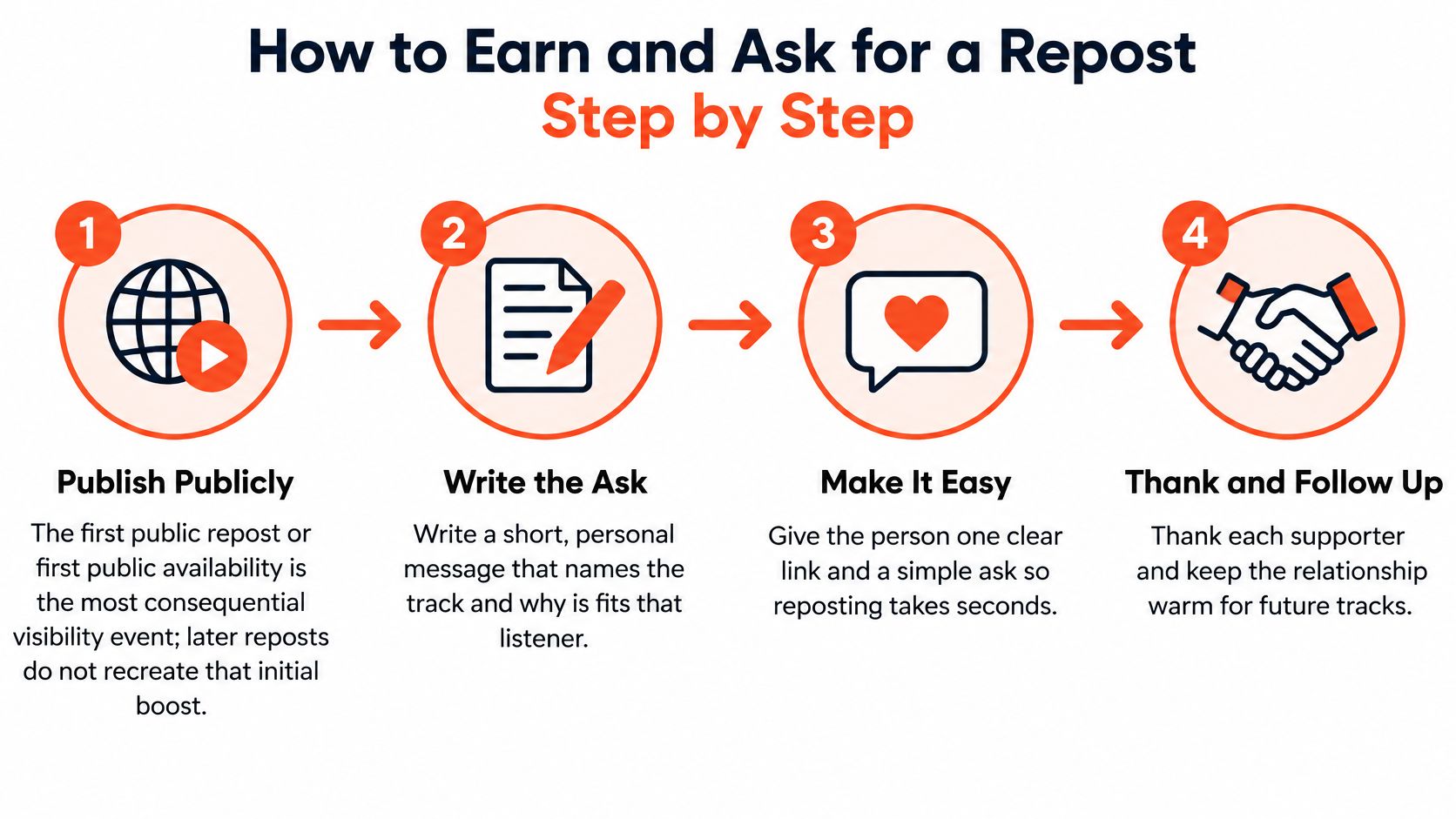
Publish the track publicly before you do anything else. SoundCloud's sharing documentation explains that a track is pushed to the top of followers' feeds only the first time it is reposted or when it becomes public, and private tracks stay off your public profile and out of search. The common slip is leaving it private while you "test" it, then spending the launch moment on a quiet day.
Write the profile and the track description so they invite a reaction. Two or three lines on where the track came from and what you want listeners to notice is enough. The slip here is a description full of genre tags and thank-yous, which gives a listener nothing to respond to.
Spend the first several days replying to relevant listeners by name. Specific beats enthusiastic. "That filtered break at 1:40 is the reason I sent this one" starts a conversation; a row of fire emojis doesn't. The slip is doing all your engagement on release day and disappearing by Wednesday.
Verify your email address before you need it. A verified email is required to add a caption to a repost, per SoundCloud's caption guidance. Finding that out at 11pm on release night is a wasted evening.
Ask one compatible artist after genuine support, and name a detail. One track-specific observation, one link, one sentence about why their listeners would want it. The slip is the copy-paste ask that names nothing, or asking before you've interacted at all.
Keep the caption under 140 characters including spaces. Captions appear in followers' Streams alongside the repost rather than on the reposter's profile page, so the caption travels with the track and is worth writing carefully. The slip is a caption that says thanks and nothing else, when you have a short line to tell a stranger why to press play.
Treat each account's repost as a single shot. A track can be reposted only once by an account, and editing the caption afterwards doesn't repost the track or push it back into followers' Streams. The slip is spending that one repost on a loose match, or rewriting captions later hoping for a second bump that can't happen.
Practical rule: write the caption before you send the ask. If you can't compress the reason into 140 characters, the reason isn't clear enough yet.
When the repost round is finished, the next channel to work is playlists, and the sequencing in this guide to playlist pitching picks up where a repost leaves off.
Metrics That Show Whether Reposts Work
| Metric | What it shows | How to calculate |
|---|---|---|
| Reposts per 100 qualified profile visits | Whether your targeting matches listeners | Reposts divided by qualified profile visits, times 100 |
| Repost conversion rate | Share of asks that turn into reposts | Successful reposts divided by qualified asks |
| Plays from repost traffic | Whether the new audience actually listens | Plays in the seven days after each repost, tracked by source |
| Listener retention | Whether listeners stay through the track | Completion or repeat-listen proxy, compared across cohorts |
| Comments from non-followers | Fresh discovery beyond your existing audience | |
| Follower conversion | Whether reposts leave you with people you can reach again |
What to log for every ask
Set the dashboard up before the first request, not after. For each ask, record the timestamp, the source account, the genre match, the account's follower count, whether the repost happened, profile visits, plays from repost traffic, a completion or repeat-listen proxy, and follower conversion. That's nine fields and roughly two minutes per row. Without that row, you cannot compare one release with the next.
SoundCloud's Fan Insights documentation lists reposting among the usage behaviours it collects for artist analytics, alongside plays, likes, comments, sharing and downloads. Repost reporting can be examined by track, audience, city, country, SoundCloud app, website, RSS feed, and third-party app. Artist Pro users get additional detail on which tracks received reposts and who the listeners behind them are. Use the city and country breakdown to see where the response is strongest, then weight your next shortlist toward curators whose audiences sit in those markets.
How to read cohorts
Compare groups, not single posts. Sort asks by source artist and by release timing, then line up at least two or three comparable posts before you draw a conclusion. One quiet repost might be a Sunday night problem. Three from the same cohort that produce nothing is a fit problem.
SoundCloud publishes no benchmark conversion rate for reposts. Any universal percentage you see quoted belongs to someone else's audience, so compare your own cohorts and ignore those targets. I treat a rising repost count with flat plays as a failed recommendation, not a growth result. If you want the surrounding signals in one place, this guide to SoundCloud engagement covers the measures that sit alongside reposts.
Fix the second problem before the next round of asks. A repost sent to a profile that doesn't convert is a recommendation you cannot reuse.
Pace Your Asks and Start This Week
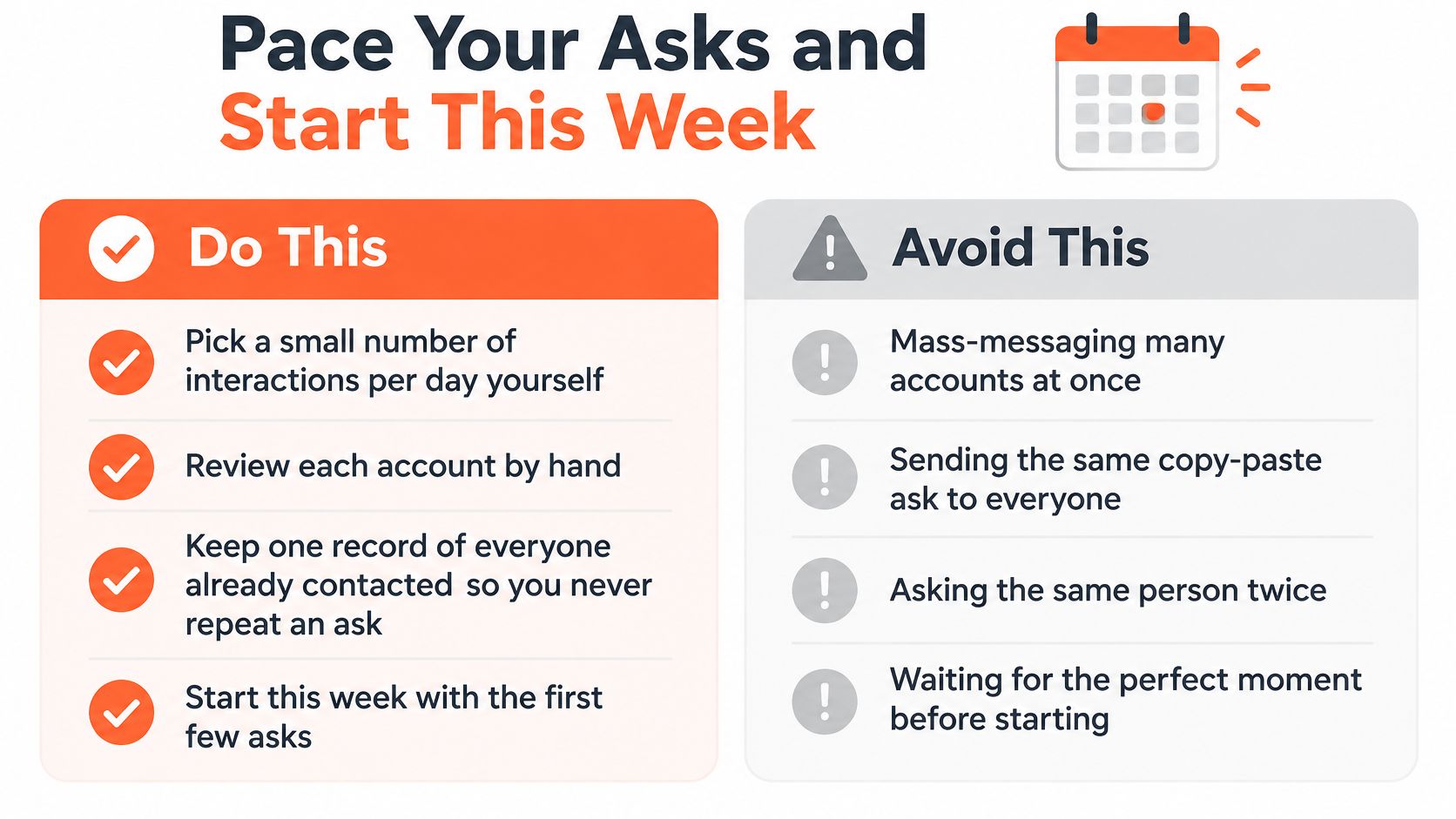
Volume is where most repost campaigns fall apart, and not because the platform punishes ambition. It's because volume forces you to stop looking at who you're asking. Choose a number of interactions you can review by hand each day, and keep it fixed even in a strong week. Ten thoughtful interactions a day beat fifty rushed ones, and the record you keep while screening tells you when someone has gone quiet.
Where a repost swap turns transactional
A reciprocal repost stops being a recommendation the moment it becomes a quota. Three markers give it away: the same person is asked repeatedly across releases, the ask arrives with a number attached ("I'll repost three of yours if you repost three of mine"), and the request gets pressed again after the recipient has gone quiet. A curator who feels invoiced will repost you once to clear the debt and never again.
Accounts to leave off the list
Some accounts cost more than they return. Skip anyone who repeatedly reposts material with no connection to their own catalog, anyone whose tracks show no meaningful listening or comment activity, and anyone who opens with a demand for mass reciprocal action. These accounts inflate a count and dilute the recommendation, which is the opposite of what you're buying.
The platform rules back this up. Reposting the same material over and over, or chasing engagement through services that claim to supply it, is exactly what SoundCloud's terms are written to stop. A repost you had to force is worth less than no repost at all.
Judgement call: if you wouldn't send this track to the person's listeners for free, don't ask them to.
One week, one release
Here's the sequence I'd run for the next release, and it fits inside seven days.
- Pick the release and build a shortlist of about 15 accounts using the screening order from the scene review. Fifteen is enough to compare results and few enough to review properly.
- Publish publicly and rewrite the profile and description so a first-time listener has a reason to comment. Do this before outreach, not after.
- Reply to relevant listeners by name for the first three or four days. Specific observations, no template language, no link dumping.
- Send one short, track-specific request to the best-matched artist on your shortlist, with the caption written and the reason clear.
- Book a review date after two or three posts. At that review, check plays from repost traffic first, then comments from non-followers, then geography.
That last step matters more than it looks. If you review plays first, you find out whether the recommendation reached anyone. Comments and geography tell you whether those listeners have anything in common with the ones you want next.
This is also where a curation tool earns its place, provided you stay in the reviewing seat. Our daily shortlist is built around the target artists, genre and scene you choose, and you look at each recommended listener yourself before anything happens on your account. Each SoundCloud account connected to SCHelper needs its own active subscription, and you can disconnect your SoundCloud account from the workspace whenever you stop.
If you want the prospecting half of this workflow handled, SCHelper builds a daily shortlist of SoundCloud listeners around the target artists, genre and scene you pick, so the accounts you review already sit close to your sound. You connect through SoundCloud OAuth, we never store your password, and nothing happens on your profile without your review. Start with one release, one shortlist, and a review date three posts out.