
What Is Music Marketing? a Practical Guide for Artists

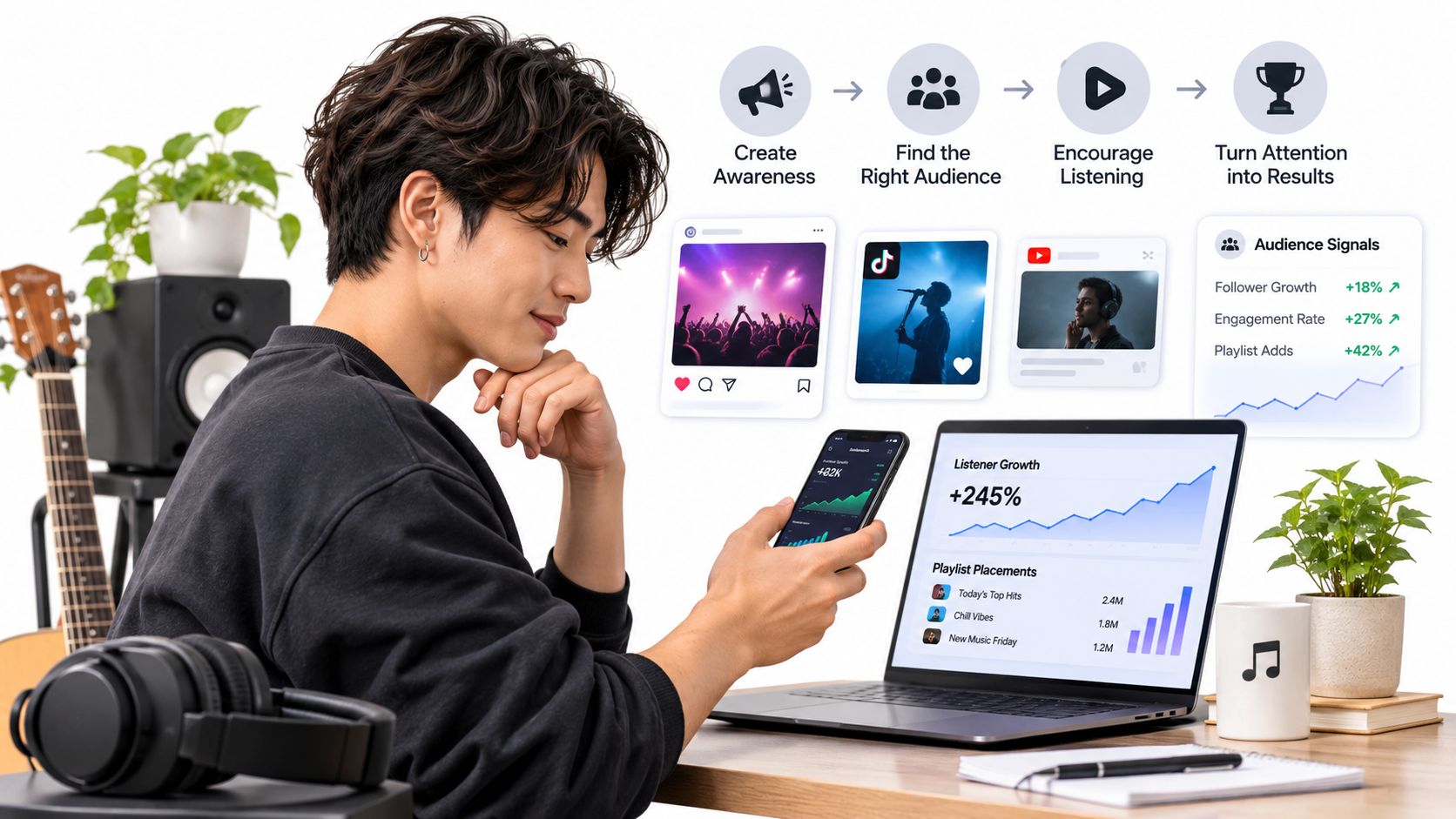
Music marketing is the coordinated work of creating awareness, finding a relevant audience, encouraging listening, and turning attention into measurable outcomes: streams, followers, subscriptions, sales, ticket sales. That market is enormous and almost entirely digital: in 2024, global recorded-music revenue reached US$29.6 billion, with streaming generating US$20.4 billion, or 69.0% of the total, according to IFPI's global music report.
So why do artists with real play counts still have no audience they can reach on a quiet Tuesday?
Table of Contents
- What Music Marketing Means for an Independent Artist
- How the Discovery-to-Loyalty Funnel Works
- Channels Where Music Marketing Happens
- Metrics That Show Whether Your Marketing Works
- Misconceptions That Waste Time and Money
- Build a Routine Between Releases
What Music Marketing Means for an Independent Artist
Marketing is not the same thing as a release. Think of a release as a shop opening its doors: the lights are on, the shelves are stocked, and the sign is painted. Marketing is the person standing at the counter who learns who walks in, what they linger over, and what would bring them back next week. Without that person, the shop is technically open and functionally empty.
For an independent artist, the job breaks into recognizable parts: positioning yourself inside a genre or scene, planning a release, optimizing your profile, researching who listens, distributing content, engaging a community, and measuring what worked. Distribution makes your music available. Marketing decides who finds it and whether they come back. Those are different problems, and only one of them is solved by uploading a track.
The Three Categories of Activity
Every marketing action you'll ever take sits in one of three buckets. Knowing which bucket you're in stops you from confusing spending with building.
- Paid promotion: ads, boosted posts, paid placements. It buys reach, and it stops the moment you stop paying.
- Organic promotion: hand-pitched playlists, conversations in scene communities, showing up consistently with content. Slow, but it compounds.
- Owned channels: your SoundCloud profile and an email list. This is the only tier where nobody can throttle your access to the audience.
Owned channels are where marketing turns into an asset. If you're publishing updates, tour dates, or release notes, it helps to publish music updates with VeloCMS so those updates live somewhere you control rather than only in a feed you rent.
Before you read further, write your own one-sentence definition of music marketing for your project. Then pick the three outcomes you'll track for the rest of this guide: something that shows discovery, something that shows a first real action, and something that shows people coming back. Most artists skip that third one, and it's the only one that predicts a career.
How the Discovery-to-Loyalty Funnel Works
A track can travel far and still leave you with no audience. Reach works like a wide net; targeting is the mesh. A huge net with loose mesh catches water, the same result as untargeted promotion. Attention tells you who looked. Audience ownership tells you who can hear from you again.
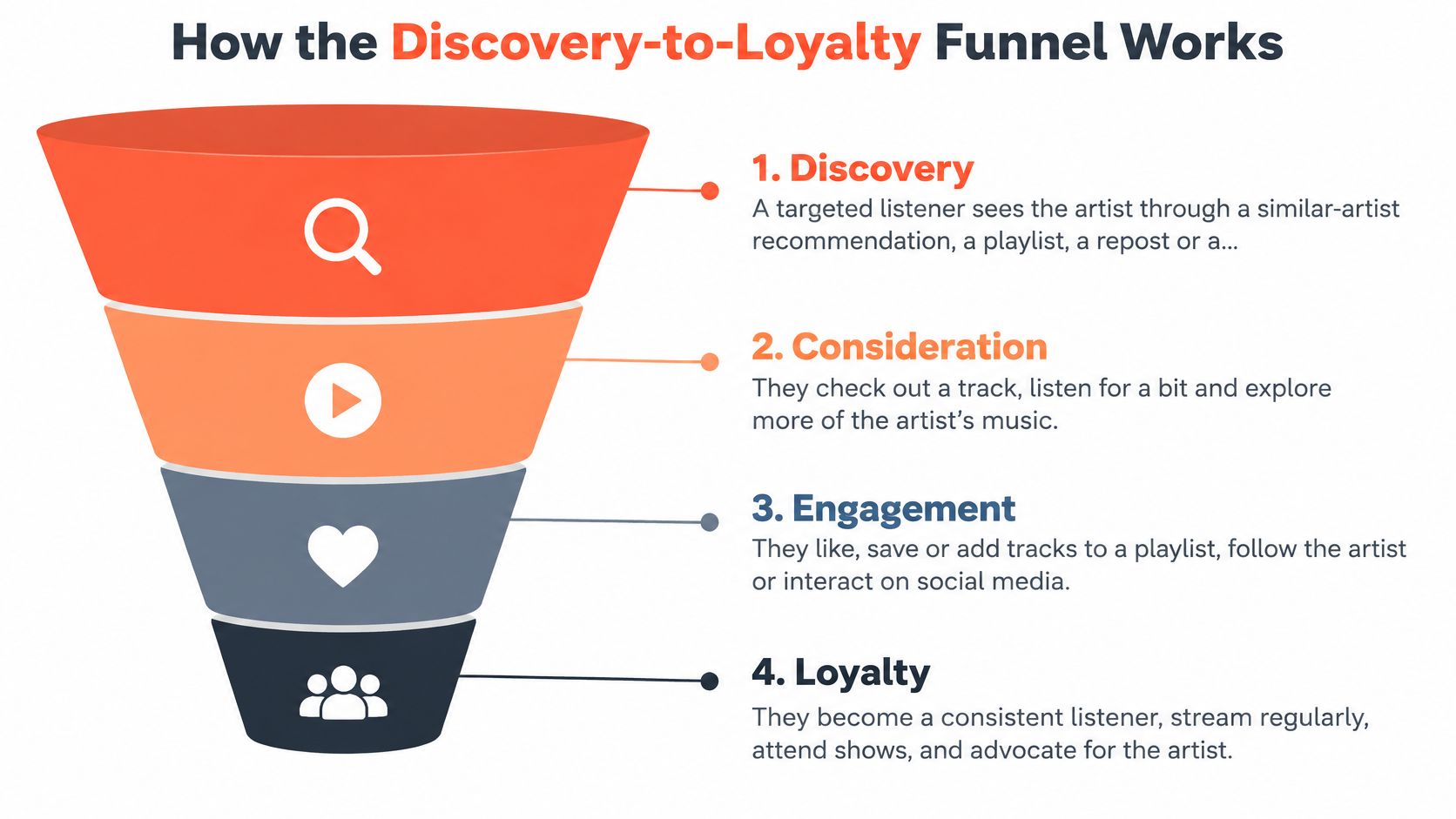
Industry data puts streaming at 69.0% of global recorded-music revenue in 2024 and subscription streaming alone at 48.9% of the global market in the IFPI's decade review of digital transformation. Awareness is no longer the finish line; an attributable listening action is what marks progress through the funnel. Read it as four narrowing stages: discovery, consideration, conversion, retention.
Discovery
Consideration
The listener taps through to your profile or a track page to judge whether the sound fits. This is the moment your profile does its work: artwork that reads at thumbnail size, a bio that names the scene, a pinned track that represents you. A profile that looks abandoned kills consideration no matter how good the discovery was. Marketing can send people to that page; it cannot make a neglected page feel alive.
Conversion
Retention
Repeat plays and returning listeners. This is durable demand, and it's the only stage that tells you whether you have fans or spectators. A listener who comes back without another push is closer to an owned relationship than a listener who arrived once through a spike.
The leak check: find the stage where the most listeners drop off, fix that stage first, and only then add more activity at the top. Pouring more discovery into a broken profile is how artists spend six months promoting nothing.
Channels Where Music Marketing Happens
Most channel advice reads like a checklist of platforms. Roles are more useful than a list, because a channel that doesn't do its job in the funnel is just noise.
| Channel | Role in the funnel | What to measure |
|---|---|---|
| SoundCloud profile | Home base where discovered listeners land | Profile visits, repeat listening |
| Streaming playlists | Temporary exposure to new listeners | Plays from new listeners, click-through to profile |
| Short-form video | Shows the sound in seconds | Video views, profile visits, link clicks |
| Scene communities | Relevant, manual conversations with fans | Replies, reposts, direct messages |
| Press and blogs | Credibility around a release | Referral traffic, mentions |
| Email list or direct-to-fan page | Owned contact with fans | Signups, repeat purchases |
| Live shows | Turns listeners into in-person fans | Ticket sales, attendance, merchandise sales |
Your profile is the only channel in that table you fully control, so it deserves disproportionate attention. Everything else is a road leading to it or a relationship built beside it.
Short-form video works because it delivers the sound before the listener has decided anything. Thirty seconds of a hook, filmed with a phone, usually outperforms a polished visualizer. Scene communities are the opposite: slow, conversational, and the highest-trust channel on the table. Press and blogs do their real work as credibility markers you can point to, not as traffic sources.
Pick two channels that fit your genre and your actual time budget, then build a routine around them. Spreading thin across all seven produces seven half-finished efforts and zero momentum.
Metrics That Show Whether Your Marketing Works
Here's the distinction that separates artists who grow from artists who plateau: attention is not ownership. A stream, view, or follower count shows potential reach. Saves, repeat plays, direct messages, email signups, and ticket or merchandise purchases show a relationship.
The signals worth collecting are first-party ones: where listeners are, how often they come back, what they save, what they share, and who replies. Those are the signals that answer real decisions, like which city to book, where to put a small ad budget, and whether to release in March or September.
- Reach signals: impressions, view counts, follower totals. Directional only.
- Retention signals: returning listeners, seven-day and thirty-day return rates. Evidence of a fanbase.
Reading Your Numbers as Cohorts
Don't judge a post by its impressions. Take the listeners you acquired in one week and ask how many came back seven days later, then thirty. That comparison, repeated monthly, is the clearest read you'll get on whether anything is compounding.
Here's a worked example. Say a week of activity produces 400 new profile visits, 60 plays, and 9 saves. Visit-to-play sits at 15% and save rate at 15%. That reads as a healthy track: the profile is converting browsers into listeners, and one in seven listeners is committing to the song. Now imagine the same 400 visits with 60 plays and one save. The discovery worked and the track didn't land. Different problem, different fix.
A smaller audience with strong saves, repeat plays, and opt-ins beats a bigger audience built on broad reach, because the first group is reachable and the second is a number. Artists who chase visible metrics rather than conversion quality tend to spend money at the wrong stage, and it's a hard habit to break once the dashboard rewards it. For a closer look at why inflated numbers actively mislead, this piece on fake followers maps the damage.
Privacy is part of the craft. Collect only what you'll use, store contacts only with clear consent, and treat the people on your list as individuals who chose to hear from you, not as interchangeable leads. The moment you email a fan like a target, they can tell.
Misconceptions That Waste Time and Money
The costliest belief in independent music is that volume solves discovery. It doesn't. More releases without listener fit add noise to a catalog nobody is filtering for you, and a louder launch amplifies whatever the profile already does, including its weaknesses.
Misconception one: more releases mean more growth. A new single is not a growth strategy. Sequencing, positioning, and audience fit decide whether the release finds anyone, which is why release calendars built around a listener group outperform calendars built around productivity.
Misconception three: follower count proves loyalty. Check saves, repeat plays, and return rates before you trust the number. A profile with 20,000 followers and a 2% return rate is a monument to an old campaign.
Misconception four: buying engagement builds a career. Inflated numbers teach you the wrong lessons about what worked, erode trust with real listeners who notice the gap between the count and the conversation, and can put the profile at risk on the platform.
Misconception five: marketing means running ads. Paid promotion is one tool, and it works best after the music and the profile are ready to receive the traffic. Ads pointed at an unfinished profile just buy faster disappointment.
Marketing also cannot do several things, and it's honest to say so. It can't rescue a song listeners don't want to hear, compensate for a neglected profile, or replace a release plan. It usually needs several months of cohort data before the picture is clear. Anyone promising you a read after one week is guessing.
Build a Routine Between Releases
The volume problem is the reason routine beats intensity. Approximately 120,000 tracks are uploaded daily, and 88% of tracks on streaming platforms received fewer than 1,000 streams during 2025, according to One To Watch's 2025 artist research. A louder launch rarely cuts through that. Steady, relevant activity does.
So build the routine in five steps.
- Choose two channels from the table and stop there. Match them to your genre and your real available hours. A producer with two free evenings a week should not be running five platforms badly.
- Spend a fixed block each week on targeted discovery and human contact. Find the listeners and curators inside your scene, send a few personal messages, and post one piece of content to keep the profile alive between releases. One genuine message to a curator who programs your subgenre beats a hundred cold pitches.
- Review weekly, compare monthly. Each week, look at profile activity. Each month, compare seven-day and thirty-day return rates for listeners acquired in the same period. Retention is the signal that matters; everything else is context.
- Build a small first-party list. Email signups or a direct-to-fan page, collected only with clear consent. This is the part of your audience nobody can take away with a policy change.
- After each release, fix the leakiest stage before adding top-of-funnel activity. If listeners visit and don't play, work on the profile. If they play and don't save, work on the track, or on which listeners you're reaching.
Our tool, SCHelper, is built for step two and step three. You choose the target artists whose listeners already match your sound, and each day we give you a focused batch of recommended listeners with a reminder to review them, so the routine holds between releases rather than restarting from scratch every time. Customers remain responsible for the activity on their account and for the artists, audiences, and recommendations they choose to review. If you want the release-side companion to this routine, this guide to music release strategy handles the calendar around it.
Playlist placement only counts as exposure unless listeners save the track, revisit the artist, or join a direct channel. Everything else is a number that resets on Monday.
Marketing is the difference between a track that exists and a track that finds people, and the only honest way to measure it is whether listeners come back without being asked. SCHelper is a web app for SoundCloud artists that turns that work into a daily routine: you pick the artists whose audience matches your sound, we surface a focused batch of listeners each day, and you decide who to engage with. Visit SCHelper when you're ready to build an audience between releases instead of waiting for the next one to fix it.