
Rap Promotion Guide: A Release Plan That Builds Listeners

Your track is out, the clip got attention, and your SoundCloud plays moved. But the comments have gone quiet, the next upload feels like starting over, and you're wondering whether to buy more exposure. Before spending again, check whether the people who discovered the song came back.
Rap promotion works when discovery starts a listener relationship. A view creates an opportunity, not a fan. Build your release around a clear handoff from clip to track, relevant audience targeting, and evidence that listeners want another listen.
Table of Contents
- Rap Promotion Timeline From Pre-Release to Week Two
- How to Build a Listener Map Around Comparable Rap Artists
- Curators, Collaborations and Playlist Pitching Compared
- Turning Short-Form Views Into Real Listeners
- Engagement Limits That Keep Your Account Safe
- Measuring Promotion That Actually Converts
- Confirm Your First Two-Week Test Before You Scale
Rap Promotion Timeline From Pre-Release to Week Two
An independent release needs preparation before launch and sustained attention afterward, not a release-day scramble.
Release timeline by phase
| Phase | Timing | Core actions | Metric to check |
|---|---|---|---|
| Preparation | Weeks 4 to 3 before release | Finalize metadata, artwork, credits, artist profiles and one destination link | Profile complete and reviewed |
| Concept testing | Weeks 3 to 2 before release | Test three to five short clips or hooks | Replies, saves and profile visits per clip |
| Platform and curator pitching | At least 7 days before release | Submit eligible tracks to platform tools; contact genre-aligned curators | Submission confirmed and reply rate |
| Release day | Release day | Push the strongest clip; message existing listeners | Clip replies and profile visits in the first 24 hours |
| Post-release push | Days 1 to 14 | Scale the winning concept; keep outreach running | Day 7 saves and profile visits against baseline |
Treat this as a working calendar, with clip counts as testing choices rather than performance benchmarks. Spotify recommends submitting eligible music at least a week before release through its pitching process, according to Spotify for Artists' playlist guidance.
Prepare the destination before creating demand
Start by checking the artist name, credits, artwork, biography, and track information across your release assets. Open your destination link on a phone while logged out. A listener shouldn't have to search through unfinished profiles to find the song featured in your clip.
During concept testing, vary the creative idea, not just the caption. Try a performance take, a hook-led edit, a lyric explanation, and a beat-focused clip. Log meaningful responses beside each asset so your choice doesn't come down to whichever video you personally prefer.
A detailed music release strategy helps keep delivery tasks separate from audience-building work. Both need an owner, even if you're doing everything yourself.
Launch with evidence, then keep working
Submit eligible pitches early and approach suitable independent curators alongside them. Don't hold the whole campaign for an editorial decision.
On release day, publish your strongest tested clip and notify listeners who've asked for updates. Give them a direct route to the finished track rather than a general announcement with several competing links.
After launch, make new versions of the winning concept instead of endlessly reposting the same file. Compare saves and profile visits against your pre-release baseline at the scheduled checkpoint.
Practical rule: Release day is a distribution deadline, not the end of the campaign.
How to Build a Listener Map Around Comparable Rap Artists
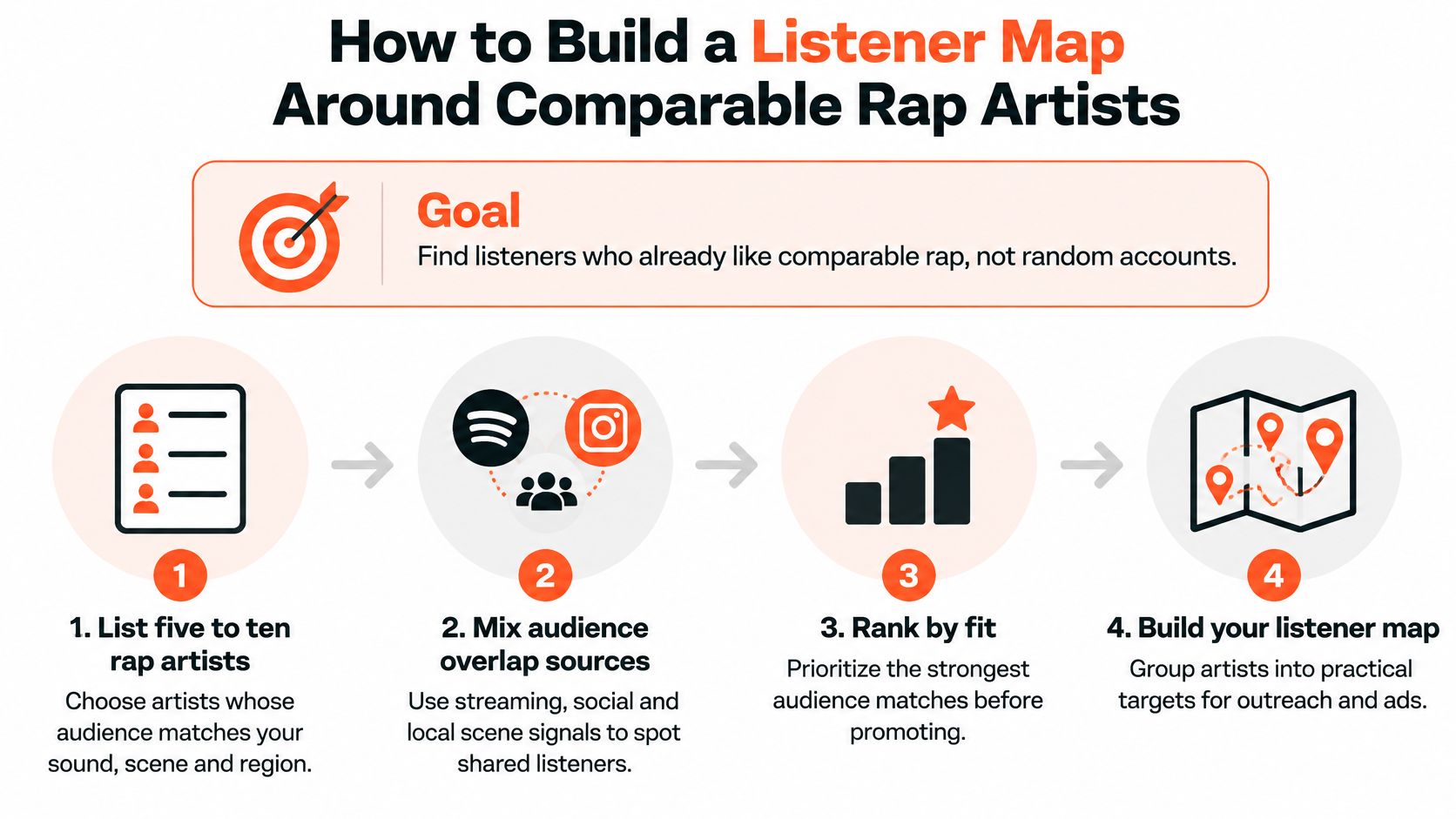
Find people who already enjoy comparable rap, not random accounts that happen to be active. A listener map connects your sound to artists, communities, and listeners with a plausible reason to care.
Build the map from listening evidence
Choose comparable artists. Make a working list of five to ten artists whose sound, scene, and region overlap with yours, mixing established names with accessible peers. A Bristol drill producer should investigate relevant UK audiences before defaulting to Atlanta trap listeners because those artists are bigger.
Inspect recent engagement. Open comments, reposts, and public listening signals to find people responding to actual music rather than promotional posts. For a melodic rapper, someone discussing a comparable artist's vocal delivery is a stronger candidate than an account leaving the same emoji everywhere.
Separate scene signals. Sort candidates by genre cues, city, language, and the music they share, then remove obvious mismatches. If you make French-language drill, a profile sharing only English-language boom bap needs stronger evidence of fit before it belongs on your shortlist.
Rank the remaining profiles. Use simple labels such as strong fit, possible fit, and unclear, supported by a short reason. A listener reposting intimate, guitar-led rap belongs higher on an emo-rap shortlist than someone whose activity is entirely club-focused.
Keep a contact record. Save the profile, relevant artist connection, fit note, and contact status in Google Sheets. For a Manchester grime release, that record stops you approaching the same listener through overlapping artist communities.
Review manageable daily batches. Read each profile before deciding whether an interaction makes sense, and skip accounts where you can't find a genuine connection. A thoughtful response to someone discussing a producer's drum sound is more appropriate than dropping your latest drill link into an unrelated conversation.
Distinguish audience fit from artist similarity
Artists can sound alike while serving different listening contexts. A technically dense rapper may appeal to lyric-focused listeners, freestyle communities, or gym-playlist audiences, depending on the track. Your map should identify the relevant context, not merely collect names from the same genre.
At SCHelper, you choose the target artists whose listeners match your sound and scene. Our daily shortlist can reduce the discovery work around those choices, but the final profile review belongs to you.
Keep rejected candidates in your records too. Knowing why a profile wasn't suitable helps you refine the artist list instead of repeatedly searching the wrong audience.
Curators, Collaborations and Playlist Pitching Compared
| Channel | Best for | Lead time | Main risk |
|---|---|---|---|
| Platform editorial pitch | Eligible releases with complete metadata | 7 or more days before release | Low odds and only one gatekeeper |
| Independent genre curators | Playlists with loyal, genre-specific listeners | Reserve 2 to 3 weeks in your calendar | Slow replies and strict fit requirements |
| Peer features and verse swaps | Shared audiences in the same scene | Before recording and clearance deadlines | Thin exposure if the partner's listeners don't match |
| Blogs and podcast hosts | Scene coverage and long-form context | Reserve 3 to 4 weeks in your calendar | Pay-to-play offers that waste budget |
| Local DJ and radio plays | Regional scenes and local fans | Before the relevant show's submission deadline | Hard to measure without tagged links |
These are planning allowances, not promised response times. No single channel should carry the release, and potential reach isn't the same as useful audience access.
Match the pitch to the recipient
Platform editorial pitches offer substantial potential reach, but you don't control selection. Complete the genre, mood, instrumentation, and release context accurately; a useful pitch line might read: “A tense Bristol drill track built around clipped delivery and a sparse bass arrangement.”
Independent curators deserve a fit-led approach. Identify an actual track on the playlist and explain the connection: “Your recent addition of [track title] shares this song's restrained percussion and late-night mood.” Replace the bracketed detail with something you've listened to.
Peer features and verse swaps work when both artists' listeners have a reason to cross over. Before recording, agree on credits, release ownership, asset delivery, and who will publish what; try, “Your conversational delivery would suit the open verse, and we can each film a performance edit.”
Buy services carefully, not credibility
Blogs and podcasts need a story beyond availability. “This release connects our local cypher scene with the producer's live-band background” gives a host an angle to examine. Decline fees presented as a condition of editorial coverage, and distinguish those offers from clearly disclosed advertising.
Local DJs and radio hosts need usable files and context. “Here's the clean version for your regional rap segment, with credits and a download” is more useful than a long biography. Give each outlet a distinct tagged destination link, while accepting that broadcast listeners may search independently.
Use the music promotion channel guide to assess channels against your immediate objective. Never send identical pitches indiscriminately: each recipient gets a personal reason, a clear request, and a single destination.
Turning Short-Form Views Into Real Listeners
More than half of 16–24-year-olds identify TikTok as a main place for music discovery, compared with 37% of consumers overall, according to SAE's overview of social media and music promotion. That overview also discusses an Ireland music-industry report in which younger listeners discovered an average of nine new artists annually, versus two among older adults.
Those differences matter when choosing where to spend effort. They don't mean every young listener wants the same content, or that a widely viewed clip will send people to SoundCloud.
Remove friction from the next listen
- Link to the actual track. Put the SoundCloud destination in your bio rather than sending interested viewers to a homepage where they must search again.
- Start with the musical payoff. Try opening with the hook in the first two seconds rather than a logo, introduction, or explanation.
- Make the profile match the clip. Pin or prominently feature the promoted track so visitors recognize its artwork and title immediately.
- Answer the comment itself. If someone asks about a lyric, explain that line. A specific exchange gives them a reason to continue the conversation.
- Use location as a creative clue. Review listener cities and comment context when choosing captions, local references, and posting times.
The first-two-seconds approach is an editing test, not a universal platform rule. Compare it with a version that builds tension if the song depends on a delayed payoff.
Respond to the audience you actually reach
Say an Atlanta artist posts a verse clip and receives thoughtful replies from Manchester. A useful next post might acknowledge those listeners, ask which local sounds they connect with, or show a different section of the verse. Repeating the original caption ignores the information they've given you.
For content-production planning, Mallary.ai's guide to scale TikTok growth with automated workflows offers another resource. Keep production efficiency separate from the listener relationship: shortcuts shouldn't replace personal replies or relevant creative choices.
Repeated, low-friction interactions give someone opportunities to move from recognizing a clip to choosing the full song. Make that choice easy without turning every conversation into a sales request.
Engagement Limits That Keep Your Account Safe
Identical or near-identical comments and messages sent at scale, along with repeatedly liking or reposting the same tracks, fall under SoundCloud's Community Guidelines on spam. A comment doesn't become acceptable just because it includes someone's username.
SoundCloud also prohibits techniques that misrepresent popularity and unsolicited promotional messages under its Terms of Use. Purchased plays and fake engagement aren't a legitimate substitute for listener interest.
Set limits around review quality
SoundCloud doesn't publish a universal safe daily engagement number. Any cap you choose is your operational guardrail, not an official allowance or a guarantee against restrictions.
- Keep batches personally reviewable. Stop when you can't explain why each listener is relevant.
- Write for the actual context. Respond to a specific musical observation rather than inserting your release into an unrelated discussion.
- Never buy plays or likes. Inflated activity makes audience assessment less trustworthy.
- Don't revisit tracks for attention. Repeated interactions with the same material can become intrusive.
- Reduce activity when responses deteriorate. Review relevance, wording, and complaints before expanding your reach again.
Our account-engagement strategy guide provides additional context for evaluating outreach choices. The deciding question should remain whether the interaction serves a plausible creator–listener relationship.
A technical ability to perform an action isn't permission to use it for promotion.
Protect access and retain responsibility
SCHelper is not affiliated with SoundCloud. We use a secure SoundCloud connection without storing your password, and we prohibit spam, fake engagement, abuse, and unauthorized access to another person's account.
SoundCloud's developer documentation describes its authorization framework, but account authorization doesn't override the platform's engagement policies. Secure access and acceptable conduct are separate responsibilities.
You remain responsible for your account activity and the recommendations you choose to review. Don't interpret a suggested audience, connected account, or available control as platform approval of every possible action. If an interaction feels irrelevant when considered individually, reducing its volume won't make it relevant.
Measuring Promotion That Actually Converts
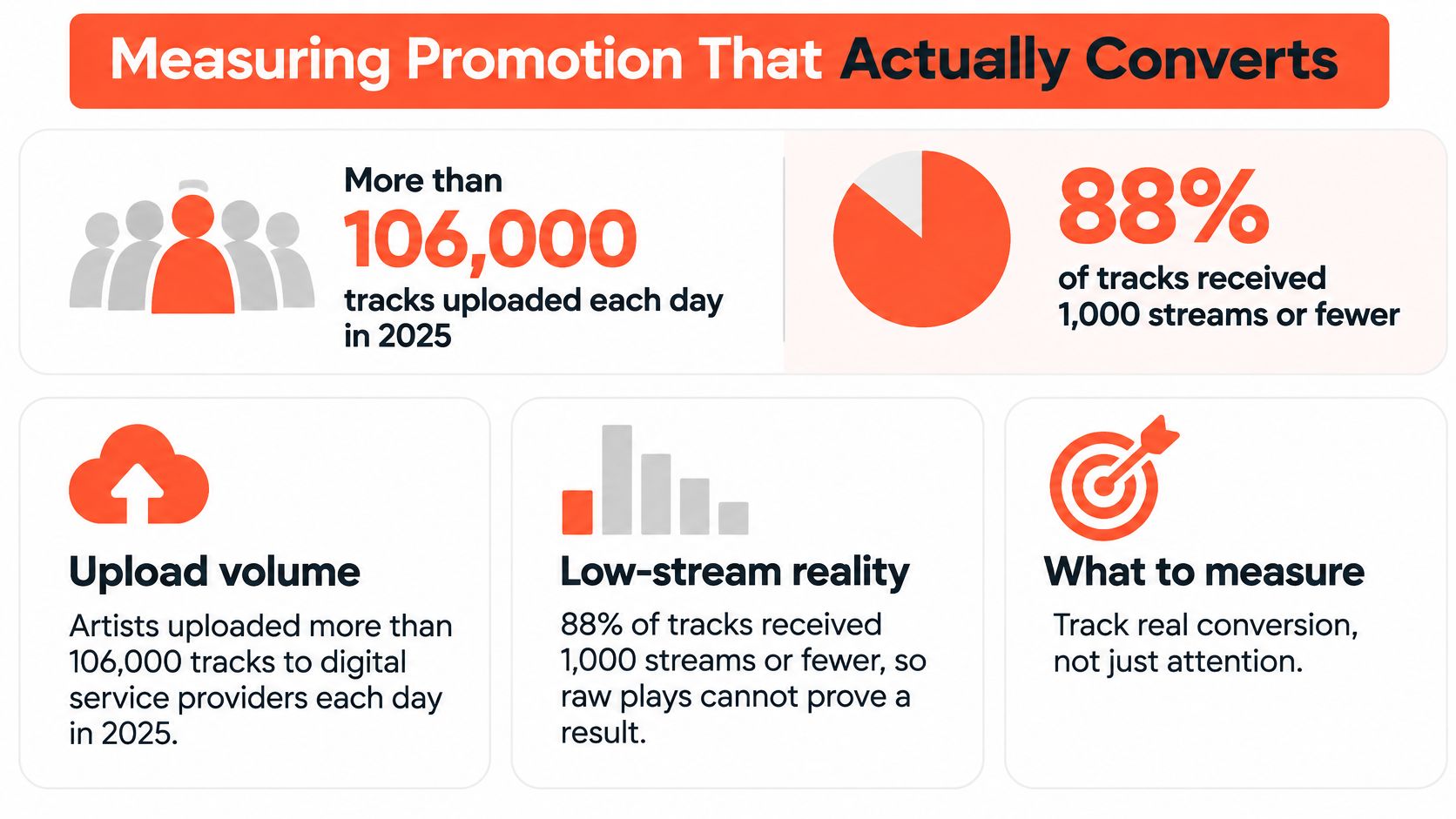
Artists uploaded more than 106,000 tracks to digital service providers each day in 2025, while 88% of tracks received 1,000 streams or fewer, according to CD Baby's breakdown of Luminate's findings. In that crowded environment, a rising play count alone can't establish that your campaign is building an audience.
Metrics that signal fans versus vanity
| Metric | Type | What it shows | Check at |
|---|---|---|---|
| Plays | Vanity | Exposure without proof of interest | Day 3 and day 7 |
| Saves | Signal | Intent to return to the track | Day 7 |
| Profile visits from new listeners | Signal | Discovery is converting into curiosity | Day 3 and day 7 |
| Comments and reposts | Signal | Listeners are responding to or sharing the music | Day 7 |
| Follower count alone | Vanity | Can hide weak retention | Day 14 |
| Repeat plays by the same listeners | Signal | Real fan retention over time | Day 14 |
These checkpoints are a practical review schedule, not industry benchmarks. Plays aren't worthless; they're incomplete when reported without evidence of what happened afterward.
Read each metric for what it can prove
Plays establish that listening activity occurred, not that the listener chose to continue the relationship. Saves indicate an intention to return, although intention and actual return aren't identical.
Profile visits suggest curiosity about the artist beyond the individual clip or track. Comments reveal the nature of someone's response, while reposts show a willingness to share, so inspect their substance rather than treating every interaction equally.
Follower totals describe audience size without proving current attention. Repeat plays provide stronger retention evidence when your analytics expose them, but aggregate play growth shouldn't be relabeled as identified returning listeners.
Keep a decision sheet, not a trophy cabinet
Create a sheet with campaign source, date, creative asset, audience segment, spend, profile visits, saves, and available repeat-listening evidence. Mark unavailable figures as unavailable rather than inventing precision. Where a platform doesn't expose saves, record its available engagement actions under their actual names.
Calculate cost per meaningful action by dividing spend by the chosen outcome, such as saves or attributable profile visits. Keep those calculations separate so you're comparing like with like. Tagged links help identify routes into a track, but they won't capture every later search or return visit.
SoundCloud's artist-facing Playback approach also emphasizes top fans, engagement, listening time, cities, and audience growth rather than treating plays as the whole picture.
Budget decision: If audience size rises but returning-listener evidence stays flat, investigate the creative and audience fit before buying more reach.
Confirm Your First Two-Week Test Before You Scale
Use one track, one audience segment, and one measurable next action. A narrow test makes the result easier to interpret than a campaign in which every asset, audience, and channel changes together.
Set a decision before spending
- Record the starting position. Pick the track with the strongest existing response and capture comparable saves, profile activity, and repeat-listening evidence. Use the same measurement window throughout.
- Choose a defined audience. Select a segment from your listener map and an outreach channel suited to it.
- Limit creative changes. Run the preparation and test schedule, changing a single variable at each review, such as the hook, clip opening, or message.
- Log the checkpoint. Compare the scheduled results against your baseline, noting other activity that might have influenced them.
- Scale or revise. Expand the concept and segment when intent and return behavior improve. If only exposure rises, fix the handoff or creative before increasing outreach.
You can apply this discipline to a fresh profile, a mix, or audience building between releases. Keep personal review in the workflow, and remember that you're responsible for the artists, audiences, and recommendations you choose.
Every SCHelper plan includes audience research, organized listener recommendations, and account-management tools to support a focused rap promotion routine. Visit SCHelper to build a daily shortlist around your chosen artists, genre, and scene, then review each batch yourself and judge progress by the listeners who return.