
Boosting SoundCloud Plays Without Empty Spikes

Table of Contents
- Why Raw Play Spikes Fade Fast
- A Scorecard for Plays That Matter
- Reach Similar Artists and Nearby Scenes
- How to Run a 30-Day Play Campaign
- Pace Each Day So the Test Stays Readable
- When Play Counts Send You the Wrong Way
- Pick a Plan Length and Start the Next Track
Why Raw Play Spikes Fade Fast
SoundCloud had approximately 140 million registered users and more than 375 million tracks in 2023, according to Business of Apps. The same dataset puts the catalog at about 100 million tracks in 2015, meaning it grew by roughly 275% by 2023. Uploading into that library makes your music available. It doesn't give a particular listener a reason to choose it.
Start with a concrete test track. Say you're promoting a finished house single called After Hours. Before reaching anyone, lock its artwork, title, description, and audio file. You're testing audience discovery, not simultaneously testing a new cover, a rewritten description, and a different mix.
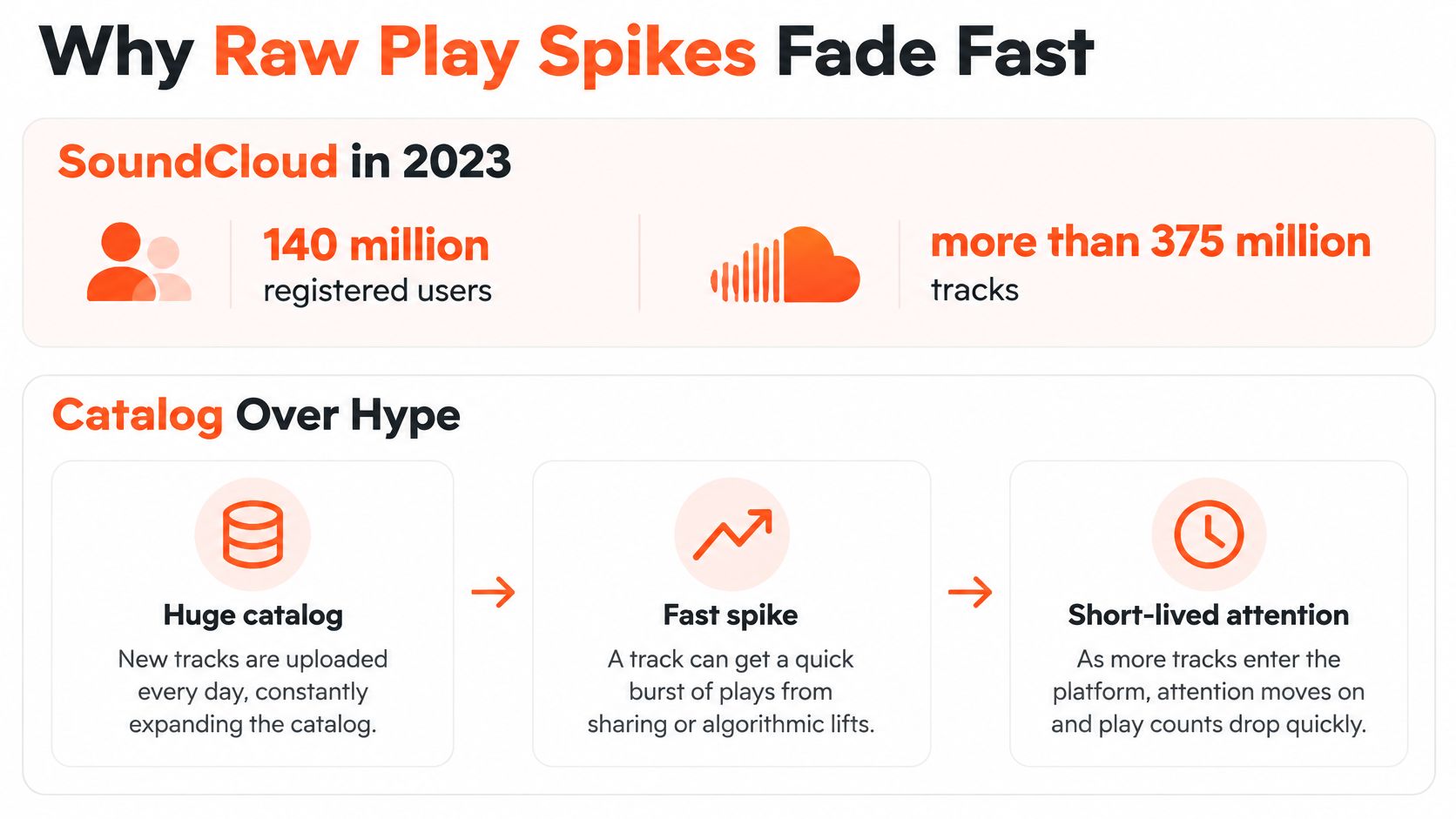
Give the spike a second question
Suppose After Hours gets a burst of attention after a broad promotional post. The counter rises, but nobody comments, reposts, or returns. You bought or earned exposure, yet you still don't know whether you reached people who want this music.
Compare that with a quieter result: listeners from a relevant club scene visit, start the track, and some return later. That gives you an audience worth testing again. It also gives you something more useful than a screenshot of a high counter.
Practical rule: Treat a play spike as a question about audience fit, not proof that promotion worked.
Don't change After Hours halfway through because the opening days feel slow. Hold the presentation steady, record what happened, and let the audience comparison explain the result. Otherwise, you won't know whether a better response came from better targeting or a different track page.
A Scorecard for Plays That Matter
What each SoundCloud signal means
| Signal | What SoundCloud counts | Lag | Keep it if |
|---|---|---|---|
| Play | Play-button click, excluding the artist's own plays | Signed-in real time; anonymous up to 24 hours | Plays rise in a segment that also gains a second action |
| Recommended plays | Plays from stations and the autoplay queue | Same play-count timing | Algorithmic plays rise without a matching drop in direct plays |
| Repeat listeners | Fans who played the track more than once | Review at 7 and 30 days | Second plays grow, not only first clicks |
| Like, comment, or repost | Those actions on the track | With the activity | Engagement rises with new plays; reposts reach that user's followers |
| A new follower observed in the same window | With profile activity |
SoundCloud's guidance on promoting and improving your stats explains that a play is a button click and that anonymous activity can take up to 24 hours to appear, while signed-in activity updates in real time. A click doesn't establish completion, attention, or fan conversion. The review windows in the table are campaign checkpoints, not promises about when someone will return.
The Artist Insights track-page guide defines recommended plays as plays generated through SoundCloud's recommendation system, including stations and the autoplay queue, and repeat listeners as fans who played a track more than once. Keep those distinctions intact: a recommendation-driven start isn't evidence that a person you contacted visited your profile.
Read the funnel without inventing attribution
A qualified profile visit means a visit associated with an audience you've deliberately selected for musical relevance. It is not every account you opened while researching. If your tools can't measure qualified visits reliably, record that denominator as unavailable rather than substituting the number of people contacted.
For a broader framework for distinguishing activity from results, you can measure social outcomes with PostPulse. Apply the same discipline here: decide which behavior matters before choosing the tactic.
Establish the comparison before reaching listeners
At the start, save the track's existing plays, engagement, followers, and available geographic and source breakdowns. Use matching observation periods when comparing results, and keep a separate note for anything you can't measure directly.
Our SoundCloud for artists guide provides context for preparing the artist profile around that track. A visitor should understand whose music they're hearing and where to listen next.
There isn't a universal conversion target in SoundCloud's cited guidance. Compare the track against its own baseline, and retain a tactic when a relevant segment gains plays and another meaningful action, rather than celebrating a larger total alone.
Reach Similar Artists and Nearby Scenes
Choose the people before choosing the promotional channel. Listeners who already engage with artists in your scene offer a defensible starting point because you can explain why the music might interest them. Then test a narrow neighboring audience instead of assuming genre boundaries describe everyone's taste.
SoundCloud's Music Intelligence Report on emerging scenes says listeners discovering a track through another user's Liked By section are more than three times as likely to like, repost, or comment themselves. It also reports that listeners spend 4% less of their time in their most-played genre than in 2019. These findings support testing social discovery and adjacent scenes, not promising the same uplift for your campaign.
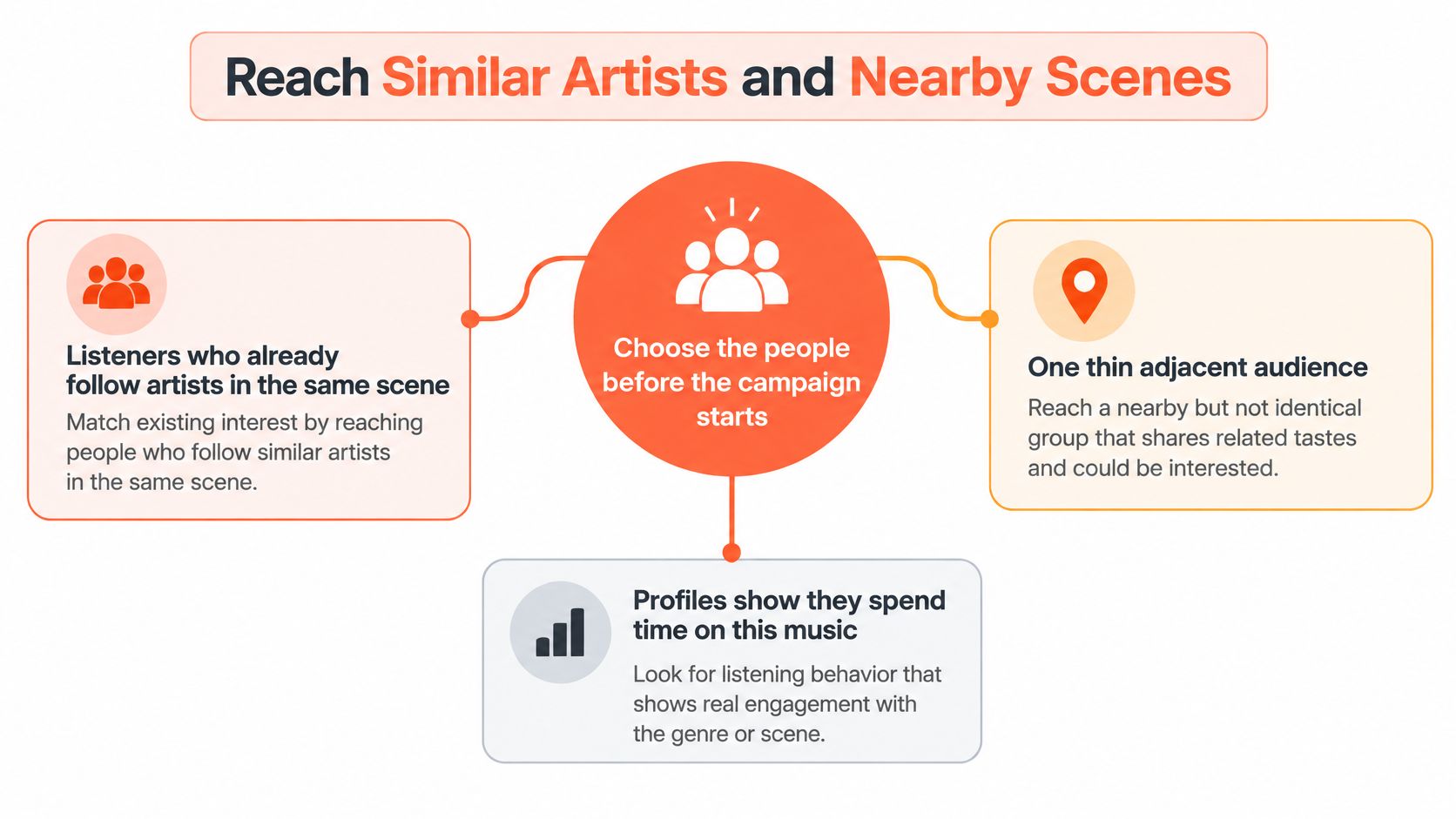
Find evidence of crossover
For a melodic techno single, a hypothetical starting set could include two established melodic artists and one breaks or electro artist. The adjacent choice should have evidence behind it: listeners commenting across those styles, reposting related tracks, or participating in shared scene communities.
For a hip-hop vocalist, try two rappers from the same city scene alongside one R&B or alternative vocalist whose listeners share music across those boundaries. These are example test designs, not prescribed audience sizes or guaranteed combinations.
Inspect the listeners, not just the artist biography. A similar production style doesn't prove that the audience explores other musicians. Equally, an artist with a different genre label may have an unusually relevant community.
- Keep active overlap: Look for listeners whose visible engagement connects the target artist with music close to yours.
- Reject fame without relevance: A famous name isn't useful merely because its audience is large.
- Check willingness to discover: An audience devoted exclusively to one artist may offer less discovery potential than a smaller, curious scene.
Prefer the audience that returns
Social proof gives a listener context: someone whose taste they recognize has already found something worth hearing. Your job isn't to manufacture that endorsement. It's to put your music within reach of people who might choose it.
Commercial value also needs a narrower interpretation than raw popularity. SoundCloud's Insights guidance distinguishes listener engagement signals, while its explanation of fan-powered royalties ties value to how individual listeners listen, including listening time and associated advertising or subscription revenue. That doesn't make every repeat listener profitable, but it explains why silent starts aren't a sufficient objective.
How to Run a 30-Day Play Campaign
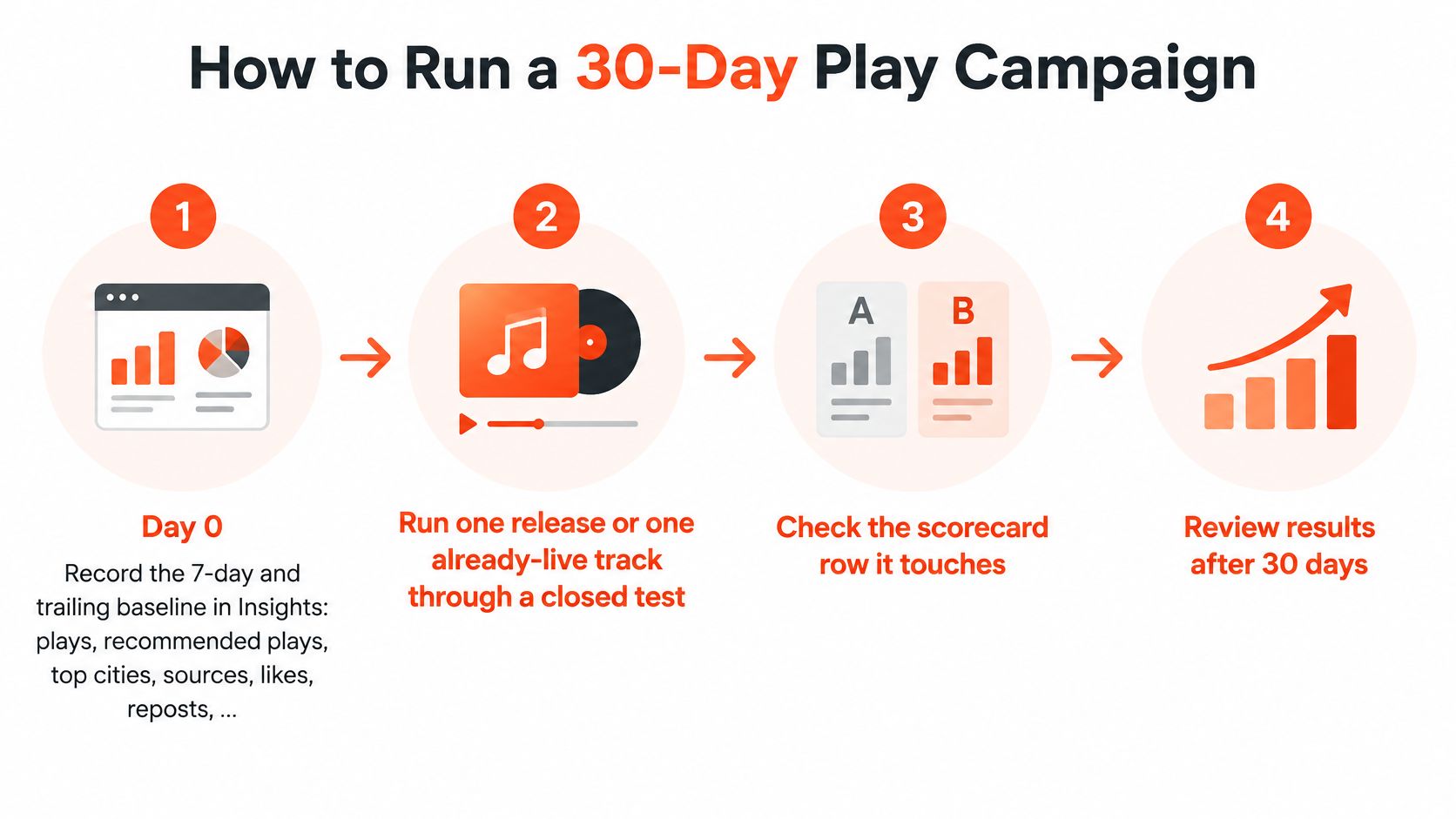
Set up a test you can interpret
Choose the candidate audiences. As a hypothetical setup, shortlist three to five closely matched artists and one adjacent artist. Write a specific reason for each choice, such as shared local events or listeners who repost similar releases. Reject candidates whose only qualification is popularity.
Review a fresh listener shortlist each day. Exclude anyone already contacted and inspect the remaining accounts yourself. Choose people you'd still consider relevant community members if they never played your track. Don't turn every interaction into a demand for attention.
Keep the listening destination unchanged. Leave the artwork, title, description, audio, and destination page alone. If you must fix a broken page or replace an incorrect file, record the intervention and avoid treating the entire period as one clean comparison.
The preparation work belongs alongside your broader music release strategy, but this test needs a narrower scope than a full launch. Keep unrelated promotional events in a separate log.
Make the checkpoint decisions
Allow reporting to settle after each session. Record when the session happened, but don't interpret incomplete activity as a verdict. Keep source, geography, and target-artist labels separate rather than combining everything into a daily total.
At day 7, compare the cohorts. Calculate incremental plays per qualified profile visit where that denominator is available. Read the engagement alongside it, and continue outreach only where starts and another useful behavior improve together. Small samples should remain provisional.
30-day campaign checkpoints
| Checkpoint | What to record or compare | Decision |
|---|---|---|
| Day 0 | Written numbers and an unchanged track asset | |
| Day 7 | Repeat outreach only where plays and a second action both improved | |
| Day 30 |
Consider a hypothetical house producer testing listeners of two club artists and one adjacent breaks artist. The producer keeps the mix page unchanged. At the first checkpoint, the breaks cohort has generated starts but no improvement in reposts or returning interest, so the producer stops reaching new listeners from that group.
Pace Each Day So the Test Stays Readable
Use one focused review block a day as your working default. If you miss a session, resume at the usual size rather than doubling the next batch to catch up. This is an experimental rhythm, not a statement that any particular activity volume is safe or permitted.
The block should be long enough to inspect a fresh shortlist and short enough that you can make deliberate choices. Don't push the same track again that afternoon just because the counter hasn't moved. You'll create another intervention before you've understood the first.
Separate actions before interpreting results
Keep a record of previously reached listeners so you don't repeatedly approach the same people. Give paid posts, playlist requests, and audience-review sessions distinct dates where practical. Spacing helps interpretation, although it doesn't guarantee clean attribution when listeners move between channels.
Predeclare the review schedule before starting. Avoid changing targeting inside the initial observation window unless something clearly needs attention, such as an account warning, a broken destination, or obviously unsuitable recommendations. A pleasing early jump isn't enough to declare a winner.
A smaller, steady week is more useful than a frantic day you can't attribute.
For a vocalist releasing a single on Friday, the useful habit is a consistent review appointment, not constant refreshing. Review relevant listeners on weekday mornings, let weekend reporting settle, and keep a short daily note. Record who was reached, which target artist connected them to the test, and which other promotional activities were deliberately held back.
Keep the log simple and the choices deliberate
A usable daily entry can be brief:
- Audience reviewed: Name the target artist or scene and the reason the shortlist fits.
- Action taken: Describe the interaction you chose, without treating a reviewed account as a confirmed visitor.
- Other promotion: Note paid posts, playlist outreach, collaborator shares, or their absence.
- Exceptions: Record missing information, technical problems, or account notices.
SoundCloud's Terms of Use prohibit techniques or services designed to misrepresent a track's popularity or a user's activity, and specifically address multiple or repetitive activity. Human review isn't a blanket exemption from those rules. Keep every interaction authentic, respect other users, and stop activity that prompts a platform warning rather than trying to preserve the campaign schedule.
A controlled pace serves measurement. It isn't permission to repeat unwanted behavior.
When Play Counts Send You the Wrong Way
Start with the symptom, then check the relevant signal. SoundCloud's Insights basics excludes artists' own plays and notes that anonymous plays may take up to 24 hours to update. Those definitions explain why your listening experience and the reported audience count can disagree, but they don't explain every disappointing result.
Play-count misreads and the correction
| What you see | Likely misread | Correction |
|---|---|---|
| Total jumps after you replay the track | Own listens treated as audience | Ignore self-plays; use Insights, which excludes them |
| Evening looks strong, next morning looks dead | Anonymous plays still updating | Wait up to 24 hours before judging that day |
| Every source rises the same week | Paid, playlist, and outreach mixed | Separate those efforts by several days and reread |
| One-time or low-intent starts | Don't scale; require a second action | |
| Recommended plays up, direct plays flat | Recommendation-driven discovery mistaken for outreach | Report the rows separately on the scorecard |
The table gives possible explanations, not diagnoses you can make from the counter alone. A flat morning could reflect reporting delay, but it could also mean few new people listened. Wait for complete reporting before deciding which explanation fits.
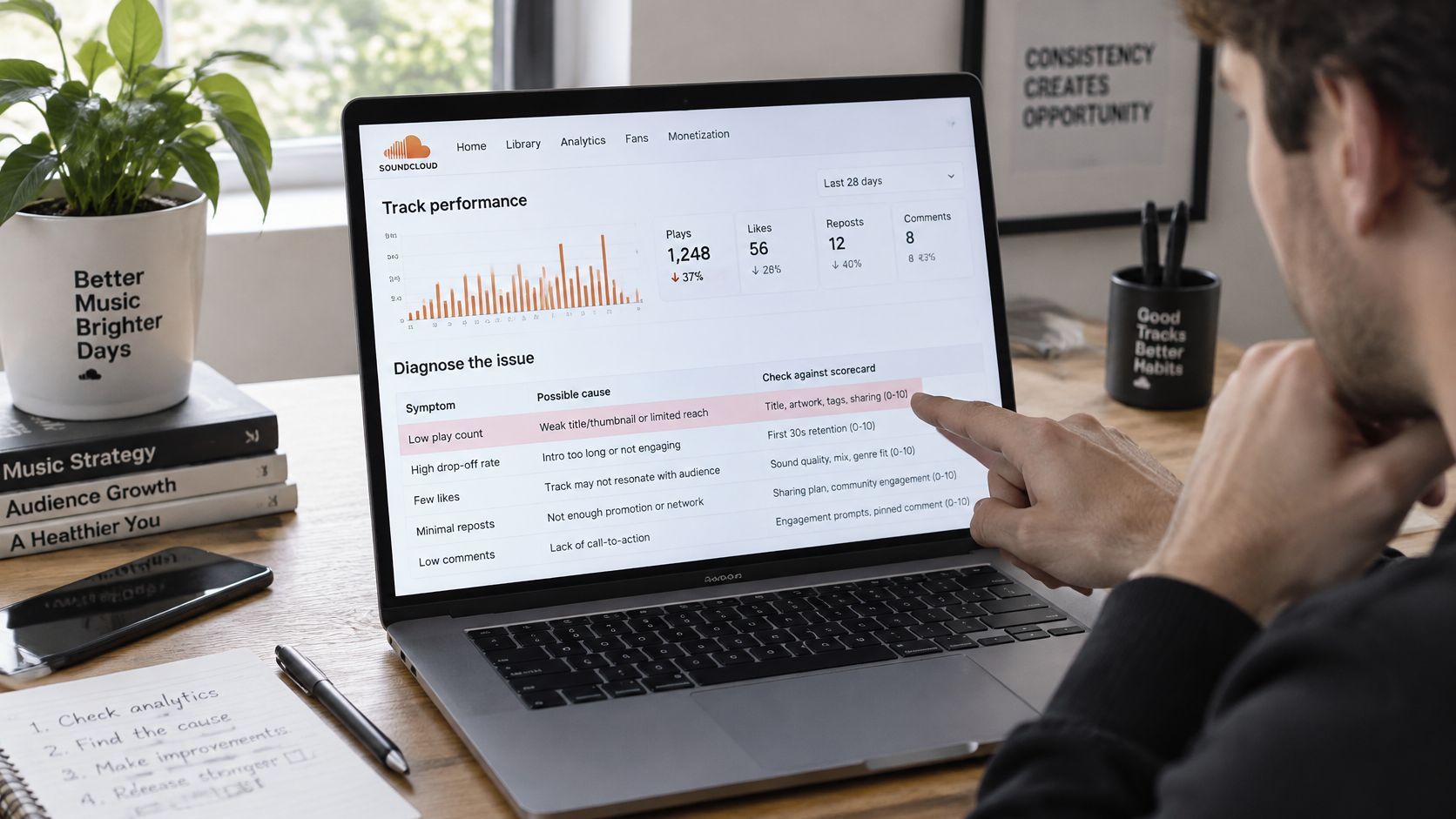
Inspect who responded, not just where plays appeared
If the aggregate looks healthy but the audience seems wrong, inspect the accounts behind likes, reposts, comments, or downloads where your access permits. Compare them with the audiences you intended to reach. A geographic match alone doesn't establish musical relevance, and an unfamiliar city doesn't automatically make a listener irrelevant.
Recommendation-driven plays deserve their own reporting row. They may represent useful discovery, but a rise there doesn't establish that your outreach caused it. Avoid describing an algorithmic increase as a successful audience-contact experiment unless you have evidence connecting the two.
Decision check: Fix the measurement problem before increasing the promotional effort.
Change the variable that failed
When engagement stays flat after reporting settles, change the audience before adding reach. When several promotions overlap, change the schedule so the next observation period is easier to interpret. When the evidence is incomplete, change neither.
Reject a guaranteed uplift that doesn't come with an account-specific, controlled test. A before-and-after comparison is useful evidence, but even that can be affected by unrelated shares, release timing, or recommendation activity.
Finish the review with a written decision rather than another refresh: Change the audience, not the pace, because completed reporting shows more starts without corresponding engagement or returning listeners. If a different signal forced your decision, name that signal instead.
Pick a Plan Length and Start the Next Track
Choose the next commitment according to the decision your campaign supports. If a cohort produced returning listeners or relevant followers, carry it into a test of the next release. If every cohort produced isolated starts, change the target artists before increasing volume or extending the campaign.
Don't assume the next song will behave identically. Keep the audience hypothesis, establish a fresh baseline, and check whether that group responds to the new release. You're building a repeatable method, not preserving a winning label forever.
Match the subscription to the work
Our SCHelper plans provide different timeframes for that audience work:
- Single-track test: The 1-month subscription costs $9.99 and includes one month of targeted growth on one account.
- Steady follower growth: The 3-month subscription costs $26.99 and is our recommended option for that goal.
- Longer-term audience building: The 6-month subscription costs $53.99, suited to work continuing across releases.
Each connected SoundCloud account needs its own active subscription. A manager working with separate artist profiles therefore needs a subscription for each profile. We accept PayPal and Stripe, with access after payment.
Keep responsibility with the artist
SCHelper is a web app and isn't affiliated with SoundCloud. We organize daily listener recommendations around your chosen artists, genre, and scene; you review the batch before choosing what happens. You remain responsible for the audiences you select and the activity on your account.
Pick a timeframe that reaches your next meaningful decision, not one based on a promised play count. Keep the scorecard beside the daily review, and judge the next track by whether relevant listeners choose to return.