
How to Get SoundCloud Plays After Release Day

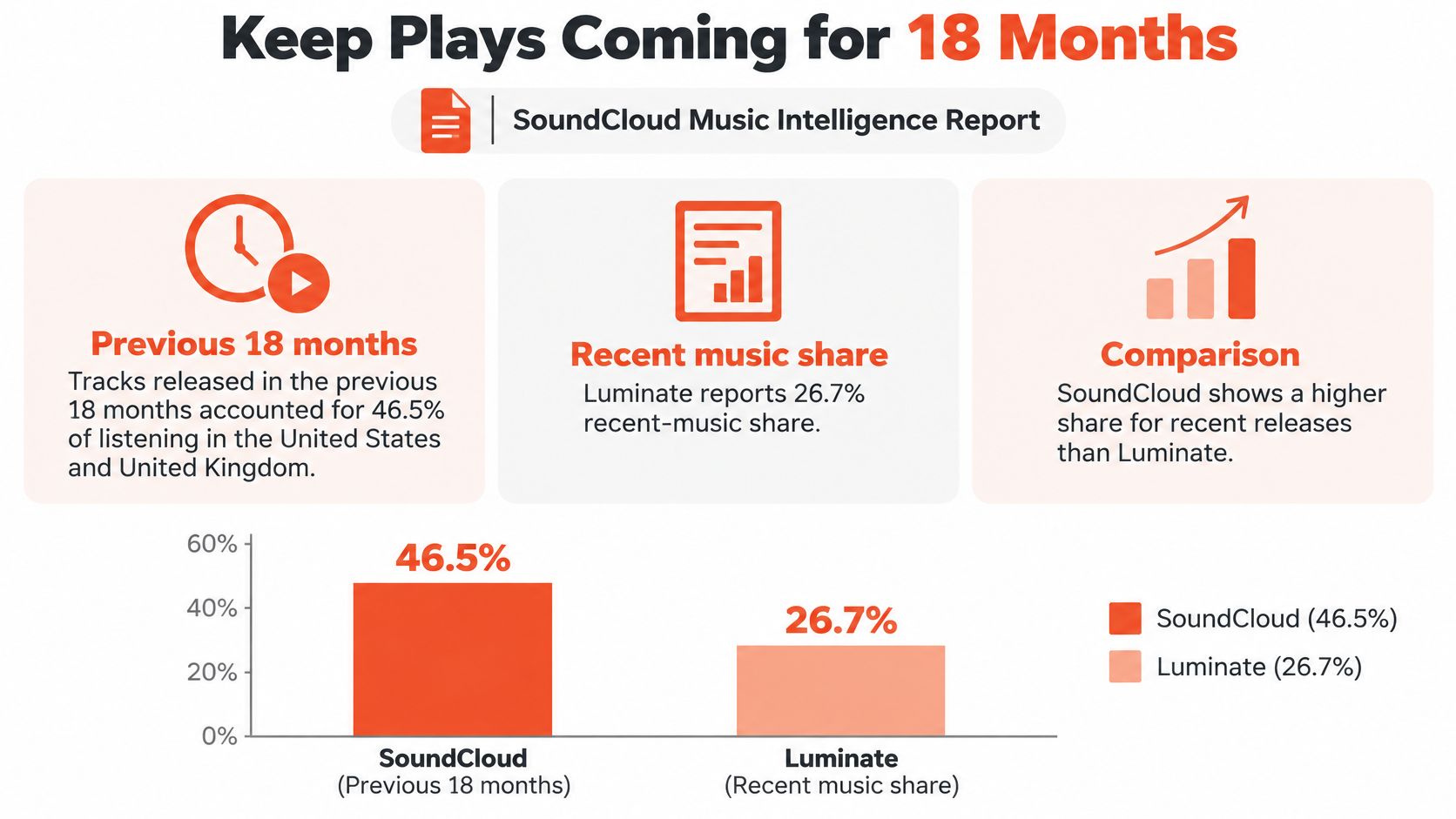
46.5% of listening in the United States and United Kingdom went to tracks released within the previous 18 months, according to SoundCloud's 2024 Music Intelligence Report, as summarized by iMusician's report coverage. That changes the question from “How do I get a launch-day spike?” to “How do I keep the right listeners finding this track after release day?”
The practical answer is a measured routine: present one strong track clearly, reach people who already like similar music, and use SoundCloud Insights to find out which exposure brings listeners back. Plays can rise sharply and then fade. A useful strategy treats each release as an ongoing discovery opportunity, not a link to share once and forget.
Table of Contents
- Run a 30-Day Play Routine
- Choose Listeners Already in Your Scene
- Fix a Play Count That Stalls
- Keep Plays Coming for 18 Months
- Score Durable Listeners at 7, 30, and 90 Days
Run a 30-Day Play Routine
Start with one public track that already represents your current sound. A folder of older demos gives a new listener too many directions; one focused track makes it easier to decide whether your music fits their taste.
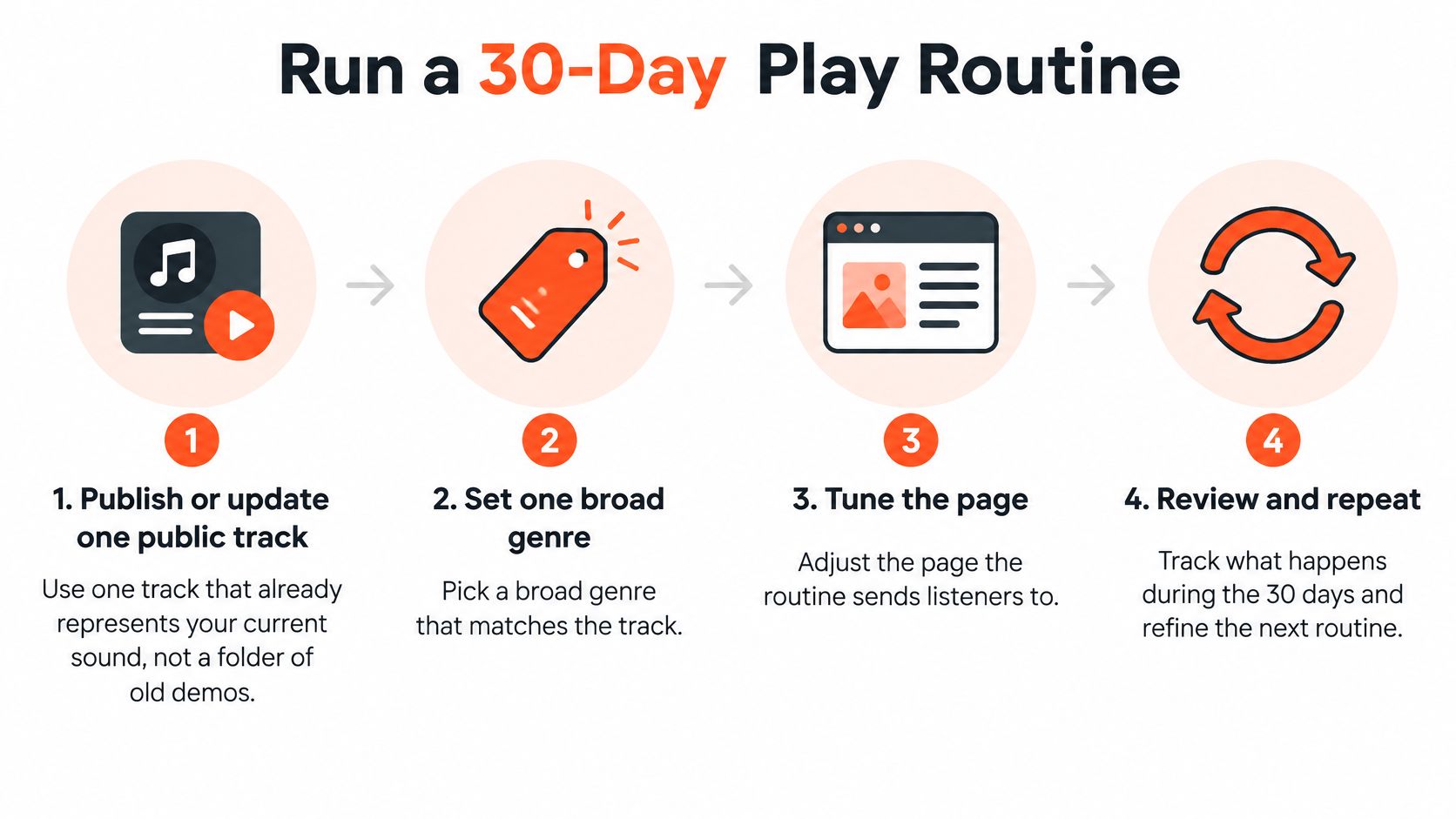
- Publish or update one track. Choose a public track that sounds like the artist you are now. Check that the audio, title, and profile presentation are ready before sending anyone to it.
- Set one broad genre and a few useful tags. Add three to five terms a potential fan might search, such as “UKG edit” if that accurately describes the track. Avoid private jokes or unrelated tags that promise a different sound.
- Tune the page. Make the artwork easy to recognize at thumbnail size. Open the description with the tempo, scene, and a suggested next track, then add a waveform comment at a moment worth hearing.
- Review and repeat. Tell existing supporters about the release once. After that, build new exposure and check whether the people who find the track stay, respond, or return.
Short-form clips can give a track another entry point, particularly when the clip makes its sound recognizable before the listener reaches SoundCloud. In 2023, 82% of surveyed 16-to-24-year-olds used short-form video to engage with music, compared with 72% who used audio streaming, according to IFPI, as reported by Music Week. Reuse the track artwork and a concise section of the song in a 15-to-20-second clip, then make the destination clear.
Use weekly pass signals
| Week | Main action | Metric to watch | Pass signal |
|---|---|---|---|
| Week 1 | Publish one strong track with genre, tags, artwork, and a one-time share to existing fans | Plays, likes, and repeat listeners | A 7-day baseline, not only a first-day spike |
| Week 2 | Reach one small cohort that already plays a closely overlapping artist, with specific comments | Profile visits from that cohort | Visits from people already in the scene |
| Week 3 | Add a short clip or a playlist you control and leave on-page elements unchanged | Traffic-source mix | A second source besides your own profile |
| Week 4 | Release an alternate edit, DJ version, or playlist refresh | 30-day repeat listeners versus new plays | Repeat listeners rising, not only cold plays |
Practical rule: Give each week one new exposure. Keep the track page steady while you measure what that exposure brings.
Choose Listeners Already in Your Scene
Start with a similar-artist test. Pick an artist whose listeners already have a reason to care about your sound, then look for a small group of people who engage with that artist's music. A relevant audience is more likely to visit your profile and hear the track than a broad set of listeners with no musical overlap.
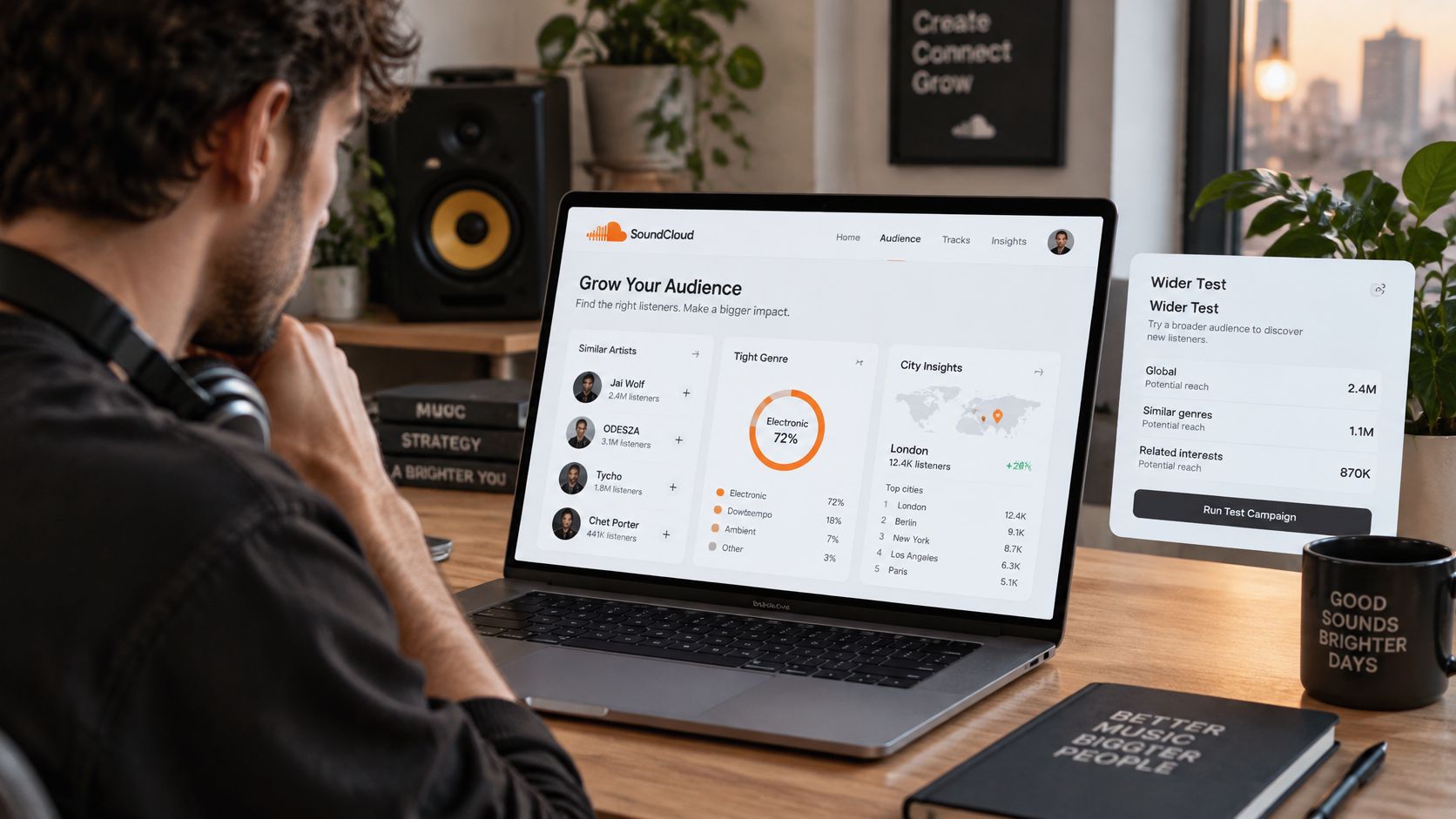
Use this order when deciding whom to reach:
- Similar artists first. Choose one reference artist with a sound and audience that overlap with yours.
- Then narrow the genre. Match the track to a recognizable lane rather than using every style that appears somewhere in the arrangement.
- Next, check geography. If Insights already shows a city returning to your track, test a related local scene before chasing a distant audience.
- Only then widen the test. Broader discovery can make sense after you know what your more focused audience does with the track.
For a one-week cohort test, choose 15 to 30 listeners around one reference artist and note why each person fits. Compare profile visits, new followers, likes, comments, reposts, and repeat plays. Keep a simple list of who you've already contacted, so you don't direct the same pitch to the same person again.
A rap vocalist in Atlanta who applies a global tag list may get scattered visits from people who have little connection to the local sound. A week focused on fans of two nearby peers gives a more useful comparison: do the profile visits cluster around the scene, and do any listeners return? Paid or free account status can be an optional comparison, but judge the groups by track completion and repeat plays, not by the account badge.
Fix a Play Count That Stalls
A quiet morning doesn't always mean a track has stopped moving. SoundCloud says logged-in listener data can update in real time, while some Insights may take up to 24 hours to appear; offline SoundCloud Go plays can be delayed until the listener reconnects, potentially for up to 30 days, according to SoundCloud's Insights guidance. Use a steady review rhythm instead of reacting to an incomplete snapshot.
Check total plays, likes, comments, reposts, listener locations, traffic sources, and repeat listeners about every 24 hours during the first seven days. SoundCloud records plays separately from likes, comments, and reposts, and track Insights can separate algorithmic plays from stations and autoplay. That distinction helps you tell whether a play came with a listener action or appeared through a discovery surface.
| Symptom | Likely cause | Next change |
|---|---|---|
| Flat after day 2 | Only existing friends played it | Add one external clip and one overlapping-artist cohort |
| High plays, almost no likes | Station autoplay or mismatched tags | Check station versus profile source and fix genre plus the first 15 seconds |
| Plays from one city only | Local scene without a second entry point | Keep that city and test one similar-artist cohort |
| Spike, then silence | A single share and no later asset | Add a playlist update or alternate edit in week 2 |
| Comments but no replays | Interest without a clear next track | Pin the strongest track and link it in the description |
Treat each row as a diagnosis to test, not proof of a single cause. For example, high plays with few likes could reflect station plays, but it could also mean your tags attract listeners who aren't a good fit. Check the traffic source first; if the source looks right, review the genre and opening seconds before changing anything else.
Use comparable windows when you test a fix. A track with a local audience may be better served by adding one similar-artist cohort than by replacing the page and starting over. A track that gets comments but few returns needs a clearer next step, such as a pinned strongest track and a direct link in the description.
A single spike can look impressive while telling you very little about who wants to hear the track again.
Compare 7-, 30-, and 90-day windows by repeat listeners and completion, not just the accumulated play total. Prioritize the city or traffic source that brings people back, and don't stack several edits after one disappointing day. A sudden increase without likes, comments, or repeat listening is a signal to investigate, not a success metric.
Keep Plays Coming for 18 Months
A track can find listeners long after release week. SoundCloud has reported that nearly half of listening goes to music released within an 18-month window, approximately twice the industry average, in its April 2025 product update. Use that window for measured refreshes, not repeated link drops. Each new asset should give listeners a distinct reason to return, and its results should be compared with the track's earlier audience.
Refresh the track without muddying the results
Choose one release-ready asset at a time:
- New artwork on the same title. Change the visual presentation while keeping the rest of the page steady.
- An alternate edit. Give returning listeners a different version to hear.
- A DJ version. Offer a mix-friendly edit when it suits the track and its audience.
- A playlist update you control. Place the track in a new context alongside music listeners already know.
- A short clip linking back to the track. Use a distinct passage and make the full track easy to find.
Give each refresh time to attract listeners before adding another. SoundCloud Insights can help you compare profile activity, reposts, stations and autoplay, external links, and search. Record the source alongside listener responses, then decide which approach is worth repeating. A burst of plays without returning listeners is a weak signal; a smaller audience that comes back may be more useful.
Recommendations can influence how listeners encounter new artists. In a report covered by Music Ally, the Digital Media Association found that 86% of surveyed U.S. streaming listeners said their service's recommendations for new artists and songs were useful in 2023. Accurate genre and context signals help listeners understand where a track fits.
Score Durable Listeners at 7, 30, and 90 Days
A useful play is one connected to a listener action: a like, comment, repost, profile visit, or return listen. A raw total can include people who don't come back, so keep a scorecard that shows who returned, where they came from, and what they did.
Use one row for each review window and one column for each metric. Record the date and the Insights source beside the figure, so you can compare like with like rather than trying to reconstruct a campaign from memory.
- At 7 days, set the baseline. Write down plays, likes, comments, reposts, cities, traffic sources, and repeat listeners. This is the reference point for later choices, not a judgment of the track's full potential.
- At 30 days, check for durable discovery. Look for repeat listeners, a source beyond your own profile, and a city or source that brings people back. If only new plays rise, test whether the new audience is a fit before adding another promotion.
- At 90 days, choose whether to refresh or move on. Compare completion and return listening with the baseline. Refresh the track if the audience is still responding; otherwise, put the next release at the center of your effort.
For a fuller approach to finding listeners and building engagement, use this guide to getting more listeners on SoundCloud. Keep the scorecard simple enough to update by hand, and don't let one quiet day push you into changing several things at once. A spike without comments or return listens isn't a durable result.
This week, lock your strongest track, begin week one of the 30-day routine, and record its baseline. Then choose two reference artists whose fans are likely to match your sound. SCHelper can support the research side by organizing listener discovery around artists you choose, but it can't guarantee plays.