
Follow Unfollow Strategy That Keeps Your SoundCloud Safe

The most popular follow unfollow advice starts with the wrong question: how many accounts can you follow before something goes wrong? A daily quota doesn't tell you whether anyone likes your music, and staying below someone else's suggested limit doesn't establish compliance. Your job isn't to manufacture reciprocal follows. It's to identify listeners who have a reason to come back.
A useful follow unfollow strategy treats discovery as an audience-qualification experiment. That means choosing relevant people, making deliberate decisions, measuring listening rather than notifications, and stopping when the activity isn't earning its place.
Table of Contents
- Why Follow Unfollow Is Really an Audience Test
- Defining a Target Cohort Worth Reaching
- Safe Daily Batching and Confirmation Workflows
- Smart Unfollow Timing and Retention Rules
- Measuring Qualified Engagement Instead of Follower Counts
- Safer Alternatives for Sustainable Growth
- Your Follow Unfollow Workflow Checklist
Why Follow Unfollow Is Really an Audience Test
A follow can introduce your profile to someone. It can't establish that they enjoy your releases, care about your scene, or want a continuing connection. Those are separate questions, and you should evaluate them separately.
My recommendation is straightforward: follow people whose activity you'd want in your feed, even if they never followed back. If that standard leaves your prospect list looking thin, improve the targeting rather than lowering the standard.
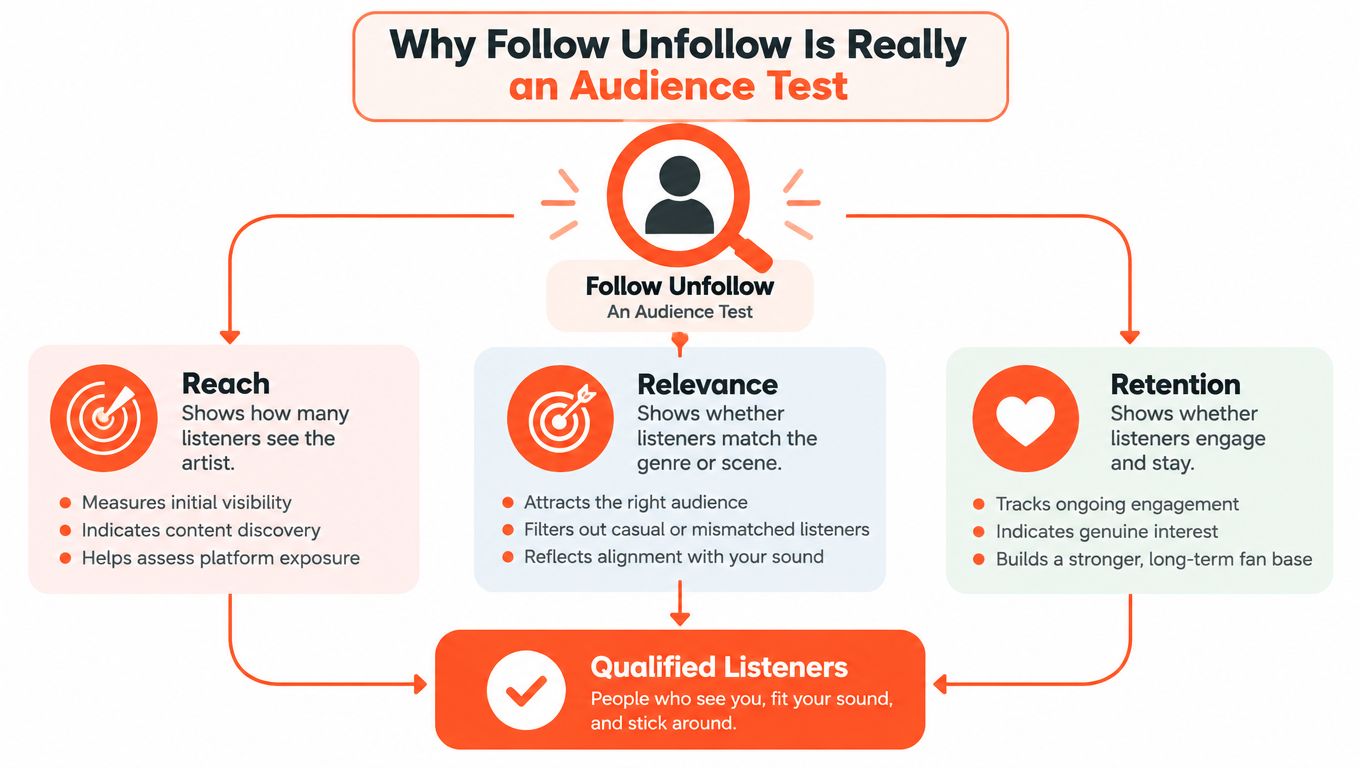
Separate attention from audience fit
Consider a hypothetical indie producer choosing between indiscriminate outreach and a carefully reviewed list of listeners who engage with adjacent artists. The indiscriminate approach asks whether someone will return a notification. The targeted approach asks whether that person might enjoy the producer's next release.
Neither outcome should be assumed. The targeted approach is more defensible because the artist can explain why each connection makes sense and evaluate whether that judgment was correct.
Use these distinctions when assessing a prospective audience:
- Reach: Did the person encounter your profile or music?
- Relevance: Does their visible activity suggest an affinity with your sound?
- Retention: Did they maintain the connection and engage beyond the initial introduction?
A follow-back is permission to keep earning someone's attention, not proof that you've acquired a fan.
Put platform rules ahead of growth tactics
SoundCloud distinguishes relevant interaction from spam. Its community guidelines prohibit repeatedly following large numbers of accounts in a short period, repeated unfollowing and refollowing to attract attention, and automated or repetitive follow/unfollow tools.
That boundary matters more than any third-party quota. Slowing down prohibited activity doesn't turn it into acceptable relationship-building, and a confirmation button doesn't automatically settle the compliance question.
Define success before taking action: a relevant connection that produces meaningful engagement without crossing those boundaries. If your workflow only makes financial or operational sense at bulk volume, reject it. You need an audience-development process, not a more elaborate notification campaign.
Defining a Target Cohort Worth Reaching
Start with the sound of the release you're promoting, not the largest artist you can name. A loosely related audience may look attractive on a spreadsheet while giving you little basis for expecting listener interest.
Write a short targeting statement before opening any follower list. For example: listeners who engage with atmospheric electronic releases, follow artists in the same scene, and show interest beyond self-promotion. That's a proposed cohort, not a claim about guaranteed conversion.
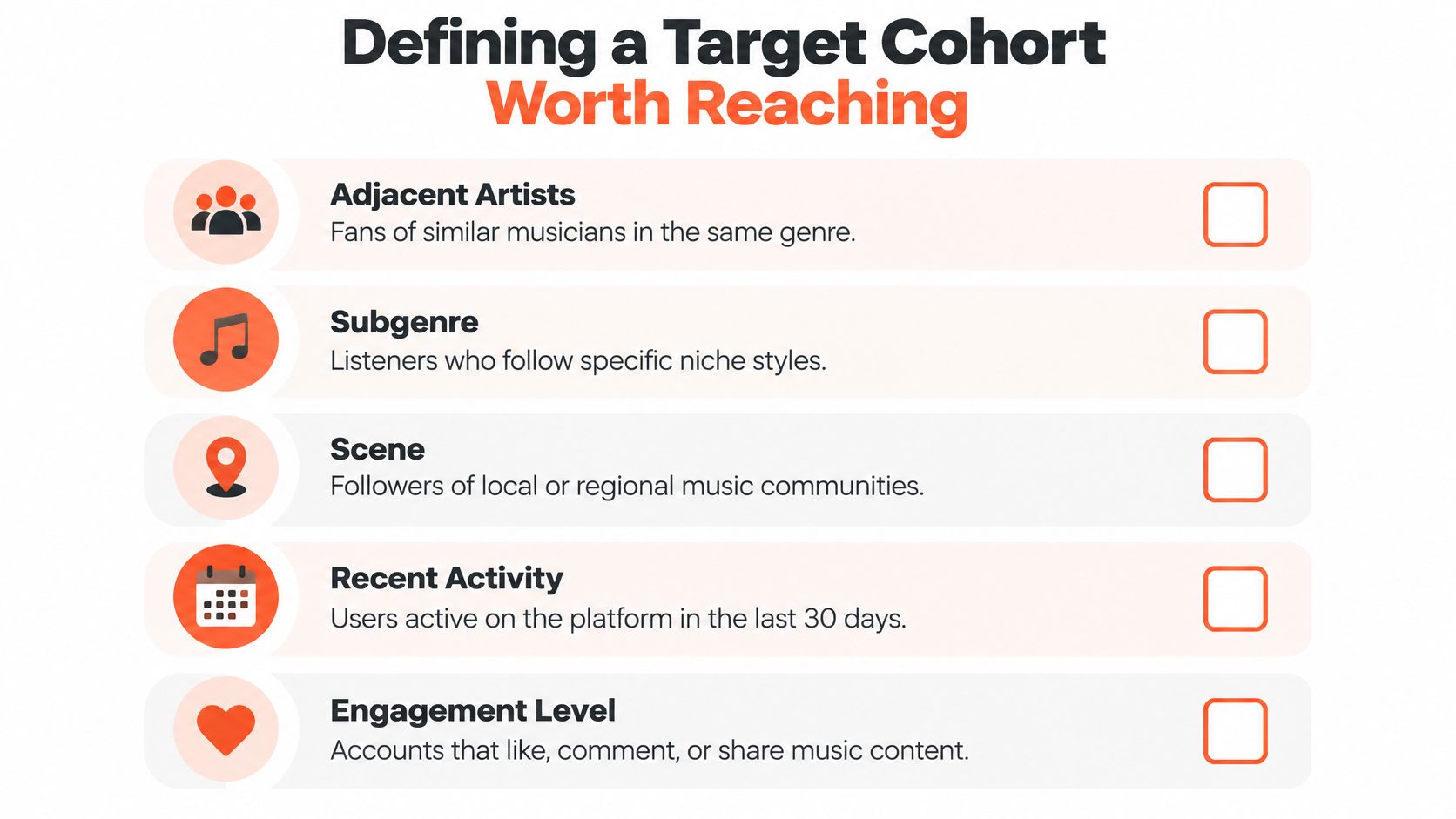
Choose adjacent artists with a musical reason
A useful source artist shares something specific with your release: production style, vocal approach, DJ context, scene affiliation, or listening mood. Being filed under the same broad genre isn't enough.
Apply these filters during manual review:
- Musical affinity: Look for engagement with tracks that have a plausible relationship to yours. A compatible listening history matters more than an impressive profile.
- Scene connection: Local collectives, labels, promoters, and community accounts can help you understand context. Geography is useful when your release or live activity makes it relevant.
- Recent activity: Favor visible evidence that the account still participates. An old follow alone doesn't demonstrate current interest.
- Engagement quality: Read comments and inspect repost choices where available. Specific musical reactions are more useful evidence than repeated promotional requests.
- Prior contact: Exclude accounts you've already approached so discovery doesn't become repetitive targeting.
Treat these as review criteria, not a bot-detection formula. An empty profile isn't proof of automation, and a polished profile isn't proof of genuine interest.
Keep the shortlist selective
For a practical approach to examining potential audiences, use this guide to finding real listeners on SoundCloud. Keep a written reason beside each source artist so you can distinguish deliberate selection from browsing habit.
Paid-account status can be an optional comparison filter, but don't treat it as evidence of musical taste. Likewise, avoid excluding an otherwise relevant listener just because their location doesn't match yours.
Refresh the shortlist when your musical direction changes or a source starts producing irrelevant recommendations. Targeting is a judgment task. If you can't articulate why an account belongs in the cohort, skip it rather than forcing a decision.
Safe Daily Batching and Confirmation Workflows
The safest starting point is manual activity inside SoundCloud, supported by a review list you control. Organize the research separately from execution so you can reconsider a recommendation before doing anything with your account.
Use a session cap as an internal workload boundary, not a claim about what SoundCloud permits. Set it low enough that you can inspect every profile without rushing, and don't increase it because yesterday's session completed without an error.
Build a review-first routine
Open the selected source artist, examine the recommended listener, and decide whether you want the connection. Listen where appropriate, inspect relevant activity, and record the reason for your decision.
A usable routine should include:
- An explicit skip option: You shouldn't have to accept weak recommendations to finish a session.
- A visible action record: Record completed actions so an error or page refresh doesn't prompt duplicate activity.
- A deliberate confirmation: Review what will happen before authorizing it. Reject unattended execution.
- A clear stop control: You must be able to leave without a queue continuing in the background.
Spread genuine review across manageable sessions rather than compressing it into a burst. Don't add random likes or comments to disguise the pattern. If an interaction has no independent purpose, leave it out.
For managers coordinating releases and account responsibilities, Premierely's SoundCloud channel management guide is a useful companion planning resource. Assign responsibility for outreach so separate team members don't unknowingly contact the same people.
Treat safeguards as controls, not permission
When evaluating software, distinguish account security from platform compliance. OAuth and avoiding password storage address credential handling. They don't establish that every action a connected tool performs is permitted.
The available cross-platform limits discussion concerns Instagram rather than SoundCloud, so its quotas and detection claims aren't a SoundCloud operating manual. Don't transfer them.
Pause when you encounter restrictions, unusual failures, or an unexplained deterioration in response quality. Investigate before restarting, and never compensate for a disrupted session by cramming the missed activity into the next one.
Smart Unfollow Timing and Retention Rules
Unfollowing should be a decision about whether a connection still belongs in your listening environment. It shouldn't be the second half of a bargain the other person never agreed to.
Don't schedule removal because someone hasn't returned the follow. A listener may engage with your music without wanting another account in their feed, and you may still value what they post.
Decide what deserves to stay
Give each connection a review outcome rather than a countdown:
- Keep for musical value: Retain artists, curators, or listeners whose activity you want to follow.
- Keep for meaningful interaction: A thoughtful comment, relevant repost, or continuing exchange deserves more weight than reciprocity alone.
- Continue observing: When the evidence is incomplete, don't force an immediate keep-or-remove decision.
- Remove for irrelevance: Unfollow when the account no longer fits your interests or the original targeting judgment was clearly wrong.
A peer-reviewed study of Twitter relationships found a 64% lower likelihood of unfollowing in reciprocal relationships and linked information overload with unfollowing. That's evidence about Twitter, not a SoundCloud timing rule, but it supports prioritizing relationship quality over aggressive acquisition.
Retention rule: Don't remove a worthwhile connection merely to make your following count look more selective.
Use a quiet window, not a universal deadline
Choose an observation window that includes a meaningful opportunity to encounter your music. Document when you reviewed the connection and what you could observe. There's no verified SoundCloud waiting period that makes removal automatically appropriate or safe.
Keep cleanup separate from discovery so you can assess existing relationships without pressure to replace them. Never put removed accounts back into an attention-seeking follow cycle.
Passive connections don't require punishment, but perceived social proof isn't enough reason to call them qualified listeners. Keep the relationship if you value it. Classify the evidence either way.
Measuring Qualified Engagement Instead of Follower Counts
Define qualified engagement before you start collecting results. For this experiment, I'd count a relevant musical action or continuing interaction, not merely a returned follow.
SoundCloud's Music Intelligence Report describes engagement around Liked By discovery, while its artist Insights metrics include plays, likes, comments, reposts, top fans, and listener locations. Use those observable signals without assuming you can attribute every play to a particular follow.
Daily follow/unfollow tracking template
| Field | What to record | Why it matters |
|---|---|---|
| Source artist | Where you discovered the account | Helps compare audience fit |
| Cohort description | Genre, scene, geography, and optional account-status filter | Keeps unlike groups separate |
| Account reference | Profile identifier and prior-contact status | Prevents duplicate outreach |
| Date followed | Actual completion date | Establishes the observation window |
| Follow-back date | When reciprocity became visible | Separates acquisition from retention |
| Interaction status | Relevant likes, reposts, comments, or replies | Records evidence beyond a follow |
| Release context | Track promoted and other activity during the test | Helps identify competing explanations |
| Review outcome | Retain, observe, remove, or exclude | Makes decisions auditable |
Use the published Instagram analysis only as a methodological reference: it proposes 7-, 14-, and 30-day retention checkpoints, but its results aren't SoundCloud benchmarks (audience-growth experiment and cohort framework). Record unavailable information as unknown rather than filling gaps with assumptions.
Calculate distinct outcomes
Keep your measures separate instead of combining them into an opaque growth score:
- Follow-back rate: Returned follows divided by completed follows.
- Qualified-engagement rate: Reached accounts with your predefined meaningful action divided by completed follows.
- Retention rate: Cohort connections still present at the chosen review point divided by the relevant starting group.
- Loss rate: Previously acquired connections that disappeared divided by acquired connections.
Track profile visits and plays only to the extent your available reporting supports them. If the data is aggregate, label it aggregate. Don't claim individual attribution that the interface can't establish.
Use a comparable holdout group that receives content and genuine interaction without the follow-based introduction. Keep release context similar, and acknowledge that a small observational comparison can't establish causation.
For release-focused planning, pair the sheet with this guide to getting more plays on SoundCloud. If follows increase but meaningful listening doesn't, change the audience or stop the experiment. Don't answer a weak result with more volume.
Safer Alternatives for Sustainable Growth
I'd put release quality, discoverability, and existing listener relationships ahead of follow-based outreach. Those investments remain useful even when you stop prospecting entirely.
Make your profile worth arriving at. Choose a representative track, use clear release descriptions, and give a new visitor an obvious next listening choice. Don't send people toward a page you haven't reviewed yourself.
Build around genuine discovery
The SoundCloud report cited earlier gives peer-driven discovery a stronger basis for attention than an arbitrary follow quota. That doesn't mean you can manufacture the same outcome by asking everyone for likes. It means you should create opportunities for real listeners to share music they value.
Consider these alternatives according to the release:
- Relevant collaborations: Work with an artist whose audience has a musical reason to care about the result. Agree on presentation and promotion before release.
- Thoughtful playlist outreach: Listen to the playlist first and explain the track's fit without demanding inclusion.
- Community participation: Contribute useful feedback and join scene conversations without attaching a promotional request to every exchange.
- A sustainable release cadence: Publish when the music is ready and you can support it. Don't fill the feed merely to appear active.
Spend your next available session helping an interested listener find another track, not automatically searching for another stranger.
Know when to shelve the tactic
A large-scale study of Korean-speaking Twitter users associated unfollowing with relationship structure and content characteristics, including reciprocity, connection duration, bursty posting, and informativeness. Its platform differs, but the practical question remains useful: are you creating a relationship someone wants to maintain?
Use this guide to organic follower growth to plan work that doesn't depend on repeated account actions. Shelve follow-based testing when it displaces music, useful conversations, or support for existing listeners.
Managers should also coordinate across profiles. Separate artists can legitimately share a scene, but don't use a roster to approach the same listener repeatedly. Review overlap centrally while preserving each artist's distinct audience judgment.
Your Follow Unfollow Workflow Checklist
Use this as an operational audit before starting another discovery session. A completed checklist isn't a safety guarantee. It's a way to catch weak decisions before you repeat them.
Before taking action
- Check the boundary: Compare the proposed workflow with SoundCloud's rules. Stop if it depends on prohibited repetitive behavior or unattended execution.
- Name the audience: Write down the musical reason for choosing the cohort. Reject recommendations you can't explain.
- Prepare the destination: Review the profile and release you're asking people to discover. Fix an unclear listening path before outreach.
- Confirm responsibility: Make sure another manager or connected profile isn't duplicating the same contact.
- Set the review capacity: Limit the session to what you can inspect carefully, not what a tool allows.
Before continuing the experiment
- Inspect the evidence: Compare meaningful interactions with the starting cohort and holdout. Don't substitute notification activity for listening.
- Audit missing data: Mark uncertain attribution clearly. Stop making performance claims your records can't support.
- Review existing connections: Apply the retention rules to actual relationships rather than running a timed purge.
- Honor warning signs: Pause on restrictions or unusual failures. Investigate instead of retrying through them.
- Make a resource decision: Continue only if the experiment deserves time alongside releases, collaborations, and listener support.
The strongest outcome may be deciding not to scale. A narrowly useful discovery method doesn't need to become your primary growth channel, and a weak experiment doesn't need another round of higher activity.
Keep the records, preserve worthwhile connections, and redirect effort when the evidence is poor. That's how you protect both the account and the audience you're trying to build.
SCHelper offers curated similar-artist listener recommendations, targeting exclusions, and a user-confirmed workflow for reviewing follow and unfollow actions. Visit SCHelper to examine its controls against your audience criteria and SoundCloud's rules before deciding whether it belongs in your discovery process.