
How to Boost SoundCloud Plays Safely in 2026

You uploaded the track last week, shared it twice, and watched the play count stall after friends and a few strangers listened. The temptation is to do everything in one frantic evening, visit hundreds of profiles, drop comments everywhere, then do nothing for a month. That burst rarely builds an audience. To boost SoundCloud plays in a way that lasts, you need the opposite habit, a prepared track, the right listeners, and small daily batches you can measure by cohort.
Table of Contents
- Four-Phase Campaign Plan at a Glance
- How to Prepare a Track Before Outreach
- Pace Daily Outreach So Growth Looks Natural
- Measure Plays That Count, Not Just the Total
- Choose Your Next Move After the First Month
Four-Phase Campaign Plan at a Glance
Start this week with one track and about five weeks of steady work. Don't promote five songs at once, split your attention, and learn nothing about which audience responded. One public track gives you a clean test, clear data, and a page you can actually fix before you invite anyone to it.
Governing rule: The daily number is a ceiling, not a target. If a check fails, you hold the phase, you don't raise the number.
Phase one, days 1 to 3, is preparation only. Finish metadata, artwork, and tags, and make sure the track is public and searchable. If artwork is missing or tags say little more than electronic, fix that first, because outreach sends people to a weak page you'll regret.
Phase four, week 5, pauses new outreach for two days. Then you compare cohorts, which target artists, countries, and traffic sources produced listeners who came back. That's your decision point for what to repeat.
| Phase | Timing | Daily activity ceiling | Go-ahead check |
|---|---|---|---|
| Prepare the track | Days 1-3 | Metadata and artwork work, no outreach | Track is public, searchable and tagged |
| Warm up | Days 4-10 | 10-15 reviewed listener profiles | |
| Sustain | Weeks 2-4 | 15-25 reviewed profiles, one preview each week | Repeat listeners and comments rising week over week |
| Review | Week 5 | Two outreach-free days, then analysis | Clear winner among audience segments and sources |
Treat these ranges as starting points, not platform targets. A smaller, relevant batch reviewed properly beats a larger batch you rushed. If you can't explain why each profile was chosen, you're already moving too fast for the phase you're in.
How to Prepare a Track Before Outreach
Listeners who land on a thin page rarely press play twice, and SoundCloud can't recommend what it can't classify. SoundCloud's promotion guidance states that its Amplify feature recommends new tracks to listeners whose past behavior aligns with the sound, while its Buzzing Playlists highlight tracks showing strong listener engagement. Accurate metadata is what gives those features something to work with.
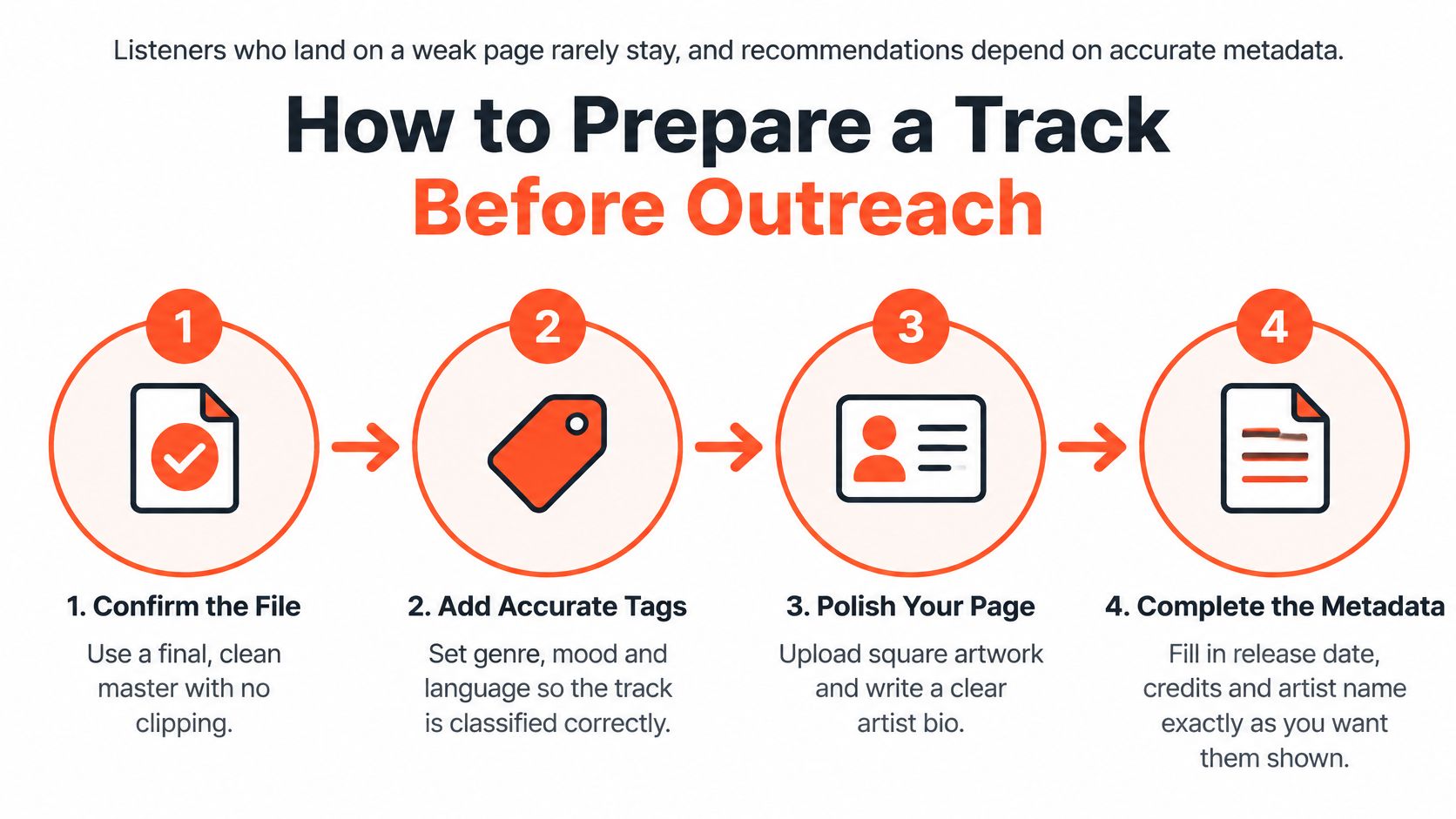
The Preparation Steps
- Confirm the master and eligibility. Use a properly mastered, clean file and publish at least one public track. If you're unsure about loudness or clipping, Vocuno's online mastering tutorial walks through the basics before you lock the file.
- Write a searchable title. Put your artist name and track name the way listeners type them. Clever punctuation hurts search more than it helps branding.
- Tag for real searches. Choose genre, subgenre, mood, and scene tags that match how fans describe the sound. Vague labels waste your best classification signal.
- Upload readable artwork. Use square artwork with text that's legible at thumbnail size, because listeners usually first see it small in a feed or playlist.
- Front-load the description. Put what the track is, the release date, collaborators, and credits in the first two lines. Readers won't expand a description to find basic facts.
- Complete release metadata. Fill every field so the upload reads as a finished release, not a test file.
- Activate platform opportunities. Turn on recommendation and playlist options where your track qualifies, including Amplify and Buzzing Playlists. This connects to a wider music release strategy rather than a single upload.
- Cut a short preview. Prepare a 20 to 30 second clip of the strongest section for external sharing later in the campaign.
Say a techno producer uploads a track called Untitled 3 and tags it only electronic. After renaming it properly and retagging with subgenre and scene labels, profile visits come from a narrower, more relevant group. Record the before and after metadata in a simple note, so you can measure whether that change, not luck, moved the numbers.

Build the Weekly Prospect List
- Pick five to eight comparable artists. Judge by scene fit, tempo, vocal style, and labels or collectives, not follower count. A mid-size artist in your exact niche beats a star whose audience is mostly casual.
- Review their active listeners. Look at public profiles of people who comment, repost, or play those artists' tracks. Note which other artists those listeners engage with, because overlap reveals real taste.
- Score each profile. Use the fit table below and be honest. A profile that looks active but listens to unrelated genres isn't a prospect just because it's busy.
- Keep 20 to 30 per week. Retain only profiles strong on at least three signals and drop the rest without guilt. A short list protects your pacing and your judgment.
- Review every profile yourself. No shortlist replaces your decision before a message or comment. Read the bio, check recent activity, and skip anything that feels copied or empty.
Take a UK garage producer who picks three scene-specific artists and studies their listeners. Most overlap comes from people who also play bassline and garage tracks, not casual pop listeners. She cuts the weekly list to the profiles showing at least three strong signals and drops the rest, ending closer to 20 names than 60, trading volume for relevance.
| Signal | Strong fit | Weak fit | Action |
|---|---|---|---|
| Mostly unrelated genres | Prioritise strong fit | ||
| Recent activity | Plays, reposts or comments within the last 30 days | Silent for months | Skip for this week |
| Profile completeness | Bio, genre tags and public tracks or playlists | Empty profile or only reposts | Review, then skip if unchanged |
| Account pattern | Individual tastes and varied listening history | Identical bios or copied messages across accounts | Exclude |
Run the table as a weekly filter, not a one-time screen. When in doubt, leave the profile for a later review rather than lowering your standard to fill a quota you invented. Twenty to thirty reviewed profiles also spread naturally across the week, giving you a cohort whose return visits you can track instead of a single spike that tells you nothing.
Pace Daily Outreach So Growth Looks Natural
Five Pacing Rules
- You choose every action. Each visit, comment, or message is one you decided on and completed yourself after reviewing the profile.
- Stay inside the daily ceiling. Work in a reviewed batch that fits your current phase. Don't borrow tomorrow's allowance because today felt productive.
- Never repeat identical notes. Every message should reference something specific in that listener's activity, a track they reposted or a playlist they built.
- Skip engagement pods. Coordinated exchanges inflate surface numbers while teaching you nothing about genuine demand for your music.
- Hold the phase when a check fails. If visits aren't converting, tighten your fit criteria or fix the track page. Raising volume amplifies the problem.
The stakes are the account itself. SoundCloud's Terms of Use state that users who repeatedly breach the Terms or Community Guidelines risk suspension or termination, with SoundCloud holding discretion to act. Repeated bad patterns don't just hurt one track, they can affect access to the profile you've built.
If you manage several artists, keep a separate plan and pacing log for each profile. Users can connect and manage multiple SoundCloud accounts, but each audience, scene, and ceiling should stay distinct so one campaign's data doesn't contaminate another's.
If you cannot explain each action from the past week to a listener who asked, you have gone too fast.
Measure Plays That Count, Not Just the Total
Your first trap is timing. According to SoundCloud's Advanced Insights help, logged-in listeners' plays update in real time, while plays from non-logged-in listeners can take up to 24 hours to appear. Check right after a batch and you'll understate your own results, then make a bad decision from incomplete data.
The same help page notes SoundCloud reports total plays for a selected period and identifies the top 50 listeners, and that self-plays from your own account do not increase the track's play total. Totals can also include listening on SoundCloud.com, the iOS and Android applications, embedded players, and the API. A rising number may come from several access points, which is normal, not suspicious.
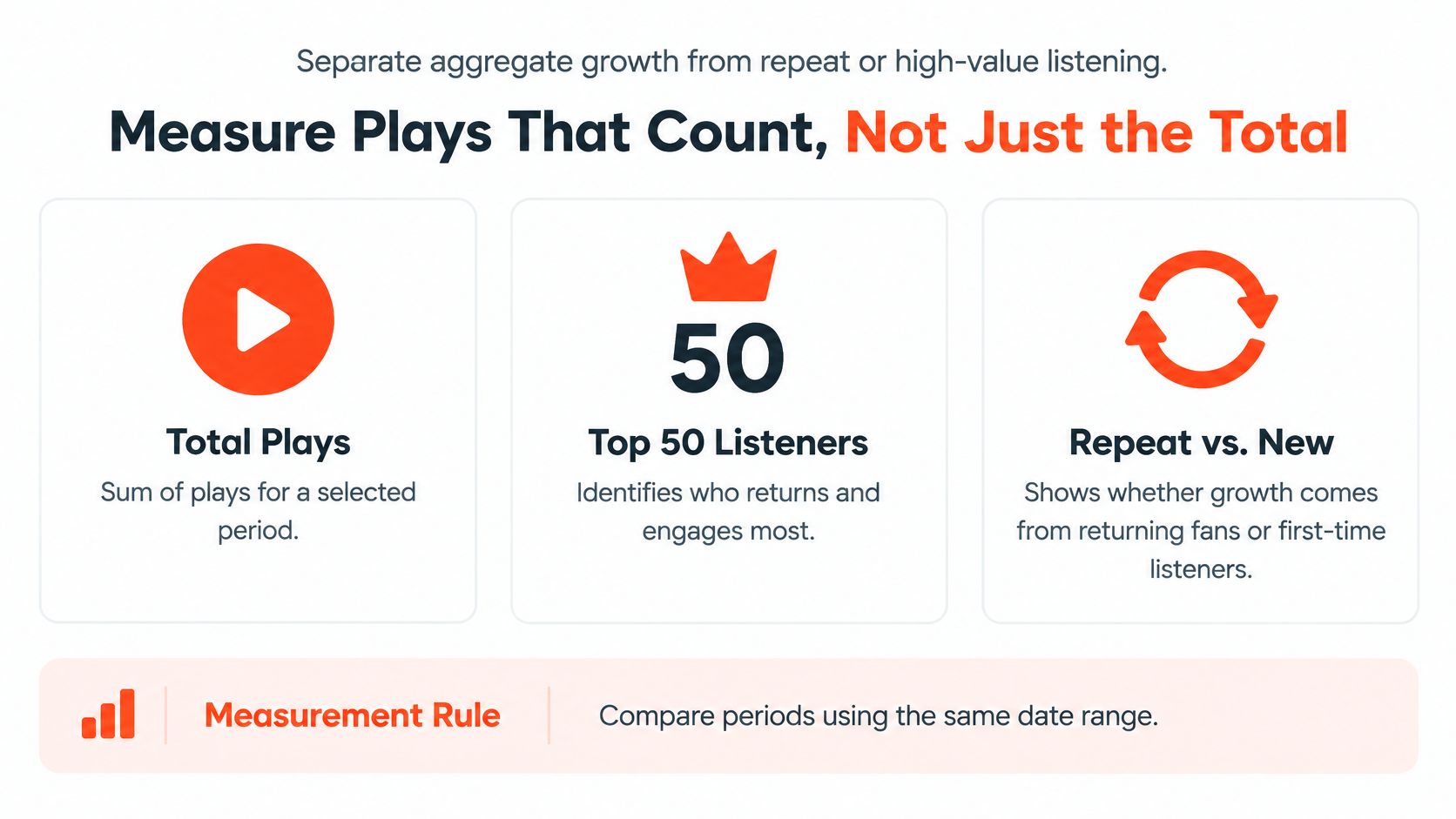
Read the Metrics in Order
| Metric | Where to find it | Healthy sign | Common misread |
|---|---|---|---|
| Total plays for period | Insights, selected date range | Rising across two to four weeks | Treated as proof of audience fit |
| Top 50 listeners | Insights listener list | Same profiles returning over time | One-time spike from a single listener |
| Repeat listening | Insights listener activity | Repeat plays from target cohort profiles | Counted as new audience |
| Profile statistics | |||
| Traffic source | Insights source breakdown | Steady share from discovery and playlists | Reading embeds as weak traffic |
| Geography | Insights location data | Matches countries in your scene | Assuming every country converts the same |
If plays dip for a day after a batch, wait the full 24 hours before judging that cohort. Compare the same weekday range across two weeks, note the source mix, and only then decide whether listener fit or timing explains the move.
Choose Your Next Move After the First Month
Chasing the highest play count is the wrong instinct. What matters is whether the right people heard a recent track and came back. Reporting on SoundCloud's 2025 Music Intelligence Report indicates music released within the previous 18 months generated 46.5% of platform listening, nearly twice the broader industry average of 26.7%.
Genre and market movement can also be sharp. The same reporting found UK garage and bassline plays rose 30% globally, while minimal and tech house plays increased 40% in the United States and 15% in Germany. Your next move should reflect where your scene is actually growing, not a generic worldwide push.

Three Decisions From Your Log
- Strong engagement, modest plays. Keep the same pacing. Relevant traction is compounding even if the headline number looks small.
- One country or scene dominates. Shift your target artists toward that market and test previews timed for that audience.
Early, relevant discovery carries weight beyond vanity numbers. The same report coverage cites a 2024 Viberate survey finding 51% of A&Rs had discovered artists on SoundCloud who later became commercially successful. Modest but well-matched traction can therefore be worth more than a burst nobody remembers.