
Assuming Direct Control: Meaning Beyond the Meme

Assuming direct control means the person with the stake both chooses the action and carries it out, rather than handing either part to someone else. At an institutional scale, Britain's takeover of company government in India in 1858 illustrates that change in who holds authority.
You might be facing a smaller version right now. Someone has drafted a reply to a collaborator, the wording feels wrong, and your cursor is hovering over the message box. Do you explain the change, approve the draft, or take over the conversation yourself?
The famous one-liner makes that moment sound decisive. The decision is less theatrical: whether stepping in will protect something important or make you the person everyone waits for.
Table of Contents
- What Assuming Direct Control Means
- Direct Control Compared With Delegation
- How a Game Line Became a Running Joke
- Three Tests Before You Step In
- When an Empire Removed the Middleman
- What Takeovers Changed and What They Did Not
- Decide What You Will Keep This Week
What Assuming Direct Control Means
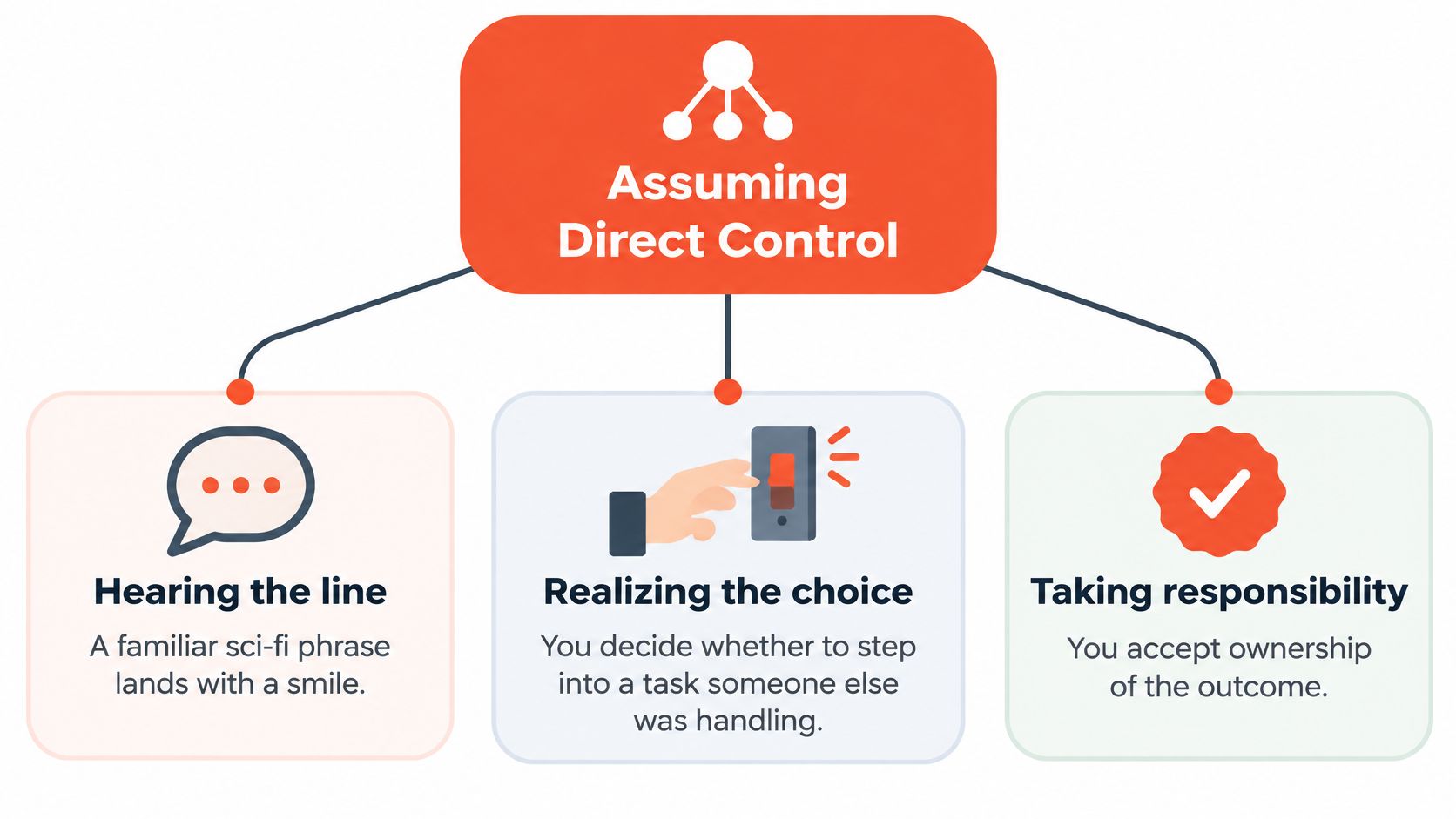
Someone drops the familiar sci-fi line into your group chat, and you smile. Then you notice that you're doing precisely what the joke describes: taking a task out of another person's hands because you want to determine what happens next.
Assuming direct control means taking a role that wasn't yours a moment ago, removing the intermediary, and choosing and performing the action yourself, with the ability to start, stop, or change it.
The words describe distinct parts of the handover. Assuming means taking up a role, not receiving a permanent job title. A label manager who normally leaves booking correspondence to an assistant assumes that role when they personally answer a sensitive request.
Direct means there's no representative between the responsible actor and the particular action. A parent who handles a school complaint personally, rather than through a delegate, becomes the person asking questions, weighing responses, and deciding what to say.
Authority has to reach the action
Control means authority coupled with a practical ability to change course. Reading reports from a distance isn't the same thing as being able to halt a response, replace a decision, or redirect the work.
A city leader stepping into a failing office illustrates the distinction. Asking for updates is oversight; taking responsibility for its operating decisions is a takeover, although staff may still perform the individual tasks.
That difference matters at larger scales. An institution can govern directly through its own officials without its leader personally doing every job.
- For an individual: Identify the action you'll personally choose and perform.
- For an institution: Identify the intermediary losing authority and the officials receiving it.
- For either: Ask what the new decision-maker can stop or change.
People search for the phrase because they recognize the game line or because a real handover has become uncomfortable. Either way, it describes who holds the action, not whether they'll handle it better.
Direct Control Compared With Delegation
Assuming direct control versus delegation
| Question | Assuming direct control | Delegating the task |
|---|---|---|
| Who decides | You, the person with the stake | Someone you appoint, inside your brief |
| Who carries it out | You | The delegate |
| Best fit | High stakes or context that is hard to brief | Repeatable work with clear rules |
| Main risk | Bottleneck and personal bias | Drift away from your intent |
| Accountability | Stays with you | Shared, and often unclear |
| How fast you can reverse | Immediate | Needs a new handoff |
The first distinction is who decides. Delegation gives another person room to choose within boundaries; it isn't merely asking them to type a decision you've already made. Direct control keeps that judgment with you.
The next distinction is execution. If you approve wording but an assistant sends it, you've kept control of approval while delegating delivery. That can be sensible, but it isn't a complete personal takeover of the task.
Information helps determine the better arrangement. Repeatable work is easier to delegate when someone can consult a clear checklist. A delicate exception is harder to hand over when the relevant history exists only in your memory.
The same message, handled differently
Say a small-label owner receives a playlist-related message from someone whose earlier collaboration ended awkwardly. The owner personally writes and sends the reply because a standard friendly note could imply a commitment they don't intend to make.
Compare that with an ordinary request for a release link and artist biography. The owner asks an assistant to send an approved note with the correct assets. The assistant doesn't need the owner's taste or relationship history to complete the task.
Keeping the action protects intent and costs time. The owner can intervene immediately in the sensitive exchange, but every message they retain also joins their personal queue.
A delegate can handle routine correspondence in parallel while the owner works elsewhere. The risk is that the delegate interprets an unclear brief differently from its author.
Make responsibility visible
Accountability doesn't disappear when someone else acts. The delegate owes competent execution, while the person assigning the task owes usable instructions and appropriate authority.
Jan Kutschera's guidance can help you clarify task ownership and handoffs before an ambiguous assignment turns into competing assumptions. Write down who can decide, who must approve, and what requires escalation.
For teams working across artist profiles, the same ownership questions belong alongside practical multi-account management. Knowing which profile is open doesn't tell someone whether they're authorized to speak for that artist.
Reversal also needs precision. You can stop your own unfinished action immediately, but you can't necessarily undo its consequences after sending it. Stopping a delegate requires communicating a changed instruction before they proceed.
The useful choice isn't between trust and distrust. It's between retaining judgment that needs you and creating a brief that lets someone else act without guessing.
How a Game Line Became a Running Joke
In Mass Effect 2, the Collector leader Harbinger takes possession of a body and announces the takeover. Know Your Meme's history of “Assuming Control” identifies the game origin and describes the phrase's later use as a forum interruption joke.
The participatory version turns a fictional possession into a conversational move. Someone inserts the line into a thread as though they've occupied the previous speaker or seized command of the discussion.

Confirmed origin versus community lore
The game connection and interruption format are documented parts of the explanation. The often-repeated claim that the format began on 4chan's /v/ board is less secure: the available history acknowledges the lack of visual evidence for that attribution.
Treat that claim as community lore, not an established first post. A plausible origin story isn't the same thing as a surviving record of who posted what, where, and when.
Readers encounter both “assuming control” and “assuming direct control.” The longer wording sounds more absolute, which helps explain its appeal as a quotable interruption, but that interpretation shouldn't become an unsupported claim about which version spread first or fastest.
Why the interruption remains reusable
The phrase is compact and announces an action without needing a detailed setup. Someone who doesn't recognize Harbinger can still understand the joke when a friend says it while taking over a playlist.
A colleague might use it when claiming the last unassigned task in a project chat. The exaggerated announcement makes a mundane handover sound like a hostile occupation, while the surrounding situation keeps it friendly.
- Playlist example: A friend takes the music controls and announces an unnecessarily dramatic change of DJ.
- Work-chat example: A colleague claims an abandoned task and jokingly presents the rescue as a takeover.
Neither use requires replaying the game's plot. Participants supply a new setting while preserving the recognizable act of stepping in.
What remains uncertain is the phrase's circulation history. Public accounts offer limited evidence about platform migration, whether the voice performance mattered more than the wording, or how usage changed after release.
That uncertainty is worth preserving. The humor works because listeners hear a takeover, not a polite request, even when nobody remembers the original scene.
Three Tests Before You Step In
Before taking work back, separate a legitimate need for your judgment from the discomfort of watching someone do it differently. Use these tests as a practical decision aid, not as a validated scoring system.
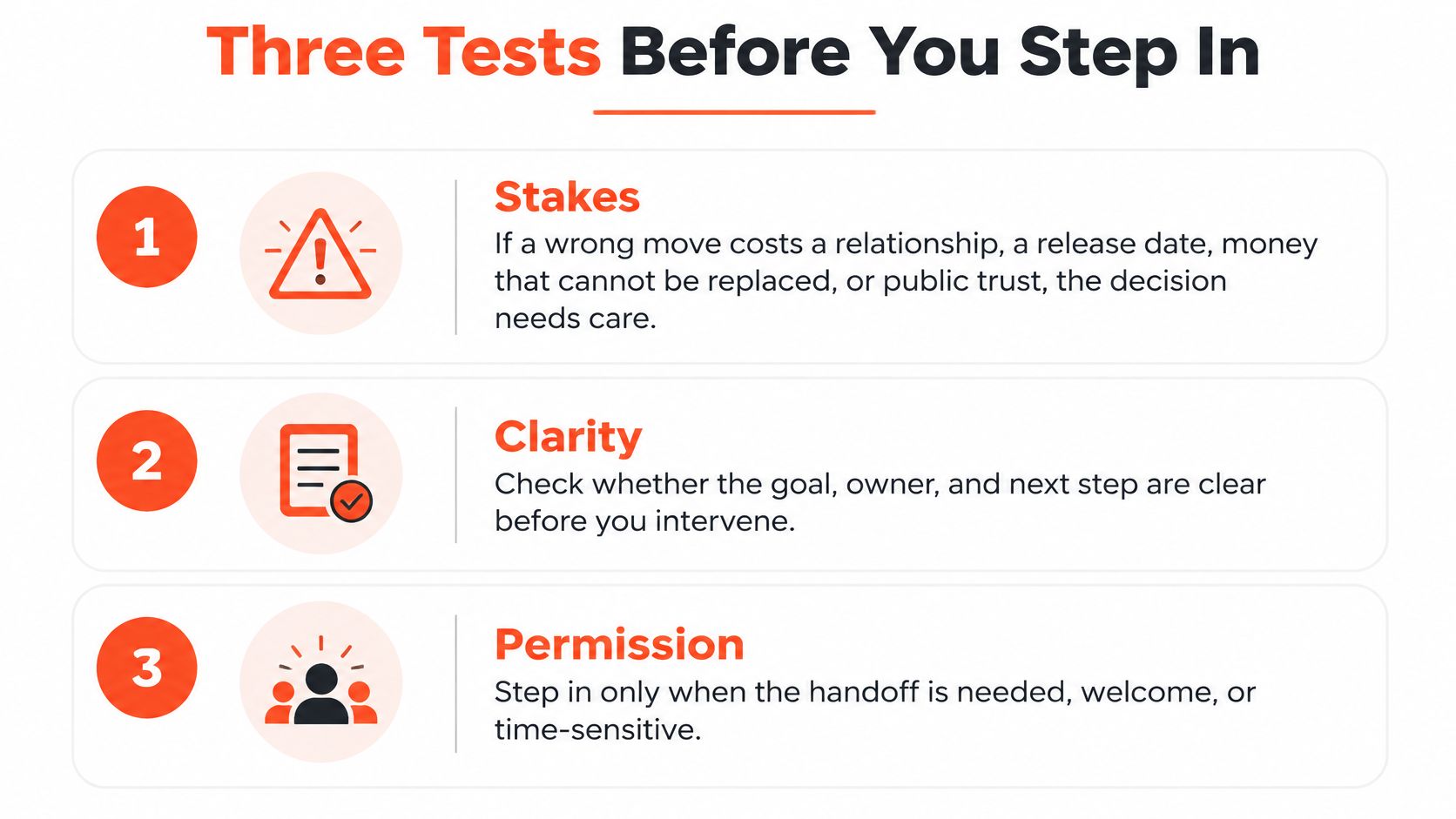
1. Examine the stakes. A wrong move that could damage a relationship, derail a release, spend irreplaceable money, or undermine public trust deserves the attention of whoever will live with the consequences. High stakes justify involvement, but they don't automatically justify doing every supporting task.
2. Locate the unique knowledge. Ask whether the judgment depends on tone, history, or an exception that only you understand. If a checklist already captures the choice, improve the handoff rather than reclaiming the work.
Check reversibility before acting
3. Test reversibility. An action you can undo the same day is easier to retain experimentally. A contract, public statement, or budget commitment needs a pause, a named approver, and clarity about who else must be told.
Three tests before you take a task back
| Test | Step in | Leave it |
|---|---|---|
| Stakes | A wrong move costs a relationship, a release date, irreplaceable money, or public trust | The cost is routine and small |
| Unique knowledge | Tone, history, or the exception sits only in your head | A checklist already captures the choice |
| Reversibility | You can undo the action the same day | The action locks a contract, a public statement, or a budget |
The reversibility row concerns immediate execution, not abandoning responsibility. Leaving a binding action pending review can be wiser than personally rushing to perform it.
Apply the tests to a collaborator's message
Suppose a producer receives a message from a collaborator who feels overlooked. The relationship matters, the producer knows the private history, and a reply can be revised before sending: personal handling makes sense.
A routine scheduling message produces a different answer. An assistant with the calendar and availability rules can handle it without borrowing the producer's judgment.
If the reply would promise payment or transfer rights, slow down. Personal involvement doesn't remove the need for appropriate review.
Practical rule: When you lack time, retain the smallest consequential decision, such as the final approval, and leave preparation with someone else.
Make that boundary explicit so the other person knows their preparation still matters. Grabbing every task without explanation creates delays and frustrates people who were ready to help.
Use a simple threshold: step in when at least two tests suggest an intermediary would distort the result, while treating irreversible commitments as a reason for additional review.
When an Empire Removed the Middleman
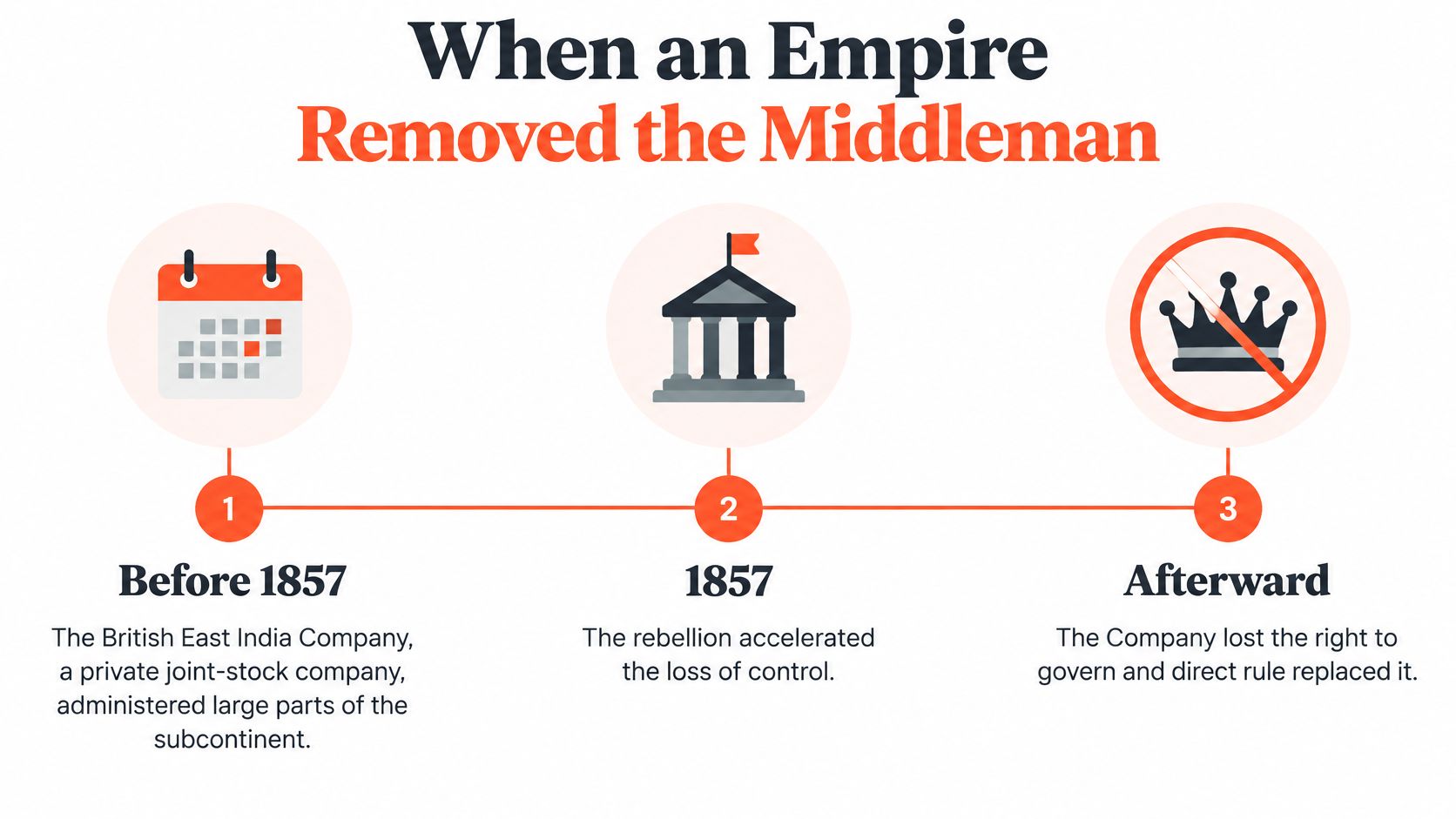
Before the rebellion, the British East India Company, a private joint-stock company, administered large parts of the Indian subcontinent. Its governing role placed a commercial corporation between Britain's imperial authority and much of the territory's administration.
The sequence is clear in Fiveable's explanation of direct control: the Sepoy Rebellion of 1857 preceded the Crown's formal takeover in 1858, and Crown rule ended with Indian independence in 1947, approximately 89 years later.
The rebellion was a crisis of imperial legitimacy, not an administrative inconvenience. Britain judged company government inadequate for maintaining security and political control over a territory it regarded as globally important.
What the Crown took over
The Crown abolished the company's governing role and transferred authority to the imperial state, creating the British Raj. British officials, rather than a commercial corporation, formally directed central administration, legislation, taxation, and military organization.
Those responsibilities make the example more substantial than a change of branding. They concern who could establish rules, collect revenue, organize force, and direct the machinery of government.
Direct rule didn't mean the monarch personally administered every office. It meant that the governing chain ran through the imperial state rather than through the company as the governing intermediary.
- Administration: Responsibility belonged to officials acting through state authority.
- Public powers: Legislation, taxation, and military organization fell under the new governing arrangement.
- Institutional responsibility: The imperial state formally held the authority previously exercised through company government.
What the example does not establish
This was a change within colonial rule, not a transfer of power to the people being governed. Describing it as direct control identifies the governing arrangement; it doesn't endorse that arrangement or establish its legitimacy.
Nor does replacing a corporation with state officials prove that administration became fairer or more effective. Those are separate questions requiring evidence about consequences, not merely the identity of the authority.
The episode gives the phrase an identifiable beginning, duration, and end. Authority moved into a different institutional chain and remained there until independence, making the takeover something more concrete than an announcement.
The limited analogy is that Britain stopped allowing a company to hold the governing levers and placed them formally in state hands.
What Takeovers Changed and What They Did Not
A takeover can change who makes decisions and improve some financial measures without resolving every problem. Findings on state interventions in financially distressed school districts show why those outcomes need to be judged separately.
A Kentucky legislative governance report summarizes increases in district spending per student of about $500 after three years and at least $2,000 after seven to ten years. It also reports that the revenue-to-expenditure ratio rose from 1.10 to 1.19, while long-term solvency improved by approximately 30 percent.
What changed after a state takeover
| Measure | Result under direct control |
|---|---|
| Spending per student after 3 years | About $500 higher |
| Spending per student after 7 to 10 years | At least $2,000 higher |
| Revenue-to-expenditure ratio | Rose from 1.10 to 1.19 |
| Long-term solvency | Improved by about 30 percent |
| Cash held per resident | No clear gain |
These measures describe different parts of a district's finances. They don't establish that every type of takeover produces the same outcomes.
Read the measures separately
Higher spending means more money was spent per student. That figure alone doesn't show whether teaching improved, services became more dependable, or residents trusted the governing authority more.
The improved revenue-to-expenditure ratio points to stronger budgetary solvency, or a better balance between revenue and spending. Long-term solvency concerns the ability to meet continuing obligations and debt service.
Cash solvency asks a narrower question: how much cash is held per resident? The report found no clear gain on that measure, so the financial picture was mixed.
A stronger result on one financial measure isn't evidence that every service, relationship, or operating problem improved.
Set a narrower standard for your own takeover
Before reclaiming a task, define what improvement would look like. Otherwise, greater personal involvement can feel like progress even when the outcome has not changed.
- Name the indicator: For a sensitive collaborator exchange, success might mean resolving the disputed commitment clearly.
- Name the acceptable cost: Decide which other work you'll postpone to handle it personally.
- Name what remains unresolved: A careful reply won't repair an unclear contract or an unreliable release process by itself.
Then you can judge whether the reason for stepping in has been addressed, rather than keeping control indefinitely.
The evidence supports a disciplined conclusion: direct control transfers authority; it does not guarantee better performance.
Decide What You Will Keep This Week
Choose a live task you're about to grab back or hand off. Name the actual action, such as answering a collaborator about a disputed credit, rather than the sprawling category of artist management.
Apply the threshold: step in when at least two tests suggest that an intermediary would distort the result. If personal involvement is justified, write down the specific slice you'll keep and the hour you'll handle it.
Keep a decision, not an entire queue
A small-label owner might retain the final answer to a sensitive booking request while leaving the assistant to gather availability and correspondence. An independent artist might personally resolve a collaboration disagreement without taking over every scheduling message.
Keep the judgment that sets taste and protects relationships. Hand off preparation that a checklist already covers, and tell the other person where their authority begins and ends.
When delegation is the better choice, send a brief with these lines:
- Result: State what a successful outcome looks like.
- Rules: Identify the checklist, approved wording, or boundaries to use.
- Stop point: Specify the exception that requires your approval.
- Due date: Give the date the completed work is needed.
Make review the boundary
For artists, DJs, producers, and small managers, SCHelper offers a review aid for listener discovery, with plans running one, three, or six months. You select the listeners you want and confirm each choice before it counts; we don't act on those selections without your approval.
Treat that review as a real decision rather than a box to clear. Preparation can make a choice easier without deciding whether it suits your music, audience, or relationships.
Before the week fills up, circle the decision that stays with you. Put its review time in your calendar and send the brief for everything else the same day.
SCHelper offers curated listener recommendations to help you review relevant audience opportunities for your SoundCloud profile. Use it to organize discovery while keeping approval in your hands, and start by choosing which recommendations fit your music.